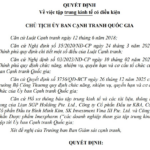


















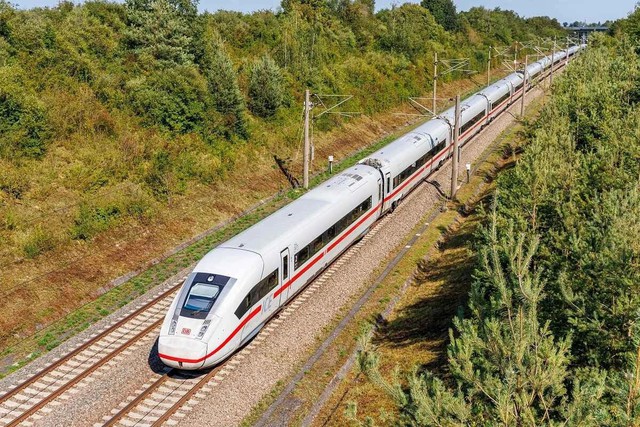
The Ministry of Construction has recently appointed the Thang Long Project Management Board (PMB) as the new investor for the North-South High-Speed Railway Project, replacing the Railway Project Management Board.
According to the decision, the Thang Long PMB is tasked with preparing the Feasibility Study Report for the North-South High-Speed Railway Investment Project. The Railway PMB is responsible for completing necessary procedures and signing the contract with the contractor for package VT-01 (Project Management Consulting for the Investment Preparation Phase of the North-South High-Speed Railway). Upon completion, all related content will be handed over to the Thang Long PMB for further implementation.
Meanwhile, the Railway PMB continues to be assigned the task of preparing the Pre-Feasibility Study Report for several other railway projects, including: the Hanoi – Dong Dang line, the Hai Phong – Ha Long – Mong Cai line, and the Eastern Ring Railway section from Ngoc Hoi to Lac Dao.
The investment preparation costs for the above projects are allocated and paid according to the approved tasks, estimates, and annual investment preparation plans, with implementation scheduled for the 2026–2027 period.
The Ministry of Construction requires the Directors of the Thang Long PMB and the Railway PMB to fulfill their roles and responsibilities as investors in accordance with the law, ensuring quality, progress, and cost-effectiveness. They are also tasked with reviewing and strengthening their organizational structures to enhance capacity and meet the assigned requirements as per construction laws and related regulations.
Additionally, the Ministry mandates that the handover process must ensure continuity without disrupting project investment preparation. All files, documents, and research results must be thoroughly reviewed and fully received to avoid resource and time wastage.
The Railway PMB has confirmed the complete handover of files, documents, financial data, and research results for the North-South High-Speed Railway Project to the Thang Long PMB.
As of January 9, 2026, the Thang Long PMB officially assumes the role of investor for the Feasibility Study Report of the North-South High-Speed Railway Project.
The Railway PMB has notified the Provincial Party Committees and People’s Committees of Hanoi, Ninh Binh, Thanh Hoa, Nghe An, Ha Tinh, Quang Tri, Thua Thien Hue, Da Nang, Quang Ngai, Gia Lai, Dak Lak, Khanh Hoa, Lam Dong, Dong Nai, and Ho Chi Minh City, as well as the Vietnam Electricity Group, about the change in the investor for the Feasibility Study Report.
They have also requested these localities and the Vietnam Electricity Group to adjust the membership of the Site Clearance Steering Committee and its Support Team by replacing representatives from the Railway PMB with those from the Thang Long PMB for coordinated implementation.
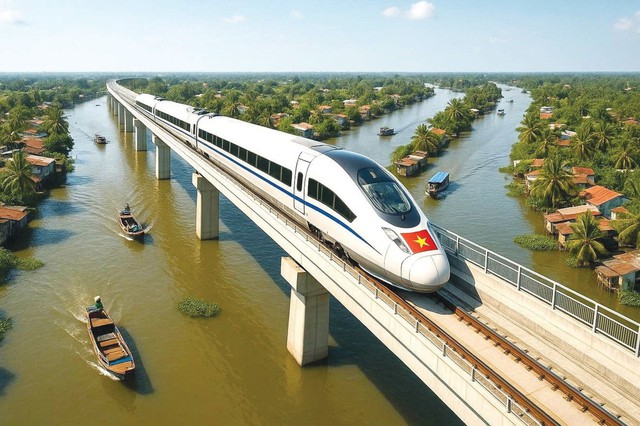
The North-South High-Speed Railway Project has a preliminary total investment of approximately 1.7 million billion VND, equivalent to about 67 billion USD. The route spans 1,541 km, starting at Ngoc Hoi Station (Hanoi) and ending at Thu Thiem Station (Ho Chi Minh City), passing through 20 provinces and cities, which will be reduced to 15 localities after administrative rearrangement.
According to the plan, the entire route will have 23 stations, including 5 cargo stations. The project is divided into multiple investment phases. The government plans to commence construction on two priority sections, Hanoi – Vinh and Ho Chi Minh City – Nha Trang, in 2026. The remaining sections will begin construction from 2028, with the goal of substantially completing the entire route by 2035.
Currently, the Ministry of Construction is proceeding with investment preparation procedures, including key aspects such as selecting the investment modality and consulting for the Feasibility Study Report, to serve as the basis for submitting to competent authorities for consideration and approval of the project’s deployment plan.
Miracle Surpassing the 3,000 km Highway Target

As of 2020, Vietnam boasts 1,163 kilometers of highways nationwide, according to Nguyen Tri Duc, Head of the Ministry of Construction’s Office. To meet the target, a minimum of 1,837 kilometers must be completed within the next five years—an ambitious goal. This presents a significant challenge, particularly given the persistent institutional bottlenecks that continue to hinder progress.
Proposed Expansion of Hanoi – Bac Giang Expressway to Six Lanes
The Chairman of the People’s Committee of Bac Ninh Province, Pham Hoang Son, has urged the Ministry of Construction to consider and support the proposal for the Hanoi – Bac Giang Expressway. The plan includes an initial 6-lane configuration, with long-term planning aimed at expanding to 8 lanes.
Gia Lai Prepares 38 Resettlement Areas for the North-South High-Speed Railway Project
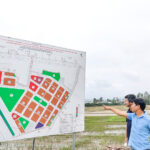
Unveiling a new era of connectivity, Gia Lai Province has taken a monumental step forward with the approval of 38 resettlement areas spanning 153.84 hectares, paving the way for the highly anticipated North-South High-Speed Railway project to traverse its territory.
Expanding Tuy Hoa Airport: Unlocking New Horizons for Travel and Tourism

The Ministry of Construction has recently approved the master plan for Tuy Hoa Airport for the period 2021-2030, with a vision extending to 2050. This plan focuses on expanding infrastructure, constructing a new Terminal 2, and adding a second runway, gradually increasing the airport’s capacity to 5 million passengers annually.
Urgent Proposal for High-Speed Rail Investment in the North-South Corridor

The Prime Minister has tasked the Ministry of Construction with leading the development of criteria and a selection process for investment methods. This initiative aims to ensure a scientific, transparent approach, safeguarding national interests while combating corruption and negativity.