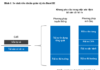
The State Bank of Vietnam has issued a directive to credit institutions regarding credit growth control for 2026. According to the new formula, the maximum credit balance as of December 31, 2026, is determined with a multiplier of only 2.6%, significantly lower than the 3.5% applied in 2025.
Specifically, the maximum credit balance is calculated by adding the balance as of December 31, 2025, to the additional growth based on the credit institution’s 2024 rating, after excluding any excess balance and loans sold in 2026 but not yet collected at the time of calculation.
Certain banks, such as those participating in mandatory acquisitions of weaker institutions, are prioritized for higher credit growth.
Based on estimates, with bank ratings currently ranging from 1 to 5 points and most institutions rated between 4 and 5, credit growth in 2026 is likely to range between 9% and 13%. The majority of banks will be assigned growth targets of around 12-13%.
Banks prioritized for higher credit growth include those involved in mandatory acquisitions of weaker institutions, such as Vietcombank, MB, HDBank, and VPBank, to support the restructuring process.
In addition to adjusting the calculation formula, the State Bank of Vietnam requires that in the first three months of 2026, the credit growth rate of each institution must not exceed 25% of the annual target. Institutions must also ensure capital adequacy and liquidity safety.
Notably, credit to the real estate sector remains tightly controlled. The growth rate of real estate credit for each institution in 2026 must not exceed its overall credit growth rate compared to the end of 2025. The State Bank will closely monitor both the growth rate and the proportion of real estate debt in each bank’s total debt.
If a credit institution fails to comply with these requirements, the State Bank may reduce its credit growth target for the year. These adjustments will be made based on ongoing monitoring, without requiring the institution to submit a formal request.
The State Bank directs credit institutions to conduct lending activities in line with their risk management capabilities, liquidity, and capital mobilization. Institutions must maintain all safety ratios, particularly liquidity and solvency indicators. Additionally, banks must enhance credit quality, ensure proper use of funds, and minimize the generation and increase of bad debts.
Regarding capital allocation, the State Bank emphasizes prioritizing credit for production, business, priority sectors, and economic growth drivers. Conversely, credit to high-risk sectors, particularly real estate, will remain under strict control.
In 2026, the State Bank commits to managing credit growth proactively and flexibly, closely monitoring macroeconomic developments, inflation, and the performance of individual credit institutions. Based on these factors, credit growth targets may be adjusted upward or downward as needed to support capital supply to the economy while ensuring banking system safety and macroeconomic stability.
Banking App Security: Auto-Pause Functionality for Suspected Fraud Detection (1-3 Requirements)

Banks must implement robust solutions to prevent, detect, and combat unauthorized access to customers’ Mobile Banking applications.
Vietcombank Aims to Rank Among the World’s Top 200 Financial Conglomerates by 2030

According to Chairman Nguyen Thanh Tung, Vietcombank’s strategic goal by 2030 is to become Vietnam’s largest financial group, rank among the world’s top 200 financial conglomerates, and secure a place within the top 700 listed companies globally.
Ms. Truong Thu Hoa Appointed as Director of the State Bank of Vietnam, Zone 4 Branch

The State Bank of Vietnam, Region 4, is headquartered in Viet Tri City, Phu Tho Province, with five satellite offices strategically located in the provinces of Vinh Phuc, Ha Giang, Tuyen Quang, Lao Cai, and Yen Bai.
VN-Index Officially Surpasses the 1,800-Point Milestone

The first trading week of the new year saw the VN-Index officially surpassing the 1,800-point milestone on January 6th, followed by a series of new highs. Despite an unexpected correction on January 8th and a capital outflow from the real estate sector in the subsequent session, the index continued its upward trajectory, closing the week at a new peak of 1,867 points.
Real Estate 2026: Surging Supply, Cooling Prices

With over 1,000 projects unlocked, nearly 580,000 successful transactions in 2025, record-breaking credit, and accelerated public investment, the real estate market is entering a pivotal phase on the cusp of a new growth cycle.