


















The Ministry of Construction has recently reported to the Government regarding the change of the investor for the North-South High-Speed Railway project. The new investor is the Thang Long Project Management Board (Thang Long Board, Ministry of Construction),
|
According to this decision, the Thang Long Project Management Board is tasked with preparing the feasibility study report for the North-South High-Speed Railway project. They are fully responsible for the quality, progress, and cost of the project. Additionally, the board must proactively collaborate with relevant agencies and organizations to receive all previously conducted research results, maximizing their utilization in the study and report preparation process.
The Ministry of Construction emphasizes that the handover must ensure continuity, avoiding any disruption to the project’s preparatory work. All files, documents, and research results must be thoroughly reviewed and fully received to prevent resource and time wastage.
Meanwhile, the Railway Project Management Board is responsible for completing the necessary procedures and signing the contract with the contractor for Package VT-01: Consulting on project management during the preparatory phase of the North-South High-Speed Railway. Once completed, all related content will be handed over to the Thang Long Project Management Board for further implementation.
The Thang Long Project Management Board, a unit under the Ministry of Construction, is currently acting as the investor or manager for several key national infrastructure projects, particularly in the transportation sector, including bridges, roads, and railways. Recently, the board was assigned to manage the upgrade and expansion of Noi Bai Airport.
The transfer of investment preparation responsibilities to the Thang Long Project Management Board is considered a significant shift in the approach to this critical railway project. With its massive scale, the project demands high management capabilities, execution organization, and coordination among multiple ministries, sectors, and localities.
Urgent Selection of Technology and Investment Methods
Regarding the North-South High-Speed Railway project, the Prime Minister recently chaired a meeting and instructed the Ministry of Construction to base its decision on the Politburo’s guidance and lead the selection of the most suitable technology for the project. The Ministry must submit a report to the Standing Government Committee for approval by January 15.
The Prime Minister also directed the Ministry of Construction to appoint a consultant for the feasibility study report, ensuring compliance with capacity, procedures, and authority as per regulations. The consultant selection process must be rigorous, objective, and aligned with the project’s technical and timeline requirements.
Furthermore, the Prime Minister tasked local authorities and Vietnam Electricity (EVN) with accelerating land clearance and technical infrastructure relocation to facilitate project implementation once conditions are met. Viettel and VNPT will continue their work on information systems and control technology for the high-speed railway.
Two days prior, the Government Office announced the conclusions of the Standing Government Committee, which assessed that the Ministry of Construction and related agencies were still “hesitant” in project implementation, particularly in research, evaluation, and investment method selection.
In response, the Prime Minister instructed the Ministry of Construction to design a set of criteria and procedures for selecting investment methods that ensure efficiency, optimization, and benefits for the nation and its people, while also preventing corruption and negativity. If necessary, the Ministry must propose specific mechanisms and policies tailored to each investment form, based on a thorough assessment of socio-economic impacts.
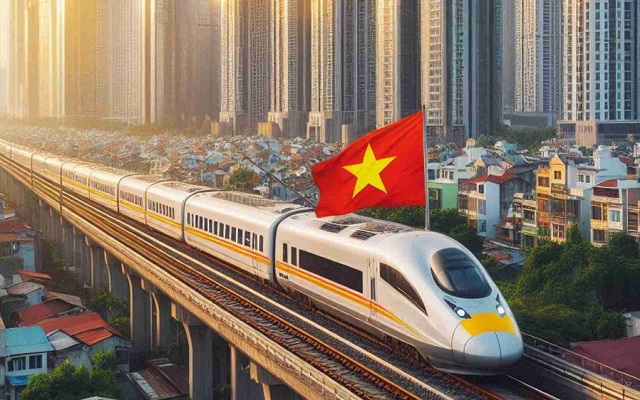
The North-South High-Speed Railway project has a preliminary total investment of approximately 1.7 million billion VND, equivalent to about 67 billion USD. The 1,541 km railway will start at Ngoc Hoi Station (Hanoi) and end at Thu Thiem Station (Ho Chi Minh City), passing through 20 provinces and cities, which will be reduced to 15 localities after administrative rearrangement.
According to the plan, the entire route will have 23 stations, including 5 cargo stations. The project is divided into multiple phases. The Government plans to commence construction on the Hanoi-Vinh and Ho Chi Minh City-Nha Trang sections in 2026. The remaining sections are expected to start construction from 2028, with the goal of substantially completing the entire route by 2035.
Currently, the Ministry of Construction is proceeding with the necessary procedures to prepare for project investment, including the critical step of selecting the investment method and consultant for the feasibility study report, which will serve as the basis for submission to the competent authorities for decision-making.
– 14:15 13/01/2026
Revamping the North-South High-Speed Railway Project: A Shift in Leadership

The Ministry of Construction has recently submitted a report to the Government regarding the change of the main investor for the North-South high-speed railway project. The new investor is now the Thang Long Project Management Board (Thang Long Board, Ministry of Construction), tasked with urgently initiating the preparation of the project’s feasibility study report.
$67 Billion North-South High-Speed Rail Megaproject Shocks with Investor Switch: 15 Provinces and EVN Receive Critical Update

The Railway Project Management Board has officially notified 15 provinces and EVN regarding the change in the lead investor responsible for preparing the Feasibility Study Report for the North-South High-Speed Railway Project.
Miracle Surpassing the 3,000 km Highway Target

As of 2020, Vietnam boasts 1,163 kilometers of highways nationwide, according to Nguyen Tri Duc, Head of the Ministry of Construction’s Office. To meet the target, a minimum of 1,837 kilometers must be completed within the next five years—an ambitious goal. This presents a significant challenge, particularly given the persistent institutional bottlenecks that continue to hinder progress.
Proposed Expansion of Hanoi – Bac Giang Expressway to Six Lanes
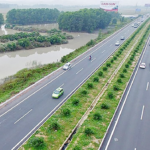
The Chairman of the People’s Committee of Bac Ninh Province, Pham Hoang Son, has urged the Ministry of Construction to consider and support the proposal for the Hanoi – Bac Giang Expressway. The plan includes an initial 6-lane configuration, with long-term planning aimed at expanding to 8 lanes.
Gia Lai Prepares 38 Resettlement Areas for the North-South High-Speed Railway Project
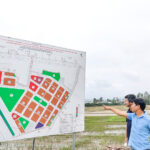
Unveiling a new era of connectivity, Gia Lai Province has taken a monumental step forward with the approval of 38 resettlement areas spanning 153.84 hectares, paving the way for the highly anticipated North-South High-Speed Railway project to traverse its territory.