















According to the latest announcement from the Joint Stock Commercial Bank for Foreign Trade of Vietnam (Vietcombank), the average lending interest rate in December 2025 rose to 5.8%/year. This marks the second consecutive month of increases in Vietcombank’s average lending rate. Previously, the rate had stabilized at 5.6%/year before climbing to 5.7% in November and further inching up by 0.1 percentage points in December.
Alongside the lending rate, the average deposit-lending interest spread widened to 2.8 percentage points in December, up from the consistent 2.7 percentage points maintained over the previous four months. Additionally, the net interest margin (NIM) after deducting related expenses—a key indicator of credit profitability—increased to 1.3 percentage points, compared to 1.1–1.2 percentage points from August to November.
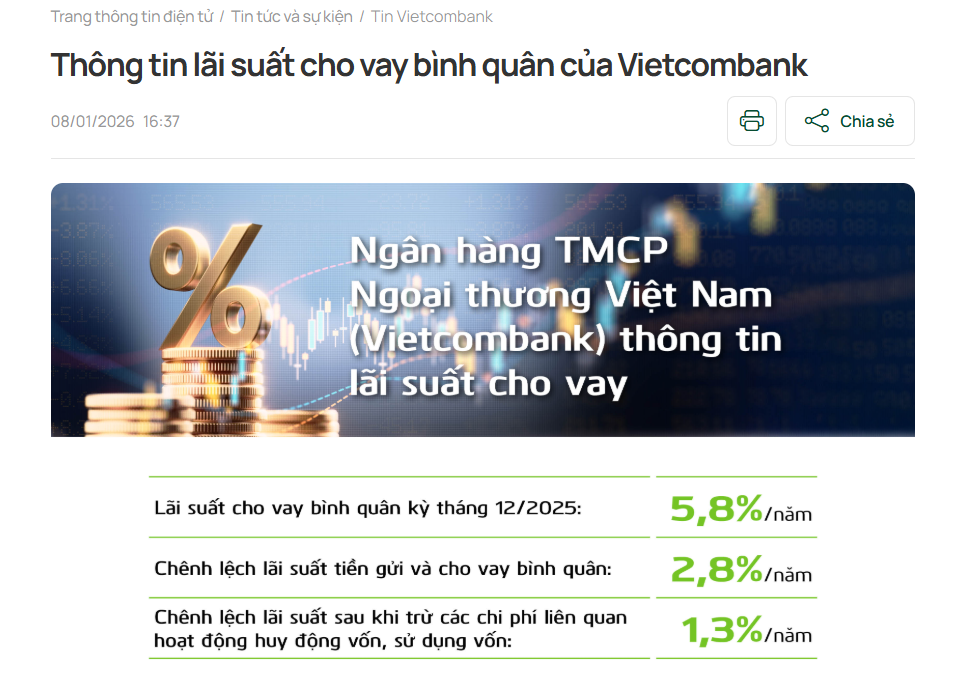
Source: Vietcombank
BIDV also recently announced that its average lending rate for December 2025 increased to 5.6%/year from the long-standing range of 5.47–5.48%. The average deposit-lending interest spread at this bank remained steady at around 2.5%/year.
The latest moves by these two leading banks come amid growing pressure on lenders to narrow their NIMs due to rising deposit interest rates. Modest adjustments to lending rates help banks balance supporting customers with maintaining business profitability.
Earlier, in mid-December 2025, four state-owned commercial banks—Agribank, Vietcombank, VietinBank, and BIDV—collectively raised counter savings interest rates across all terms, with adjustments ranging from 0.3 to 0.6%/year. This marked the first increase in deposit rates by these banks after over three years of continuous reductions and record-low rate stability.
In a recent banking sector update, Vietcap Securities noted that the recent rate hikes by the Big4 state-owned banks were unsurprising, given earlier increases by private banks and the State Bank of Vietnam’s (SBV) 0.5 percentage point increase in the OMO interest rate.
More significantly, with this adjustment, the 12-month deposit rates listed by Vietcombank, BIDV, and VietinBank rose from 4.6–4.7% to 5.2%, still 0.3–0.4 percentage points below the COVID-era lows of 2020–2021 and approximately 1.6 percentage points below pre-COVID levels.
“This indicates that the absolute interest rate level remains supportive of the economy,” Vietcap assessed.
Steering and Managing Credit Growth: SBV’s Flexible Approach to Achieving 2026 Monetary Policy Objectives
Empowering credit institutions to proactively manage lending activities, this initiative fosters expansion and credit growth. It allows for flexible adjustments in credit growth targets, ensuring alignment with capital efficiency and economic growth objectives. By linking credit growth to effective capital utilization, it supports sustainable economic development.
Vietcombank Aims to Rank Among the World’s Top 200 Financial Conglomerates by 2030
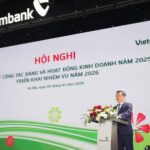
According to Chairman Nguyen Thanh Tung, Vietcombank’s strategic goal by 2030 is to become Vietnam’s largest financial group, rank among the world’s top 200 financial conglomerates, and secure a place within the top 700 listed companies globally.
Banks Attract Record-Breaking Deposits

In 2025, numerous banks reported significant growth in deposits from individuals and businesses, bolstering their capital inflows and creating a robust foundation to accelerate credit expansion. This surge in deposits enables banks to meet the increasing demand for capital, supporting the recovery and growth of economic production and business activities.
Bad Debt Auctions Surge as Banks Offload Corporate Non-Performing Loans

As the Lunar New Year approaches, the pace of non-performing loan (NPL) resolution intensifies across commercial banks. With numerous businesses struggling to secure funds for timely debt repayment, banks are increasingly resorting to auctioning off collateralized assets and debts to recover capital.
Key Highlights in the Regulation of Banking System Liquidity for 2025
In 2024, the State Bank of Vietnam proactively employed a flexible approach, utilizing both injection and withdrawal operations through treasury bills and the OMO’s outright purchase channel to stabilize exchange rates while balancing systemic liquidity. By 2025, however, the operational strategy underwent a notable shift.