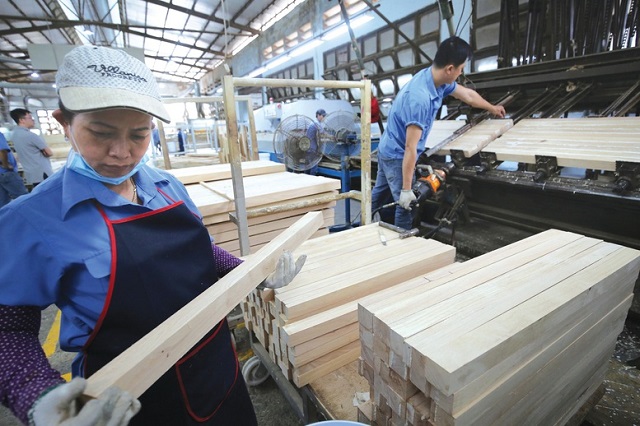
Vietnam maintains its position as the largest supplier of wooden furniture to the U.S. market – Photo: VGP/Đỗ Hương
|
The U.S. remains the primary export market
According to Mr. Phùng Quốc Mẫn, Chairman of the Ho Chi Minh City Handicraft and Wood Industry Association (HAWA), the wood industry faces unprecedented challenges in 2025, including countervailing duties and anti-dumping policies from the U.S., pressure from the EU’s Deforestation Regulation (EUDR), and domestic natural disasters severely impacting the supply chain.
Despite significant tariff challenges and anti-dumping investigations into hardwood plywood and decorative wood imports from China, Indonesia, and Vietnam, wood and wood product exports to the U.S. continued to grow in 2025.
Last year, wood and wood product exports to the U.S. reached $9.46 billion, a 4.4% increase from 2024, accounting for 55% of total export value across all markets.
Notably, Vietnam remains the largest supplier of wooden furniture to the U.S. According to the U.S. International Trade Commission (USITC), in the first eight months of 2025, U.S. imports of wooden furniture from Vietnam totaled $6.1 billion, a 9% increase from the same period in 2024, representing 45.3% of total U.S. furniture imports.
Exports of wood and wood products to Japan grew robustly by over 23% last year, surpassing the $2 billion mark for the first time, reaching $2.153 billion. This growth propelled Japan past China to become Vietnam’s second-largest wood market.
Although dropping to third place, exports to China still saw a slight increase, reaching $2.086 billion in 2025. This marks the second consecutive year that wood and wood product exports to China exceeded $2 billion.
The U.S., Japan, and China are Vietnam’s three “billion-dollar” wood markets, collectively accounting for nearly 80% of the total wood and wood product export value in 2025.
Wooden furniture remains the dominant export category. According to the Import-Export Department (Ministry of Industry and Trade), in the first 11 months of 2025, wooden furniture exports reached $9.434 billion, accounting for nearly 61% of total wood and wood product exports.
Other key export items in the same period included wood chips ($2.22 billion), wood, panels, and flooring ($2.091 billion), and wood pellets ($1.081 billion), each exceeding $1 billion in export value.
Shifting forestry focus from social welfare to production
A critical driver for the wood industry’s development is ensuring a sustainable raw material supply.
Dr. Hà Công Tuấn, Chairman of the Vietnam Association of Agricultural Economists and Rural Development and former Deputy Minister of Agriculture and Rural Development (now the Ministry of Agriculture and Environment), emphasized the need to shift forestland allocation policies from social welfare to economic development. According to Dr. Tuấn, the forestland allocation policy, initiated by Government Decree No. 01/CP on January 4, 1995, aimed at contracting agricultural, forestry, and aquaculture land use in state-owned enterprises, marked a turning point in engaging the public in forest protection and development.
At the time of Decree 01’s issuance, widespread deforestation necessitated empowering citizens through forestland contracts, serving both economic and social welfare goals. This mechanism significantly boosted local responsibility for forest conservation.
Over time, contract policies have evolved to align with practical needs and development goals. Decree 135/2005/NĐ-CP introduced stable land allocation periods based on production cycles, replacing the previous fixed 50-year term. Decree 168/2016/NĐ-CP further expanded contract types to include task-based and service-based contracts, offering forest owners greater flexibility in management, protection, and development.
However, many contracts are nearing expiration, with some showing signs of violation. The former Deputy Minister stressed the need to promptly address and terminate non-compliant contracts, reclaiming misappropriated land to protect forest resources and promote sustainable models.
Dr. Hà Công Tuấn called for a paradigm shift: Forestland allocation policies must transition from social welfare to economic development tools. He noted that social welfare programs are now addressed under three national target programs, allowing forestland policies to focus on production and value enhancement. “Forest managers should not be disadvantaged by policy,” Dr. Tuấn emphasized.
Deputy Minister of Agriculture and Environment Nguyễn Quốc Trị agreed that contract implementation has revealed shortcomings, particularly in land and forest management linked to the restructuring and development of agricultural and forestry companies.
On December 2, 2024, the Politburo issued Conclusion No. 103-KL/TW, directing the completion of legal frameworks for land, public asset management, and the restructuring of agricultural and forestry companies to enhance their efficiency.
– 11:20 12/01/2026
2026 Capital Challenge: Achieving 15% Growth on High Debt Levels Without Capital Shortages for Businesses

Looking ahead to 2026, Ms. Nguyễn Thúy Hạnh, CEO of Standard Chartered Bank Vietnam, believes that a 15% credit growth rate, built upon the substantial outstanding loans of 2025, will be more than sufficient to support the economy. She emphasizes that this year’s strategy focuses on steady disbursement, prioritizing capital for production and real estate projects that meet genuine demand, thereby effectively managing bad debt risks.
China, Thailand Media Stunned by Vietnam’s Economic Growth, Predicting It to Soon Surpass the “Land of Temples”

According to Chinese media, the GDP race between Thailand and Vietnam is poised to reshape the economic landscape of Southeast Asia.
Vietnam Aims to Become a Global Powerhouse by 2050, Targeting $38,000 Per Capita GDP

One of Vietnam’s key objectives in the upcoming period is to achieve this goal.
BlackRock, the $13 Trillion Giant, Highlights Vietnam as an Emerging Market with Key Investment Priorities
In the equity market, BlackRock maintains a neutral stance on emerging market (EM) stocks in the short term. While global megatrends are creating opportunities, a clear direction for the US dollar remains elusive.
Exposing the Human Trafficking Ring Disguised as Massage and Karaoke Services: 21 Young Women Forced to Pour Beer, Sing, and Sold to Multiple Owners

Law enforcement authorities in Lao Cai Province have successfully dismantled a human trafficking ring that exploited minors under 16 years old through forced labor in massage parlors, karaoke bars, and other illicit activities such as beer pouring and card dealing. The operation led to the rescue of 21 children and the arrest of multiple individuals involved in this criminal network.