
















As an ESG++ megacity, Vinhomes Green Paradise has announced its commitment to using 100% green energy. How does VinEnergo plan to meet the massive electricity demands of this project, Mr. Khoa?
Green energy is a critical criterion for any ESG++ megacity. From the project’s inception, Vingroup set the goal for Vinhomes Can Gio to rely entirely on clean energy from offshore wind and solar power. The Can Gio wind power project, currently under development by VinEnergo, is a key initiative to realize this strategy.
With a total investment of over VND 26.5 trillion, the project includes turbines, transmission infrastructure, and synchronized technical components. Its projected capacity of nearly 600 MW will fully meet the megacity’s electricity needs through renewable energy.
Given the projected population and its status as an international destination, Vinhomes Green Paradise could attract up to 40 million visitors annually. Does VinEnergo have a plan to scale up if demand surges unexpectedly?
From the outset, Vingroup and VinEnergo prioritized ensuring a reliable and forward-looking power supply, capable of supporting both residents and millions of visitors.
The project is divided into three phases, spanning from now until 2040, aligned with the growth in population and tourism. As demand increases, VinEnergo will expand capacity, optimize wind turbine technology, and integrate energy storage and smart management solutions to sustain the city’s vibrancy.
Could you outline the three-phase implementation roadmap for the project?
The project is structured in three phases, closely aligned with the load growth milestones of Vinhomes Green Paradise Can Gio, ensuring efficient investment and flexible operation.
In Phase 1 (2025-2030), turbines will be installed within 3-5 km of the city’s outer boundary, generating approximately 378 million kWh annually—matching the megacity’s estimated 2030 demand of 370 million kWh.
Phase 2 (2030-2035) will extend the project to 5-7 km offshore, increasing output to 1.02 billion kWh annually, exceeding the projected 2035 demand of 1 billion kWh.
In Phase 3 (2035-2040), the project will expand to 7-14 km offshore, with a total output of 1.6 billion kWh annually, supporting the city’s full development.
This phased approach ensures energy infrastructure aligns with urban growth, providing stable and reliable power to each district as it develops.
Why was the project’s offshore distance adjusted from 20 km to 3-14 km?
After thorough surveys and studies of the Can Gio seabed, we found that greater distances require complex construction solutions, deeper interventions into the natural terrain, and potential irreversible impacts on deep-sea ecosystems. To safeguard the ecosystem and minimize environmental impact throughout the project’s lifecycle—from survey to operation—we optimized turbine placement.
For VinEnergo, this project is more than an energy initiative; it’s foundational infrastructure for Vinhomes Green Paradise to develop as a green, sustainable, and energy-independent city, fully aligned with ESG++ standards.
But placing turbines just 3 km offshore could cause noise pollution, contradicting the ESG++ vision of the megacity.
Not at all. The 3-14 km range is a “noise-free zone.” At 800 meters from a turbine, noise levels are only 40-50 dBA. Beyond 800 meters, noise decreases rapidly, and at 1,200 meters, it blends into ambient environmental noise. Thus, the turbines pose no noise threat to Vinhomes Green Paradise or surrounding areas.
Locating power sources closer to the megacity enhances reliability for critical loads and reduces dependence on external power. We believe the Can Gio wind power project will be the energy backbone of this sustainable coastal megacity for centuries to come.
Thank you, Mr. Khoa!
Vietcombank and BIDV Raise Lending Interest Rates
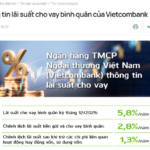
Average lending rates at Vietcombank climbed to 5.8% per annum in December 2025, marking the second consecutive month of upward adjustments. Meanwhile, BIDV also raised its lending rates after a prolonged period of stability.
Vietnam’s Ministry of Industry and Trade Responds to VinEnergo on Direct Power Purchase Agreement (DPPA) Mechanism in Urban Areas
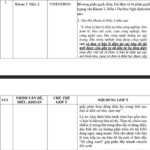
The Ministry of Industry and Trade has announced a new policy, allowing only direct electricity trading through private grid connections. This initiative aims to streamline the process, ensuring a more efficient and controlled energy exchange system.
VinEnergo Proposes Expanding DPPA Mechanism for Electric Vehicle Charging Stations: Ministry of Industry and Trade Responds
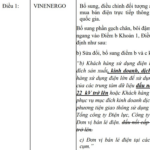
VinEnergo asserts that the current DPPA regulations restrict the participation of electric vehicle charging station service providers, thereby hindering the transition to green energy and sustainable transportation.
Completion of the 110kV Trần Đề – 220kV Sóc Trăng Power Line Project in Cần Thơ
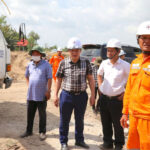
On January 5th, with the support of the Southern System Operation Center (SSO), the Southern Power Corporation (EVNSPC) successfully energized the “110kV Tran De – 220kV Soc Trang Substation” transmission line in Can Tho. This achievement was made possible through the coordinated efforts of EVNSPC’s subsidiary units under the corporation’s guidance.
New Rooftop Solar Power Regulations Proposed by the Ministry of Industry and Trade
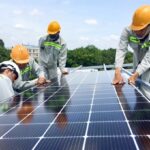
The Ministry of Industry and Trade has recently proposed a series of new regulations regarding the installation of rooftop solar power systems for self-production and self-consumption, along with a mechanism for trading surplus electricity.