













For much of modern history, Greenland has loomed in the international consciousness as a vast, icy expanse on the world map—a remote, frozen “backwater,” largely forgotten except for its role as a quiet military outpost during the Cold War.
Spanning over 2 million square kilometers, with 80% of its surface covered by permanent ice, the island seemed detached from the vibrant currents of global economics and politics. However, as the 21st century entered its third decade, Greenland unexpectedly emerged from its icy slumber, becoming the epicenter of a global geopolitical and economic storm.
No longer a desolate land on the fringes of history, Greenland is now likened to a “treasure island awakening,” where the fiercest power aspirations of superpowers converge. From Washington to Beijing and Moscow, all eyes are fixed greedily on the Arctic.
Why does every nation covet Greenland?
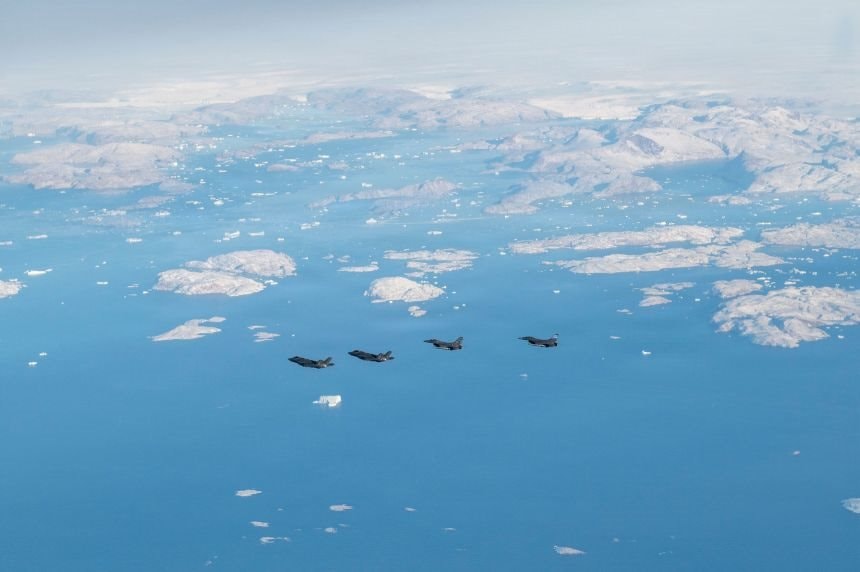
The United States’ interest in Greenland has deep historical roots, but it reached an unprecedented and dramatic level under President Donald Trump.
In 1946, as the post-World War II world order took shape, President Harry S. Truman secretly offered to purchase Greenland from Denmark for $100 million in gold. Truman’s vision was clear: Greenland was “indispensable” to North American security. Denmark declined but allowed the U.S. to establish military bases, creating a balance that endured throughout the Cold War.
However, in 2019, and more forcefully in 2025, President Trump disrupted this delicate diplomatic equilibrium by publicly expressing his intention to acquire the island.
Trump and his national security advisors elevated Greenland from a strategic ally to an asset to be possessed, deeming it essential for both U.S. “national security” and “economic security” in the face of China and Russia’s rise.
While the U.S. employs hard power and diplomatic pressure, China adopts a “slow and steady” strategy through economic diplomacy and infrastructure investment. Despite having no Arctic territory, China declared itself a “near-Arctic state” in 2018 and released a White Paper outlining its ambition to build a “Polar Silk Road.”
Beijing’s strategy in Greenland is subtle, focusing on mineral resources and scientific infrastructure.
Chinese state-owned and private companies have rapidly penetrated Greenland’s mining sector. Notably, Shenghe Resources, a rare earth giant, acquired a strategic stake in Greenland Minerals Ltd (now Energy Transition Minerals) to control the Kvanefjeld project. This way, China gains control over critical supply chains without owning territory.
Additionally, China has offered to invest in airport and scientific research station projects in Greenland. The U.S. views China’s presence as a serious security risk.
Washington fears the “dual-use” model, where civilian investments like ports or airports could be repurposed for military use or intelligence gathering. Greenland’s economic dependence on Chinese capital could also create political leverage, threatening its alignment with NATO.
While China wields economic power, Russia asserts its “Arctic great power” status through overwhelming military presence. Russia boasts the longest Arctic coastline and considers the region vital to its economic and military fortress.
Under President Putin, Russia has militarized the region more aggressively than at any time since the Soviet era, restoring airbases, deploying coastal defense missile systems, and developing a powerful nuclear icebreaker fleet.
For Moscow, Greenland is a critical choke point controlling access to the Atlantic through the GIUK gap (Greenland-Iceland-UK). Any U.S. military buildup in Greenland is seen as a direct threat to Russia’s nuclear deterrence and the Northern Fleet’s freedom of navigation.
A treasure island in every sense
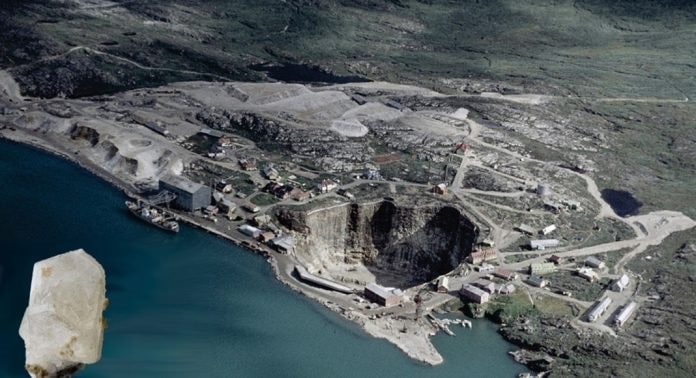
One of the primary drivers of international interest in Greenland is the belief in its boundless subterranean wealth. Greenland is likened to a periodic table lying exposed. However, the gap between massive estimates on paper and actual extraction is vast, filled with technical, legal, environmental, and societal challenges.
Greenland is estimated to hold about 1.5 million tons of rare earth elements, ranking 8th globally in reserves. Notably, it hosts two of the world’s largest untapped rare earth deposits: Kvanefjeld and Tanbreez. These are critical for the green economy (wind turbines, electric vehicles) and defense industries (missile guidance systems, fighter jets).
Feasibility studies suggest Kvanefjeld could supply 20-25% of global rare earth demand, with low extraction costs due to open-pit mining and uranium byproduct revenue. However, the area is currently restricted from mining.
In contrast, Tanbreez is emerging as a “rising star” backed by the West. The ore at Tanbreez is eudialyte, a complex mineral with very low uranium and thorium levels, safely below government thresholds.
As of January 2026, the project has made concrete progress. Critical Metals Corp has approved a pilot plant in Qaqortoq and pre-sold 75% of expected output to Western customers. This is seen as a cornerstone of the U.S. strategy to build a rare earth supply chain independent of China.
Beyond minerals, Greenland has been dubbed the “Saudi Arabia of the Arctic” by geologists.
In 2008, the U.S. Geological Survey (USGS) released staggering figures: the Northeast Greenland Sea could hold up to 31.4 billion barrels of oil equivalent, and the West Greenland-East Canada area could contain 7.3 billion barrels of oil and 52 trillion cubic feet of natural gas.
However, the oil dream shattered against nature’s harshness. Costly exploration campaigns by Cairn Energy and Statoil (now Equinor) in the 2010s failed. Dry wells, exorbitant logistics costs due to icebergs, and short operating seasons drove oil companies away.
In 2021, Greenland’s government officially banned new oil exploration licenses, declaring that “the future does not lie in oil.” This was a bold decision for a capital-hungry economy, positioning Greenland as a climate pioneer.
“Looking ahead by a few minutes”
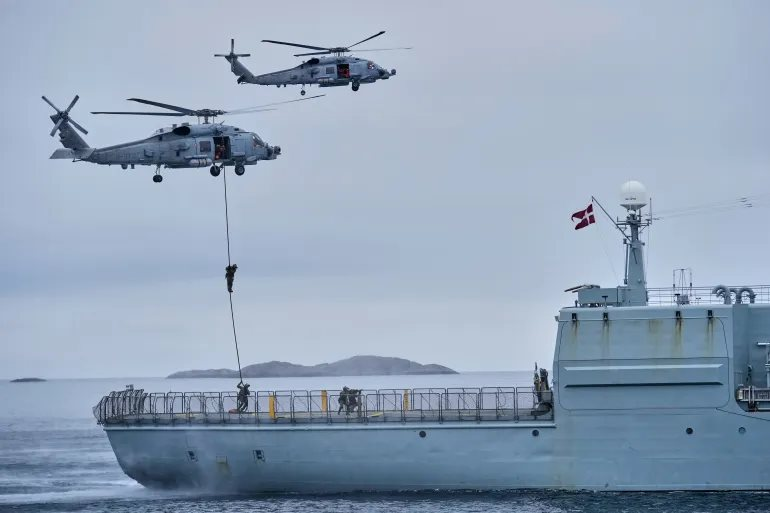
If mineral resources are a “hidden treasure” fraught with risk, Greenland’s geographic location is an irreplaceable “exposed value.” For the U.S. and NATO, the island is a great shield protecting the northern flank.
Located at the northernmost tip of Greenland (1,200 km north of the Arctic Circle), Pituffik Space Base (formerly Thule Air Base) is America’s most important overseas military asset, and perhaps the most isolated place on Earth.
Here lies the Ballistic Missile Early Warning System (BMEWS) radar station of the 12th Space Warning Squadron. The massive Solid State Phased Array Radar (SSPAR) at Pituffik detects intercontinental ballistic missiles launched from Russia or other adversaries toward North America as soon as they leave the launch pad and fly over the North Pole.
Positioned at the top of the world, Pituffik provides an unobstructed view into Russian airspace, offering precious early warning minutes—enough to decide survival in a nuclear war. It also plays a crucial role in tracking satellites and space debris.
Pituffik also hosts the world’s northernmost deep-water port, an indispensable supply hub for military and research activities in the polar region.
Greenland is no longer the forgotten island of icy fairy tales. It has truly become a “treasure island” in every sense, a scorching intersection of the 21st century.
In terms of resources, it holds the key to future technology (rare earths). Geopolitically, it is an irreplaceable security chokepoint for North America against Russia and China’s rise, prompting the U.S. to use every means—from soft diplomacy to threats of acquisition—to ensure control.
The answer from this icy land will shape not only the Arctic’s future but also the global security and economic order for decades to come.
Asia’s Bold Move: Nation Prepares to Extract Rare Earth Metals from 6,000-Meter Deep Seabed Mud, Aiming to Challenge China’s Supply Chain Dominance
This operation is capable of reclaiming approximately 350 tons of rare earth-rich sludge daily.
Unprecedented Discovery: 10,000-Meter Deep Drilling Unveils Massive Rare Earth Deposit with Higher Concentrations Than China’s Mines

This is the result of analyzing samples from 106 boreholes, totaling over 10,000 meters in length, and 35 trenches across approximately 650 acres.
Minister Trần Đức Thắng: 21 Provinces with Rare Earth Reserves to Restrict Raw Exports
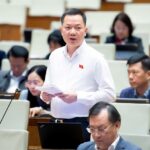
Vietnam boasts a world-leading reserve of rare earth elements, distributed across 21 provinces and cities, according to Minister of Agriculture and Environment Tran Duc Thang.
Where Does Vietnam Rank on the Latest Global Map of Rare Earth Reserves?
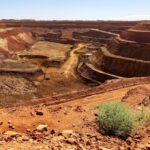
Vietnam boasts a larger reserve of rare earth elements than both the United States and Thailand.
Unveiling Rare Earth Alternatives: A Global Lifeline for the Electric Vehicle Industry Amidst China’s Supply Crunch?

Global automakers are actively diversifying their rare earth supply chains beyond China while simultaneously advancing technologies that reduce or eliminate the need for these critical materials.