










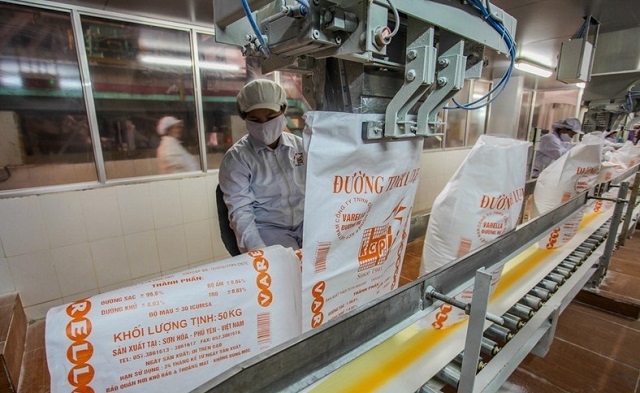
Illustrative image (Source: TTXVN)
|
On January 13, the Ministry of Industry and Trade announced that according to data from Vietnam Customs, the total bilateral trade turnover between Vietnam and India reached a record high of $16.46 billion in 2025, marking a 10.5% increase compared to 2024. Exports from Vietnam to India surged to $10.3 billion, up 14.2%, while imports from India reached $6.1 billion, growing by 4.9%.
Key export sectors with significant growth include mobile phones and components, which rose by 27% to $2.1 billion, accounting for 20.7% of total exports; computers, electronic products, and components followed with $1.7 billion, up 15.8%, representing 16.8%; and machinery, equipment, tools, and spare parts reached $1.05 billion, increasing by 11.3% and making up 10.2%.
Other notable growth areas include animal feed and raw materials, up 97%; pepper, rising 54% to $74.2 million; plastic products, increasing 53% to $252.6 million; tea, up 27.5% to $4.7 million; and seafood, growing 26% to $19.6 million.
Additionally, chemicals increased by 22.5% to $356.7 million; textiles and garments rose 23% to $194.2 million; transport vehicles and parts grew 24% to $221.2 million; confectionery and cereal products increased 16.5% to $2.8 million; and chemical products rose 15% to $150.8 million.
Conversely, Vietnam’s imports from India during this period totaled $6.1 billion, a 4.9% increase compared to 2024. India’s share in Vietnam’s total imports stood at 1.75%. Notably, Vietnam recorded a trade surplus of $4.23 billion with India in 2025, up 31% year-on-year.
The trade structure between the two countries shows significant differences. India supplies essential raw materials such as steel, chemicals, pharmaceuticals, textiles, animal feed, and seafood, while Vietnam exports technology products, electronics, textiles, chemicals, wood, footwear, spices, coffee, and pepper. This complementary relationship reduces risks and enhances regional value chains.
Regarding Indian investment in Vietnam, according to the Vietnam Foreign Investment Agency, India has 378 projects with a total investment of over $1 billion in Vietnam. Key investment sectors include energy, mineral processing, agricultural processing (coffee, tea, sugar), information technology, auto components, pharmaceuticals, hospitality, and infrastructure.
In contrast, as per India’s Department for Promotion of Industry and Internal Trade, by 2022, Vietnam had invested approximately $28.55 million in sectors such as consumer goods, electronics, construction, information technology, and pharmaceuticals in India.
In 2024, VinFast (Vietnam) announced a $2 billion investment in an electric vehicle plant in Tamil Nadu, with the first phase of $500 million launching electric vehicle products in 2025.
In December 2025, Vingroup signed a Memorandum of Understanding (MoU) with the Government of Telangana at the Telangana Rising Global Summit, committing to a $3 billion investment to develop a multi-sector ecosystem in the state, to be implemented in phases.
Given the strong economic growth of both nations, complementary market demands, and momentum from high-level visits and multilateral forums, Vietnam-India trade is poised to reach the $20 billion milestone in the coming years.
Amid global economic uncertainties, India has emerged as a stable and reliable partner, contributing to market diversification for Vietnamese businesses.
The Vietnam Trade Office in India remains committed to supporting businesses, promoting trade, and fostering investment connections, elevating the Vietnam-India economic relationship to new heights.
According to the Vietnam Trade Office in India, from January 8-10, 2026, the Indusfood 2026 International Food and Beverage Fair, Asia’s premier food trade event, took place at the India Exposition Mart in Greater Noida, Uttar Pradesh, India.
Vietnamese businesses showcased high-quality processed products, including frozen durian, jackfruit, passion fruit, dried mango, dried jackfruit, coffee, and other food and beverage items.
The Vietnam pavilion attracted significant interest from Indian and international partners. The opening ceremony of the Vietnam exhibition area was held with the participation of Trade Office representatives and local partners.
Beyond exports, the fair saw active participation from nearly 20 Vietnamese buyer delegations seeking import opportunities for raw materials from India, with a focus on buffalo meat, dairy products, and raw shrimp. This engagement promotes two-way trade, diversifies raw material sources for Vietnam’s food processing industry, and leverages India’s strengths in agriculture and aquaculture.
Furthermore, participation in Indusfood 2026 enabled Vietnamese businesses to directly engage with global buyers and distribution networks, explore new consumer trends, expand export markets to India, the Middle East, Africa, and Europe, and enhance strategic raw material imports./.
– 21:28 13/01/2026
Vietnam’s Path to Development: Why 9-10% Growth Is Non-Negotiable, According to Dr. Trần Du Lịch

Dr. Trần Du Lịch shared insights on Vietnam’s ambitious goal of becoming a developed nation by 2045.
Vietnam’s Import-Export Sector Hits Record-Breaking $920 Billion Milestone
Total trade turnover is projected to surpass $900 billion by the end of 2025, propelling Vietnam into the ranks of the world’s top 15 trading powerhouses.
“Vietnam’s Premium Exports Hit U.S. Market at Sky-High Prices: Market Share Surpasses Combined Competitors Amid Global Scarcity”

By the end of November, exports of this product had shattered all forecasted records.
ACB Launches Strategic Financing Solutions Amid Vietnam’s Textile Sector Challenges

ACB introduces tailored financing solutions to support Vietnam’s textile and garment sector as it faces market fluctuations while maintaining robust export growth and enhancing its global competitive edge.
Unbelievable Economic Milestones Achieved by Vietnam

This number continues to rise.