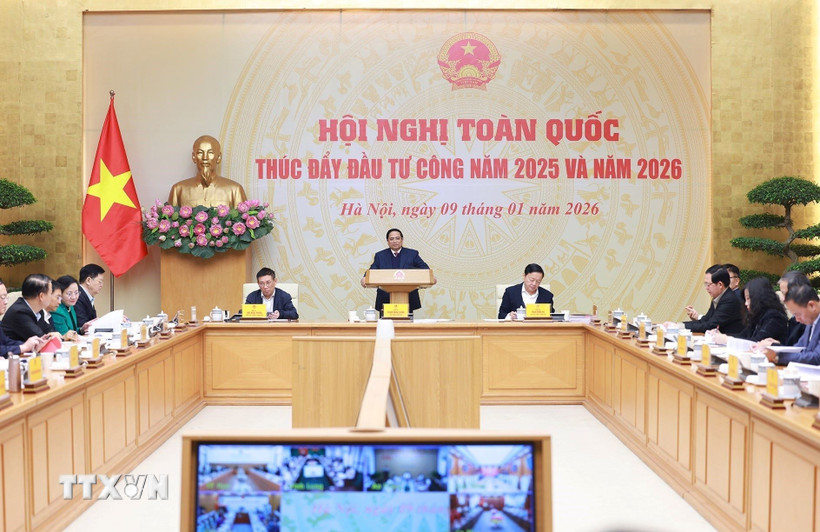
Prime Minister Pham Minh Chinh chaired the National Online Conference to Promote Public Investment for 2025 and 2026. (Photo: Duong Giang/TTXVN)
|
The Government Office has issued Announcement No. 24/TB-VPCP on the conclusions of the Standing Government at the National Conference to Promote Public Investment for 2025 and 2026.
Accordingly, on the afternoon of January 9, 2026, at the Government Office, Prime Minister Pham Minh Chinh chaired the National Conference to Promote Public Investment for 2025 and 2026 of the Standing Government with ministries, agencies, and localities.
Attending the conference were Deputy Prime Ministers Tran Hong Ha, Le Thanh Long, Ho Duc Phoc, Mai Van Chinh, Ho Quoc Dung, and Pham Thi Thanh Tra; ministers and leaders of ministries, ministry-level agencies, government agencies, and other central agencies allocated public investment capital for 2025; representatives from state-owned corporations and commercial banks; and chairpersons, vice-chairpersons of provincial people’s committees, and leaders of departments and agencies in provinces and centrally-run cities.
After hearing the report from the Minister of Finance, opinions from localities, ministries, and agencies, and the speeches of the Deputy Prime Ministers, the Standing Government concluded as follows:
The Ministry of Finance was highly appreciated for its thorough and clear preparation of conference materials, highlighting achievements, candidly addressing limitations, challenges, and bottlenecks, and providing lessons learned in the allocation and disbursement of public investment capital for 2025 and the allocation plan for 2026. Ministries, agencies, and localities actively participated with a sense of responsibility, offering insightful and straightforward opinions, along with solutions to accelerate the disbursement of public investment capital in the remaining days of the 2025 plan and the implementation of the 2026 capital plan.
At the 2025 year-end review conference and the 2026 task deployment conference of the Government and local authorities on January 8, 2026, General Secretary To Lam highlighted several issues, limitations, and causes in the management and use of public investment capital, including slow disbursement, low efficiency, prolonged projects, and cost overruns. He directed ministries, agencies, and localities to seriously absorb and implement these directives within their respective organizations.
During the 2021-2025 period, the Government and Prime Minister Pham Minh Chinh have been resolute and closely monitored the disbursement of public investment capital to boost economic growth, create jobs, and improve livelihoods. The Government submitted over 10 laws directly related to public investment to the National Assembly for approval, along with resolutions on special mechanisms for national key projects and strategic infrastructure projects. The Prime Minister issued numerous directives and organized over 20 online conferences to promote public investment.
In 2025, amidst complex global developments, to ensure the achievement of an over 8% growth target, the Prime Minister focused on the allocation and disbursement of public investment capital from the beginning of the fiscal year.
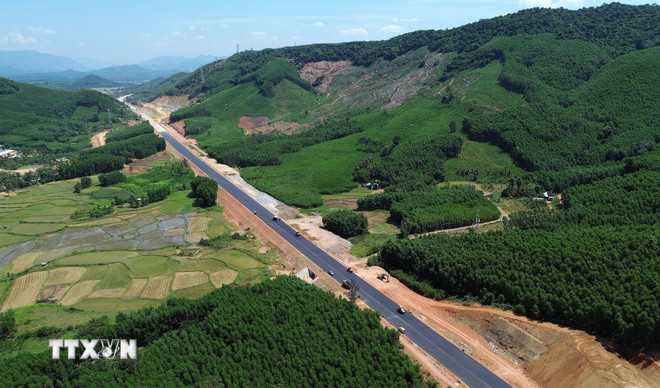
The Hoai Nhon – Quy Nhon project (Gia Lai Province) is a component of the North-South Expressway project, part of the Eastern North-South Expressway construction project for 2021-2025. (Photo: Quoc Khanh/TTXVN)
|
According to the Ministry of Finance’s report, the 12-month public investment disbursement rate for 2025 reached 83.7% of the plan. This included the completion of 3,345 km of main highways and 1,711 km of coastal roads, essentially connecting the entire Eastern North-South Expressway from Cao Bang to Ca Mau. Three groundbreaking and inauguration ceremonies were held for projects totaling 5.14 million billion VND, with private investment accounting for 75%.
However, 22 central agencies and 18 localities had disbursement rates below the national average. The Standing Government criticized these units and requested them to review, learn from the experience, and clarify the responsibilities of involved individuals and collectives.
The main reasons for slow disbursement were identified as: some ministries, agencies, and localities not strictly following directives; a tendency to avoid or shift responsibilities; slow progress in compensation, resettlement, and land clearance; and complex ODA procedures.
Key lessons learned include: strictly implementing Party and State directives; ministries, agencies, and localities proactively fulfilling their responsibilities; emphasizing the accountability of leaders; thorough project preparation; reviewing delayed projects to identify causes; flexible and creative approaches to land clearance; and upholding discipline and order.
To achieve 100% disbursement of the 2025 and 2026 public investment plans, the Standing Government requires the following key solutions:
Continue to thoroughly and resolutely implement Party, National Assembly, and Government resolutions and conclusions. Ensure “6 clarities” in assignments: clear responsibilities, tasks, authorities, timelines, and outcomes.
Specifically assign leaders and officials to each project, individualizing accountability, and promptly replacing underperforming or negligent staff.
Regularly inspect, urge, and address emerging issues directly at units and construction sites. Proactively complete acceptance and settlement procedures for investment capital.
Continue reviewing and consolidating mechanism and policy bottlenecks related to public investment for timely resolution.
Decisively address land clearance delays, mobilizing the entire political system to accelerate this process.
Vigorously implement Resolution No. 66.4/2025/NQ-CP on special mechanisms and policies to overcome difficulties in implementing the Law on Geology and Minerals.
For the 2026 capital plan: Urgently allocate and detail capital from the beginning of the year; avoid scattered allocation; prioritize capital for key and breakthrough projects.
The Ministries of Finance, Agriculture and Rural Development, and Construction, within their functions, must promptly address the proposals raised at the conference.
The People’s Committees of Ho Chi Minh City and Dong Nai Province should prioritize investment in connecting roads to Long Thanh International Airport for effective operation in the first quarter of 2026.
The Ministry of Construction and localities should accelerate key projects, including the North-South high-speed railway and rail connections with China.
PV
– 18:33 14/01/2026
Anticipating the 14th National Party Congress: Selecting the Right ‘Breakthrough of Breakthroughs’ to Elevate the Nation’s Stature
The 14th National Party Congress convenes amidst profound global shifts, as Vietnam stands poised on the brink of a transformative era of robust development. Scholars and intellectuals alike anticipate the Congress to chart the right strategic priorities, fostering genuine breakthroughs in institutional frameworks, growth models, enterprise development, and high-quality human resources. Such advancements are expected to propel the nation onto a trajectory of rapid, sustainable progress.
K-Shaped Economic Recovery: 2026 Hinges on Public Investment Momentum
Amidst the challenges of subdued domestic purchasing power and lingering exchange rate risks, the momentum for 2026 will hinge significantly on the disbursement of mega-projects and the strategic shift in export market dynamics.
Unveiling the Season 1 Champion of “A.I Battle” – Winner of a $1 Million Prize from Techcombank

At the grand finale, Techcombank awarded a prestigious international AI study abroad scholarship valued at up to $1 million to the winning team, Converged, for securing the First Prize.
Rural Vietnam: The Long-Term Runway for Modern Retail Growth

According to the Retail Industry Report by SHS Research, Vietnam’s food retail market is currently valued at approximately $70 billion. However, the penetration rate of modern retail channels stands at only about 14%—significantly lower than Thailand (approximately 48%) and Indonesia (around 23%). This gap highlights the substantial growth potential for modern retail in Vietnam, particularly as domestic consumption rebounds and consumer behavior increasingly prioritizes product quality and convenience.
Soaring Scores, Hesitant Cash Flow: Insights from Tran Duc Anh (KBSV)
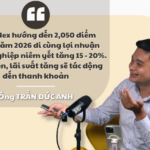
The stock market in 2026 is poised to revolve around the narrative of extending the bullish cycle, with public investment taking center stage. Foreign capital inflows are expected to rebound, and the IPO wave may continue to surge. However, rising interest rates could temper liquidity, leading to a less vibrant trading environment.