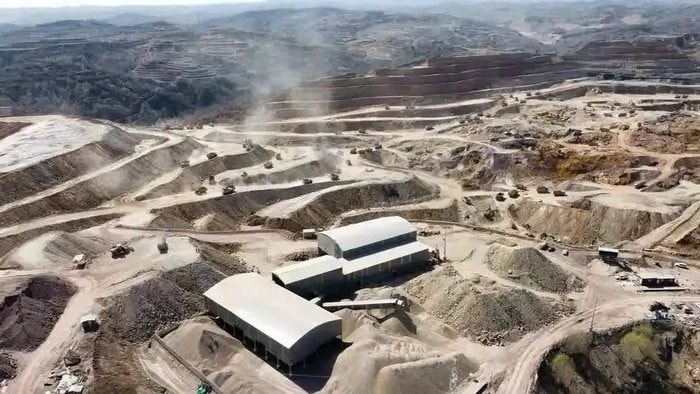
According to the China Mining Network, the detailed exploration project of the Shenjiazhuang bauxite mine in Xiaoyi City, Lüliang, Shanxi Province, has officially passed the reserve evaluation stage. The project, conducted by Shanxi Geological Exploration Institute No. 3, has uncovered a staggering 183 million tons of bauxite resources, making Shenjiazhuang the largest bauxite mine in China to date.
Beyond its massive bauxite reserves, the Shenjiazhuang mine is also rich in high-value associated minerals. Exploration results reveal approximately 198 million tons of coal (primarily coking coal), 69.5 million tons of hard clay, 13,000 tons of gallium, 4.34 million tons of Shanxi-type iron ore, and 2.03 million tons of pyrite.
Based on current market prices, the total resource value of the Shenjiazhuang mine exceeds 200 billion RMB (approximately $27 billion USD). Bauxite alone contributes significantly, with its 183 million tons valued at nearly 97 billion RMB. Coking coal, another critical associated mineral, holds even greater economic value. According to Galaxy Futures, coal prices in Shanxi currently exceed 1,200 RMB per ton. Even accounting for extraction losses, the 198 million tons of coal at Shenjiazhuang are worth hundreds of billions of RMB. For context, Shanxi’s total coking coal production in 2024 reached approximately 92.1 million tons, underscoring the immense scale of this newly discovered mine.

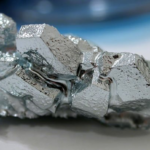
Notably, the Shenjiazhuang mine boasts 13,000 tons of gallium reserves. With global proven gallium reserves estimated at only 279,300 tons, this is a highly valuable strategic resource. Gallium is a rare metal essential for third-generation semiconductor materials like gallium nitride (GaN) and gallium arsenide (GaAs), widely used in 5G base stations, power inverters for new energy vehicles, and aerospace radar systems.
China is the world’s largest producer and consumer of alumina and electrolytic aluminum, with a substantial demand for bauxite. At one point, China’s reliance on imported bauxite reached 71%. Shanxi Province alone accounts for approximately 34% of the country’s total bauxite reserves. Under the 14th Five-Year Plan, Shanxi has undertaken 85% of the nation’s bauxite exploration tasks, surpassing the Ministry of Natural Resources’ target of 340 million tons by adding roughly 560 million tons of new reserves.
According to the latest data from the United States Geological Survey, Vietnam also possesses significant bauxite reserves, estimated at 3.1 billion tons. In comparison, China holds 680 million tons, and the United States has 20 million tons. Vietnam’s reserves are thus four times larger than those of the U.S. and China combined.
In Vietnam, Đắk Nông province leads the nation in bauxite reserves. The Deputy Director of Vietnam’s Geological Department notes that Đắk Nông has immense bauxite potential, with estimated reserves of 1.8 billion tons of refined ore, equivalent to 4.2 billion tons of raw ore, and an aluminum content exceeding 40%.
The Ultimate Guide to China’s Export Ban on Rare Earth Metals: How Vietnam Holds the Key to Global Supply
China has taken a new stance in response to US tech sector interventions.