The Hanoi People’s Committee has recently approved the detailed 1/500 scale planning for the Capital Buddhist Cultural Center in Bat Trang Commune, Hanoi. This significant development marks a milestone in the city’s cultural and religious landscape.
The designated area for the project is located in Bat Trang Commune, Hanoi (formerly Da Ton Commune, Gia Lam District, Hanoi). It is bordered to the north by a public urban utility area as per the planning, to the east and south by a planned road with a cross-section of approximately 17.5 meters, and to the west by the Hanoi – Hung Yen Road (currently Giap Hai Road) with a planned cross-section of 40 meters.
The detailed planning area for the Capital Buddhist Cultural Center spans approximately 53,106 square meters. The overall architectural planning indicators for the religious site include a combined construction density of 22.6% and a maximum height of around 3 floors.
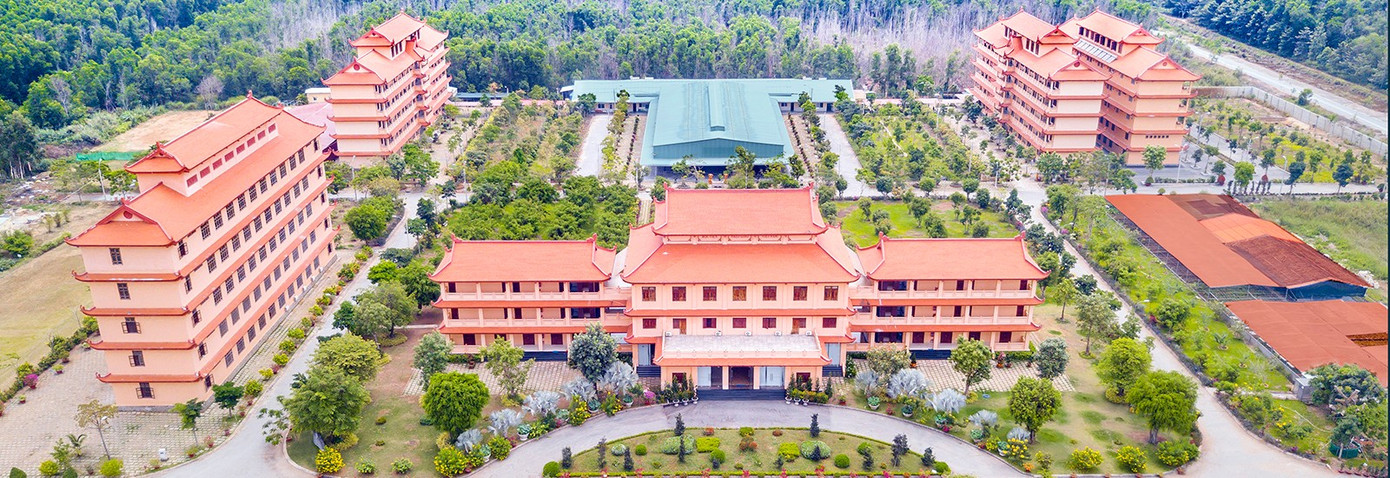
Illustrative image
The site is divided into functional zones with specific planning indicators:
The main construction area (CTC) covers approximately 20,915 square meters, comprising two zones labeled TG1 and CX5. These zones will house key facilities such as an International Auditorium, Reception Center, National Teacher Worship Hall and Library, Buddhist Cultural Museum, and an Open Plaza.
The auxiliary construction area spans roughly 26,945 square meters, divided into two plots labeled CTPT1 and CTPT2. CTPT1 includes a Nun’s Area, outdoor event spaces, and landscaped gardens. CTPT2 features a Monk’s Area, additional outdoor event spaces, and more landscaped gardens.
The parking area covers about 3,571 square meters, while internal roads occupy approximately 2,395 square meters.
This planning initiative aims to concretize the adjusted Capital Master Plan for the period up to 2045, with a vision extending to 2065, and the partial adjustment of the N11 Urban Subdivision Plan for the C4 planning block, both of which have been approved by relevant authorities. It proposes land use structures, functions, and indicators to meet the requirements for constructing the Capital Buddhist Cultural Center, ensuring synchronized architectural planning and technical infrastructure. The center will serve as a hub for organizing Buddhist cultural events, preserving and promoting traditional Buddhist values, and housing the administrative headquarters of the Hanoi Buddhist Sangha. It will also create a cultural space that attracts both locals and tourists, seamlessly integrating with the surrounding infrastructure. This plan will serve as the basis for investment management and project development in accordance with regulations.
The Hanoi People’s Committee has tasked the Department of Planning and Architecture with verifying and confirming the detailed planning documents and drawings for the Capital Buddhist Cultural Center in Bat Trang Commune, ensuring compliance with the city’s decision. The department is also responsible for archiving the planning project documents as required.
The Bat Trang Commune People’s Committee is entrusted with leading the public announcement of the approved 1/500 scale detailed planning for the Capital Buddhist Cultural Center, in collaboration with the Department of Planning and Architecture and the Hanoi Buddhist Sangha Executive Board. This ensures that relevant organizations, agencies, and the public are informed and can implement the plan. Additionally, the committee is responsible for guiding, inspecting, and supervising construction activities to ensure compliance with the planning and addressing any violations according to legal provisions.
The Bat Trang Commune People’s Committee is urged to promptly initiate the construction of the planned 17.5-meter-wide road to the east and south of the site. They are also to coordinate with investors to establish traffic management solutions, ensuring the normal operation of the existing Giap Hai Road to Khoan Te Village until the new 17.5-meter-wide road is completed.
Which Areas in Hanoi Are Forecast to Be the “Hotspots” for Investment in 2026?

According to Mrs. Đỗ Thị Thu Hằng, areas such as Đông Anh and Tây Hà Nội are emerging as highly promising destinations in the near future, benefiting directly from the ring roads and cross-city connectivity axes. Meanwhile, the medium-term outlook is gradually shifting southward, expanding opportunities across the city.
Hydraulic Company Granted 2,600m² of Prime Land on Chùa Bộc Street for Office Use
Hanoi has granted Vietnam Irrigation Consulting Corporation – JSC the use of 2,619.2 square meters of land at 116 Alley 95/8 Chua Boc, Kim Lien Ward, for their office premises.
Vietnam’s GDP Poised to Enter Global Top 10, Predicts Kinh Bac Chairman Dang Thanh Tam

“United by our love for our nation and driven by extraordinary determination, we must collectively build and execute this plan to confidently step into the new era,” emphasized Mr. Đặng Thành Tâm.
Ho Chi Minh City Apartment Prices Post-Merger Average 68 Million VND/m², Forecast to Rise Further by 2026-2028
Following the transformative expansion of Ho Chi Minh City in 2025, which included the integration of Binh Duong and Ba Ria – Vung Tau, Vietnam’s housing market is entering a period of significant reshaping. According to Vo Huynh Tuan Kiet, Director of Residential Services at CBRE Vietnam, 2026 will mark a pivotal year where trends such as urban sprawl, infrastructure-driven development, product quality enhancement, and market transparency become increasingly prominent.
Ho Chi Minh City and Surrounding Provinces Witness Surge in Approved “Paper Home” Sales Projects in Late 2025
Local Department of Construction statistics reveal that 34 projects, comprising nearly 16,000 units, are eligible for future home sales and mobilization across 12 provinces and cities in the final month of 2025. Ho Chi Minh City leads with 9 eligible projects.