The Ho Chi Minh City People’s Committee has recently issued a decision to establish an Appraisal Council for the Report on Investment Policy of the sea-crossing road project connecting Can Gio and Ba Ria – Vung Tau under the Public-Private Partnership (PPP) model.
The council consists of 11 members, including leaders from various departments and representatives of local authorities in the areas where the project is expected to be implemented. Mr. Hoang Vu Thanh, Acting Director of the Department of Finance, has been appointed as the Chairman of the Council.
According to the decision, the Council is responsible for appraising the Report on Investment Policy in compliance with Decree No. 243/2025/NĐ-CP issued by the Government. The appraisal process will focus on a comprehensive evaluation of the report’s content, clarifying any discrepancies, and proposing solutions or additional requirements as needed.
The Department of Finance has been designated as the standing agency, tasked with synthesizing opinions, coordinating appraisal activities, and reporting the results to the Ho Chi Minh City People’s Committee. Council members will work on a part-time basis, utilizing the existing personnel and resources of their respective agencies.
Regarding the sea-crossing road project connecting Can Gio and Ba Ria – Vung Tau, at the third conference of the Ho Chi Minh City Party Committee for the 2025-2030 term, Secretary of the Ho Chi Minh City Party Committee Tran Luu Quang stated that currently, residents traveling from the city center to Ba Ria – Vung Tau primarily use the Long Thanh – Dau Giay Expressway, passing through Dong Nai Province.
Among the overall connectivity options, the Secretary highlighted two feasible directions.
The first is a land connection from the Nha Be area; however, this option faces several challenges given the current conditions.
The second is a sea-based development along the Can Gio axis, aligning with the strategic vision of expanding the city’s maritime economic space, logistics, tourism, and high-quality services. This route would directly connect to the Bai Truoc – Bai Sau area in Vung Tau.
The initial proposal for the project includes two segments: an above-sea section and an underwater tunnel similar to the Saigon River Tunnel. The sea-crossing road is approximately 13-14 km long with six lanes, and construction is expected to take about three years. Two artificial islands will be built on either side to ensure navigational clearance.
Upon completion, the travel time from the city center to Vung Tau by car will be just over one hour. The city plans to further invest in synchronized infrastructure, such as expanding the Rung Sac Road in Can Gio and constructing an additional Can Gio Bridge.
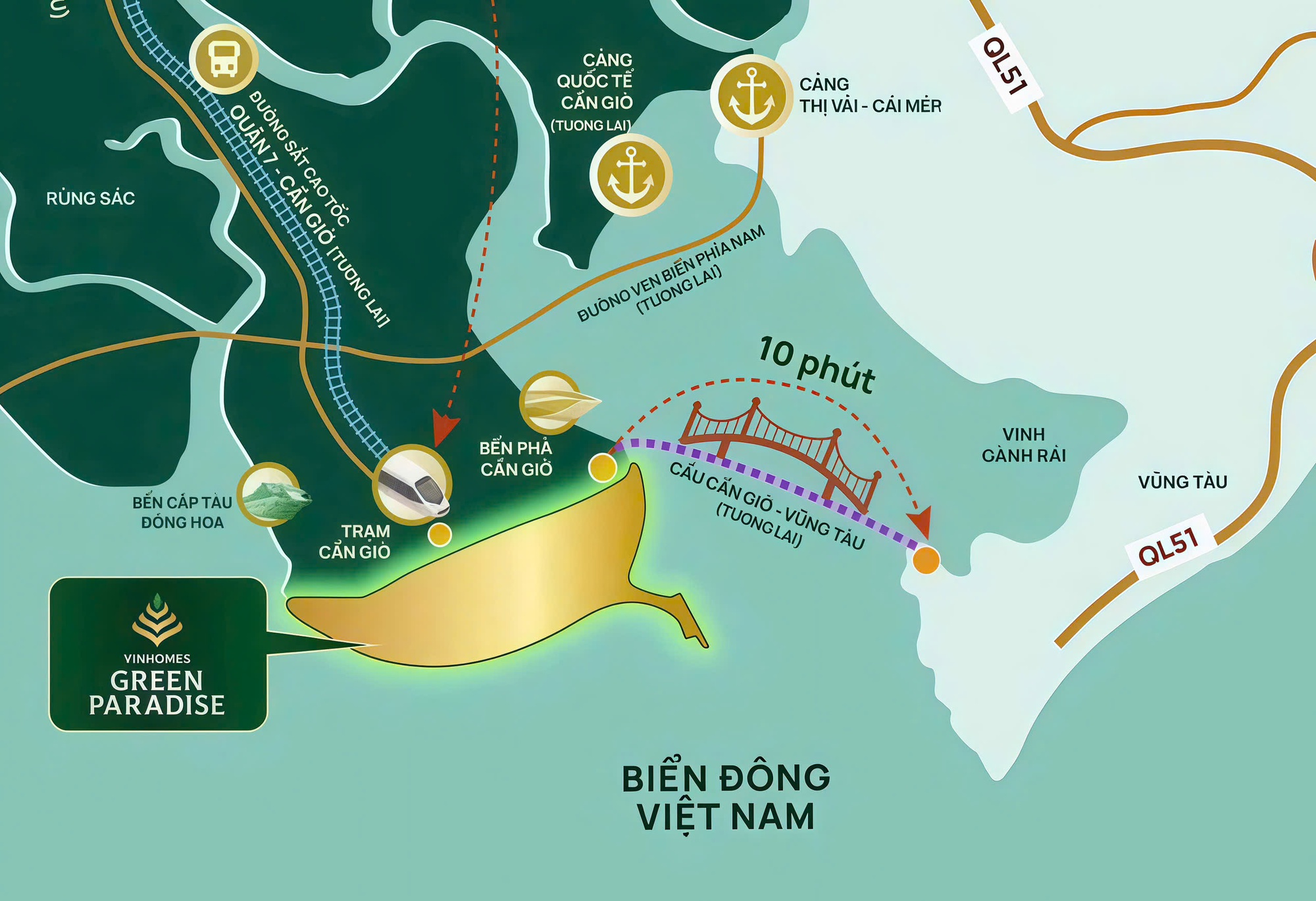
Previously, Vingroup proposed a sea-crossing route from Can Gio to Vung Tau, spanning over 14 km, including bridges, tunnels, and access roads, with a total investment of more than 104 trillion VND. The route starts from Bien Dong 2 Road (in the Can Gio reclaimed urban area), connects to Mai Sao – Ben Dinh Road, and intersects with 30/4 Road in Vung Tau.
The entire route includes approximately 3.1 km of tunnels, nearly 8 km of bridges, and about 3 km of access roads, heading southeast and crossing Ghe Rai Bay. The project requires approximately 137.5 hectares of land; the investor will provide all capital, and the government will compensate with land under the BT (Build-Transfer) model.
Ho Chi Minh City to Build $430 Million Overpass: Connecting Highways, Ring Roads, and Easing Southern Gateway Congestion
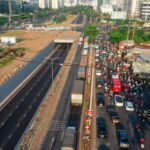
The People’s Committee of Ho Chi Minh City has officially approved the architectural design competition results for the main overpass component of the North-South Axis Road Upgrade Project (spanning from Nguyen Van Linh Street to the Ben Luc – Long Thanh Expressway), as part of Component Project 2.
Masterise Group Launches Historic Can Gio Bridge Construction, Ending Binh Khanh Ferry Monopoly and Opening New Maritime Access for Ho Chi Minh City Residents
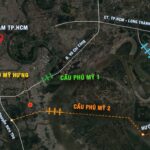
The Cần Giờ Bridge will span the lush islet between the Soài Rạp and Chà rivers, seamlessly connecting to Phú Xuân Commune in Nhà Bè District. From this point, residents of Ho Chi Minh City can effortlessly travel to District 7 or the heart of District 1 via Huỳnh Tấn Phát Street.
Launch of the Quang Ngai – Kon Tum Expressway Commenced on May 19th
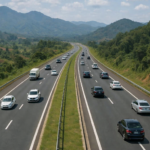
The Quảng Ngãi – Kon Tum Expressway is a planned four-lane highway with an estimated total investment of approximately 44.355 trillion VND.
Ho Chi Minh City Breaks Ground on 75,000-Seat Stadium, Nearly Double the Capacity of Mỹ Đình
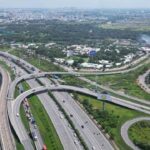
At the heart of the Rach Chiec Sports Complex, a mega-project with an investment of over 145 trillion VND, stands the Central Stadium, boasting a maximum capacity of 75,000 seats.
YouTube Channel Owner Đinh Lan to Face Trial Soon
Once a key figure in the Nguyễn Phương Hằng case, Đinh Thị Lan now faces her own day in court as a defendant on identical charges.