The Hanoi Construction Planning Institute, in collaboration with the Hanoi Department of Planning and Architecture and the People’s Committee of Vinh Thanh Commune, recently held a conference to announce and hand over the adjusted detailed planning dossier for the N4 Urban Subdivision, at a scale of 1:5000, specifically for planning block IV.8.1.
According to representatives from the Hanoi Department of Planning and Architecture, the land area undergoing the localized adjustment is strategically located in Vinh Thanh Commune, bordering several vital transportation arteries of the capital. To the north, it adjoins Hoang Sa Road (extended National Highway 5), to the west lies Vo Van Kiet Axis (Bac Thang Long – Noi Bai route), to the south is the Bac Thang Long – Hai Boi route, and to the east is a planned 40-meter road along the Ngoc Hoi – Bac Hong railway line.
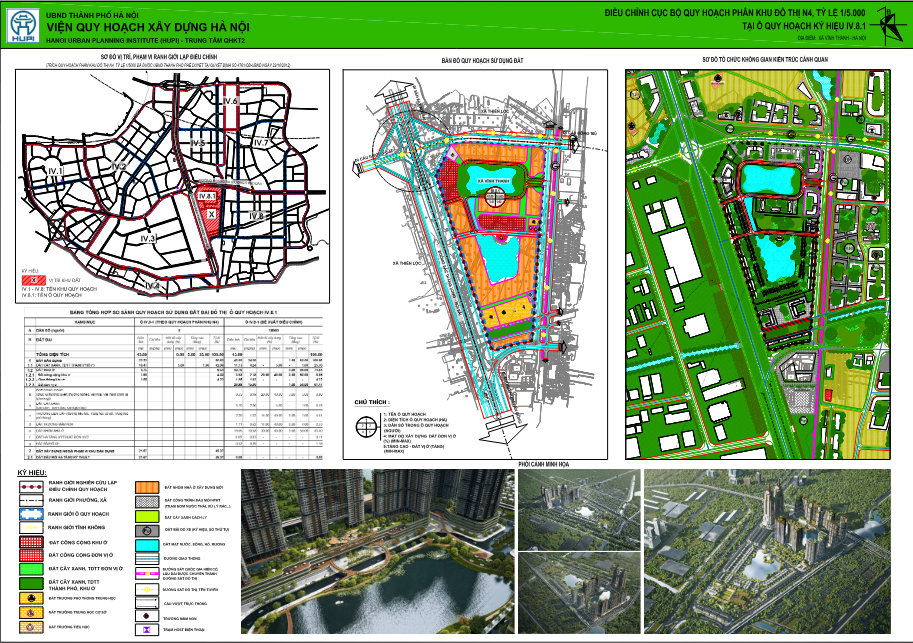
Adjusted planning block. Image: Hanoi Construction Planning Institute
Covering a total research area of approximately 43.89 hectares, this zone was previously designated primarily for public land, greenery, water bodies, and technical infrastructure, with no residential allocation. The current localized adjustment permits the development of a new urban area with a population capacity of around 18,000 residents, while significantly restructuring land use toward a modern, compact, and intelligent urban development model.
The primary objective of this adjustment is to concretely implement the Revised General Plan for Hanoi Capital until 2045, with a vision to 2065, as approved by the Prime Minister.
Based on this, area IV.8.1 is envisioned as a concentrated, mixed-use urban zone, seamlessly integrated with high-capacity public transportation systems, particularly urban railway lines.
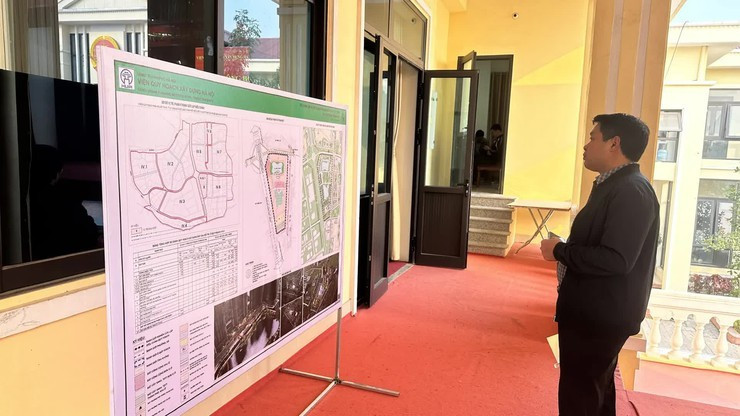
Residents reviewing the planning dossier displayed at Vinh Thanh Commune People’s Committee. Photo: Thu Hang
Beyond expanding urban development land reserves, the project is also expected to alleviate population density in the inner city, reduce infrastructure pressure on the historic central area, and create new growth momentum for the northern part of the city—identified as a key growth pole for Hanoi in the upcoming period.
In addition to architectural spatial organization, the adjusted plan allocates significant focus to the development of a synchronized technical infrastructure system. Within the urban area, the sub-area and internal road networks will be detailed during the 1:500 scale detailed planning phase, ensuring compliance with traffic land ratios and network density standards.
Notably, the plan prioritizes public transportation organization, establishing plazas, park-and-ride facilities, and public spaces linked to urban railway stations.
A standout innovation is the focus on developing underground construction spaces. Urban public facilities and mixed-use residential buildings will incorporate commercial, service, parking, and technical infrastructure functions underground, optimizing land use efficiency and enhancing urban spatial utilization.
Chairman of Hòa Bình Group: A Stable Real Estate Market Will Drive the Development of the Entire Ecosystem

Mr. Le Viet Hai believes that a stable real estate market will drive the growth of the entire related ecosystem, including construction, building materials, and other services.
Unlocking Growth: Cà Mau’s Infrastructure Advances, Yet Urban Development Lags Behind

Cà Mau is undergoing a transformative phase with significant advancements in transportation infrastructure and urban redevelopment, paving the way for comprehensive growth. However, the local real estate market still lacks large-scale, high-quality urban developments that cater to the long-term living needs of residents, workers, and international experts based in the province.
Luxury Villa and Townhouse Prices in Hanoi Surge Past $30,000/m²
In West Hanoi, villa prices remain steady at $14,000–$16,000 per square meter, with select luxury projects surpassing $30,000 per square meter. Meanwhile, in the East Hanoi area along Ring Road 2–3, terraced houses typically range from $7,200 to $8,800 per square meter, while villas fluctuate between $10,000 and $12,800 per square meter.
Ho Chi Minh City Seeks Strategic Investor for Binh Quoi – Thanh Da Urban Development Project
Ho Chi Minh City has officially issued a document outlining the selection process for strategic investors in the new urban area of Binh Quoi – Thanh Da, spanning over 400 hectares. This initiative is being implemented under the special mechanism of Resolution 260 by the National Assembly.
Exciting News for Homebuyers in Bac Ninh
In the coming period, Bac Ninh is set to welcome a wave of new urban developments and social housing projects, significantly expanding the housing supply across the region.