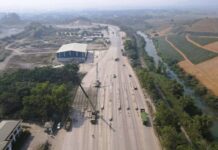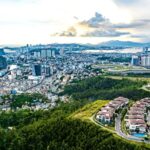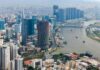











On January 15th, Ho Chi Minh City simultaneously commenced and broke ground on four major infrastructure and transportation projects, totaling nearly VND 240 trillion in investment. This significant event coincided with the celebration of the 14th National Congress of the Communist Party of Vietnam. Marking a large-scale “launch,” these projects aim to propel urban development, enhance transportation networks, and invigorate the eastern economic zone of the city.
The central ceremony took place at the groundbreaking of the Rach Chiec National Sports Complex, attended and directed by leaders from the Central Government, the Prime Minister’s Office, and Ho Chi Minh City. The other three sites included the commencement of Metro Line 2 (Ben Thanh – Tham Luong), the groundbreaking of Can Gio Bridge, and the Phu My 2 Bridge.
Among these, the Rach Chiec project stands out with a preliminary investment of over VND 145.629 trillion, structured as a public-private partnership (PPP). Spanning nearly 187 hectares, it is envisioned as a modern sports-economic ecosystem, poised to become a national and regional sports hub.
AI-generated future rendering of Rach Chiec Stadium
Rach Chiec Sports “Super Complex”: 75,000-seat stadium, sports hospital, and public park
The Rach Chiec National Sports Complex is one of the most anticipated infrastructure projects in Ho Chi Minh City, awakening after over three decades of dormancy. Located in Binh Trung Ward, it holds a strategic position directly connecting to the Long Thanh – Dau Giay Expressway.
The project spans approximately 186.78 hectares, significantly reduced from the original 466 hectares after multiple adjustments. Upon completion, it is expected to become an Olympic-standard sports center, catalyzing economic growth in the eastern innovative urban area of Ho Chi Minh City.
Key proposed components include:
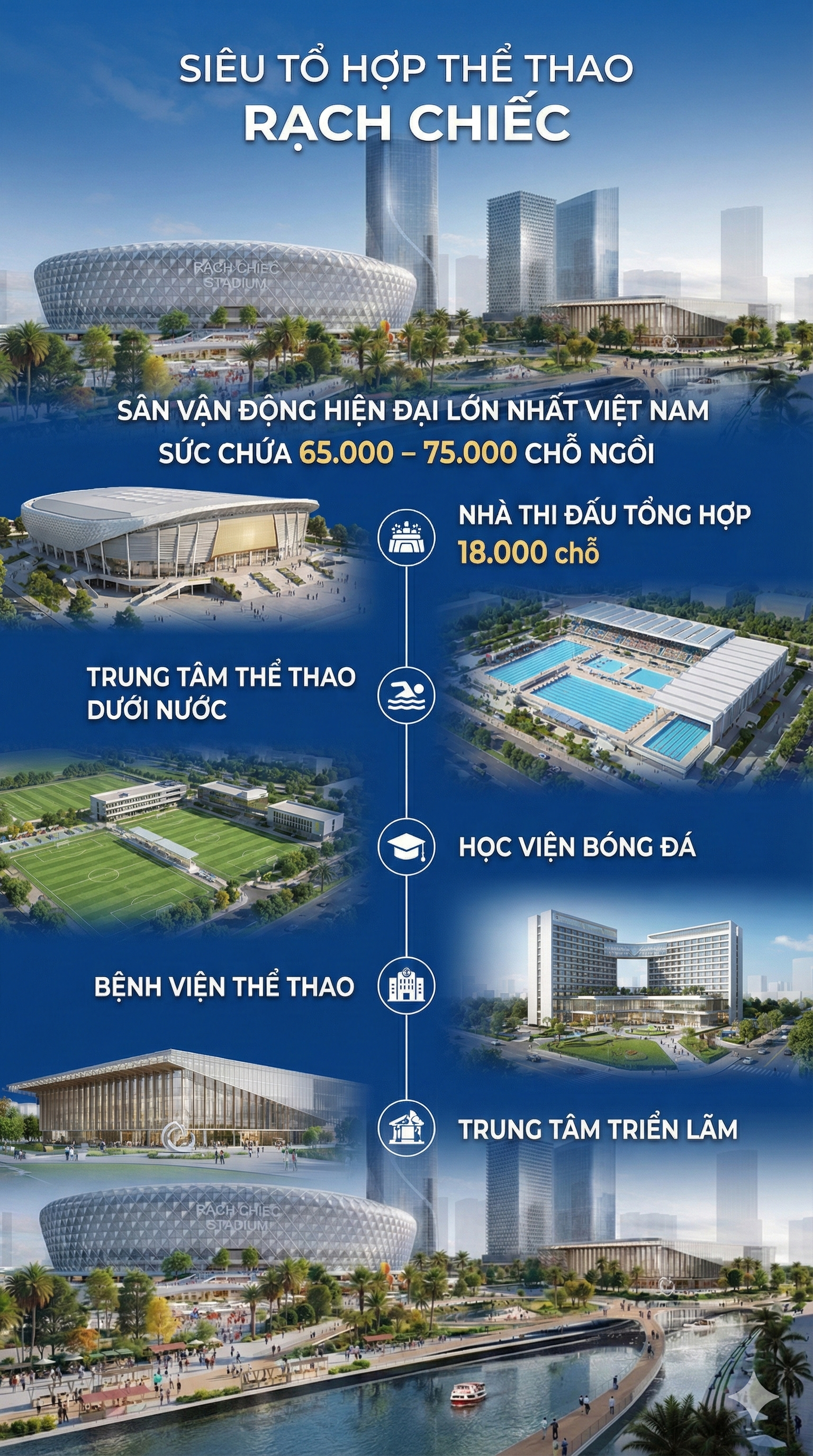
The project is slated for completion within 7–8 years. Notably, the surrounding area is already developing into the Saigon Sports City Urban Area, laying the foundation for a large-scale “sports-service-urban cluster.” This positions the area to host regional events like the SEA Games and Asiad, as well as international competitions.
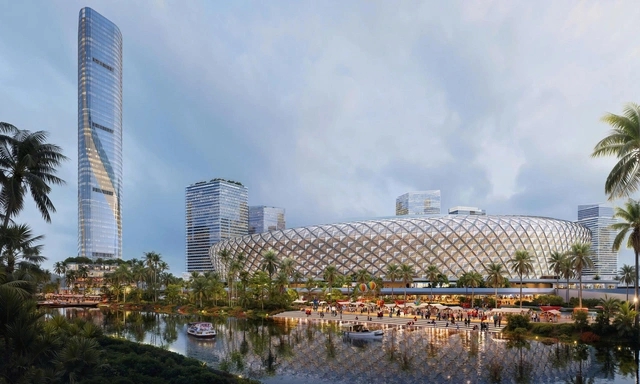
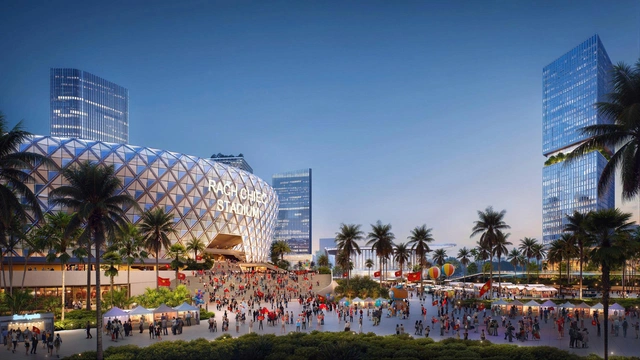
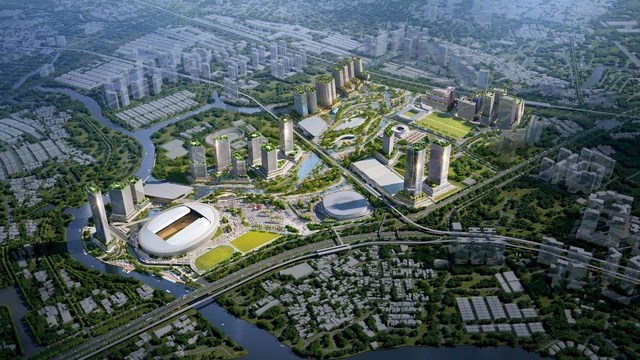
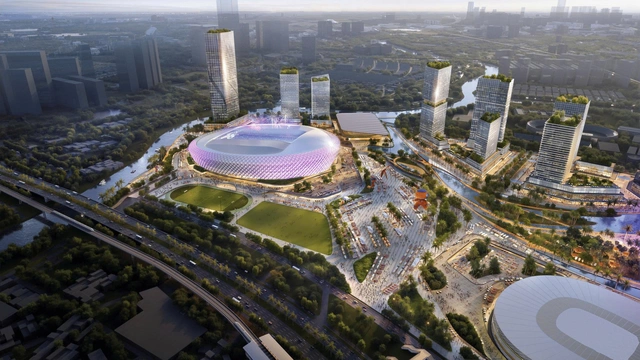
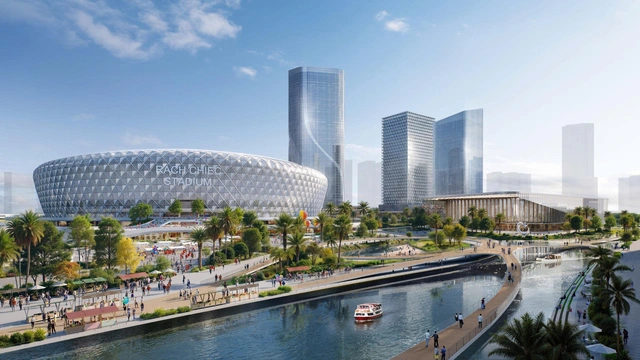
Official rendering of Rach Chiec Stadium. Photo: Developer
Under the new proposal, the project will proceed as a PPP, specifically a BT (Build-Transfer) contract under the special mechanism outlined in Resolution 98/2023/QH15 of the National Assembly. This resolution pilots unique policies for Ho Chi Minh City’s development.
The proposed investor is Sun Group’s Vung Tau Sun Company, which plans to self-finance 100% of the construction costs. In return, Ho Chi Minh City will compensate with approximately 360 hectares of land across four different areas, rather than direct budget payments.
The revival of the Rach Chiec project, alongside Metro Line 2, Can Gio Bridge, and Phu My 2 Bridge, is expected to significantly enhance infrastructure, alleviate traffic congestion, expand development space, and elevate Ho Chi Minh City’s urban landscape in the new era.
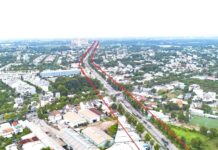
What Has Become of Hanoi’s 6,000-Billion-VND Southern Arterial Road After 18 Years of Construction?
Anticipated to alleviate congestion at the gateway to the capital, the 6-trillion-VND South Hanoi Arterial Road project has finally materialized after 18 years of challenges. The next 7 kilometers are expected to open to traffic before the Lunar New Year of the Horse.
Massive Infrastructure Boost: 4 Projects Totaling Nearly $10 Billion Set to Break Ground Tomorrow in Ho Chi Minh City
On January 15th, Ho Chi Minh City celebrated the commencement of four major infrastructure and transportation projects, with a combined investment of nearly 240 trillion VND, marking a significant milestone in the city’s development and coinciding with the Party Congress.
New Developments in Vingroup’s Proposed $4.3 Billion Maritime Route Connecting Can Gio and Vung Tau
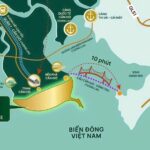
The Ho Chi Minh City People’s Committee has established an Appraisal Council for the pre-feasibility report of the Can Gio – Ba Ria – Vung Tau sea-crossing road project, to be developed under a Public-Private Partnership (PPP) model.
Ho Chi Minh City to Build $430 Million Overpass: Connecting Highways, Ring Roads, and Easing Southern Gateway Congestion
The People’s Committee of Ho Chi Minh City has officially approved the architectural design competition results for the main overpass component of the North-South Axis Road Upgrade Project (spanning from Nguyen Van Linh Street to the Ben Luc – Long Thanh Expressway), as part of Component Project 2.
Masterise Group Launches Historic Can Gio Bridge Construction, Ending Binh Khanh Ferry Monopoly and Opening New Maritime Access for Ho Chi Minh City Residents
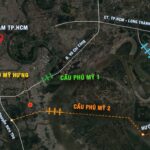
The Cần Giờ Bridge will span the lush islet between the Soài Rạp and Chà rivers, seamlessly connecting to Phú Xuân Commune in Nhà Bè District. From this point, residents of Ho Chi Minh City can effortlessly travel to District 7 or the heart of District 1 via Huỳnh Tấn Phát Street.