




Nha Trang Bay stands as one of Vietnam’s most biodiverse marine regions, boasting unique ecosystems that foster a rich array of marine microorganisms. Among these, marine fungi have emerged as a focal point for scientific exploration, given their potential to benefit human life across medicine, pharmacology, and agriculture.
Marine fungi are often referred to as a “treasure trove of natural compounds,” particularly those found on seaweed, such as species from the genera Aspergillus and Penicillium. These fungi produce bioactive substances with antimicrobial, antioxidant, and anticancer properties, making them invaluable for scientific research.
Recognizing this potential, MSc. Ngô Thị Duy Ngọc and her team at the Institute of Oceanography (Vietnam Academy of Science and Technology) initiated a study to identify natural compounds from Nha Trang Bay’s marine fungi capable of protecting cells, specifically cardiac muscle cells.
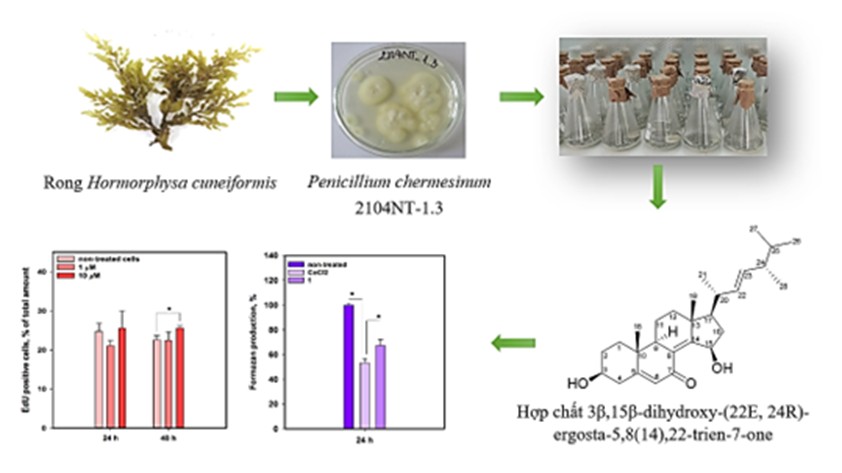
Research schematic: Extraction of 3β,15β-dihydroxy-(22E, 24R)-ergosta-5,8(14),22-trien-7-one from Penicillium chermesinum 2104NT-1.3, demonstrating cardioprotective activity in H9c2 cardiomyocytes.
During the study, the team collected eight seaweed samples and isolated 47 distinct fungal strains. Preliminary findings revealed that most strains exhibited potent antioxidant activity, a critical factor in cellular protection against oxidative stress.
Notably, several strains demonstrated the ability to safeguard cardiomyocytes from toxin-induced damage. Among these, Penicillium chermesinum, isolated from a common brown seaweed in Nha Trang Bay, showed the most promising results and was selected for further investigation.
From this strain, researchers extracted and identified four natural compounds. One compound, in particular, exhibited unprecedented potential to protect cardiomyocytes from hypoxia-induced injury—a common issue in cardiovascular diseases. Additionally, it promoted cell recovery by stimulating cardiomyocyte growth and regeneration.
The research team highlights that these findings pave the way for developing marine fungal compounds into therapeutic agents for cardiovascular diseases, especially those involving ischemia and oxidative stress.
The study’s results have been published in both domestic and international scientific journals and featured in a monograph on marine fungi of Central Vietnam. All 47 isolated fungal strains have been preserved in the Institute of Oceanography’s Marine Microorganism Collection, providing a valuable resource for future research and contributing to the sustainable conservation of marine biodiversity.
“Vinpearl Granted Extension for Submersible Vessel Services in Nha Trang Bay until March 2025”
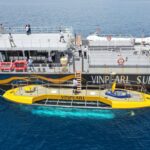
Vice Prime Minister Tran Hong Ha has approved the extension of the pilot program for submarine tours in Nha Trang Bay. The decision was formalized in Document No. 724/TTg-CN, issued on September 28, 2024.