Infrastructure Expansion and Urban Planning Outpace Housing Market Development
Over the past five years, Ca Mau has witnessed a significant wave of investment in transportation infrastructure and regional connectivity. A prime example is the Can Tho – Ca Mau Expressway, which is accelerating towards completion, aiming to reduce travel time between Ca Mau and major economic hubs in the Mekong Delta and Southern regions. Simultaneously, key arterial roads such as National Highway 1A, National Highway 63, the coastal route, and the provincial road network are being upgraded, enhancing connectivity and facilitating trade.
Beyond regional infrastructure, urban beautification projects in Ca Mau City and central areas are progressing systematically. Numerous inner-city streets, including Nguyen Tat Thanh, Tran Hung Dao, and Ly Thuong Kiet, are undergoing sidewalk renovations, drainage improvements, and lighting upgrades, gradually elevating the urban living environment to match the city’s new development pace.
However, despite these infrastructure and urban aesthetic advancements, Ca Mau’s real estate market still lacks high-quality housing options. The current supply primarily consists of individual houses, small land plots, and limited-scale projects, with a shortage of well-planned urban developments featuring integrated infrastructure, amenities, and landscaping. Core elements of modern living, such as parks, community facilities, shared spaces, and diverse housing types, remain scarce.
Meanwhile, with the growth of industrial zones, seafood processing, logistics, and service sectors, the influx of high-skilled labor, technical experts, project managers, and foreign specialists settling in Ca Mau is increasing. Most of these residents currently rely on rented individual houses or informal housing solutions, lacking integrated amenities and a cohesive living environment. This highlights a pressing demand for high-standard urban developments.
Supply Gap and Opportunities for Well-Planned Urban Projects
The disparity between the rapidly improving infrastructure and the lagging housing quality has created a significant gap in Ca Mau’s real estate market. In recent years, the province has launched several social housing and worker housing projects, such as the 1,241-unit complex in An Xuyên Ward, expected to accommodate nearly 5,000 residents upon completion. Additionally, plans to develop approximately 2,600 social housing units by 2030 demonstrate efforts to address basic housing needs for the workforce.
Nevertheless, large-scale urban projects offering high-quality living environments, integrated amenities, and modern infrastructure remain insufficient to meet actual demand. This gap presents an opportunity for well-planned urban developments to take a leading role, not only in addressing housing needs but also in enhancing Ca Mau’s urban landscape during this new development phase.
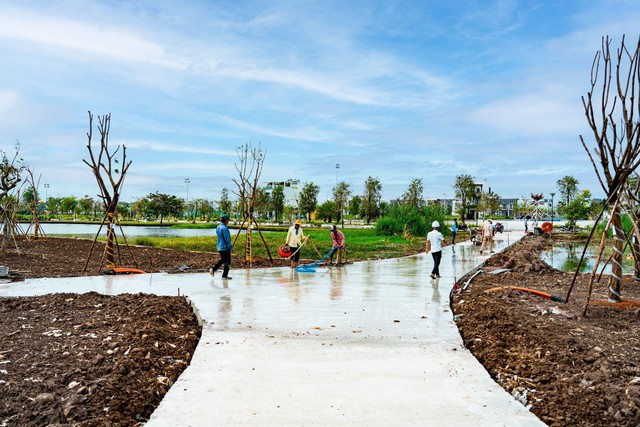
Happy Home Ca Mau Urban Area is in the final stages of internal infrastructure development.
At this stage, Happy Home Ca Mau Urban Area is showing positive momentum. Following planning reviews and adjustments, the project is focusing on completing internal infrastructure, enhancing landscaping, and implementing community amenities according to a clear timeline.
Happy Home Ca Mau is designed as an integrated urban development, emphasizing modern living spaces, community amenities, and seamless internal and external connectivity. Notably, the project is revitalizing a 12.5-hectare central park, improving walkways, and creating shared spaces, establishing a focal point from the early stages.
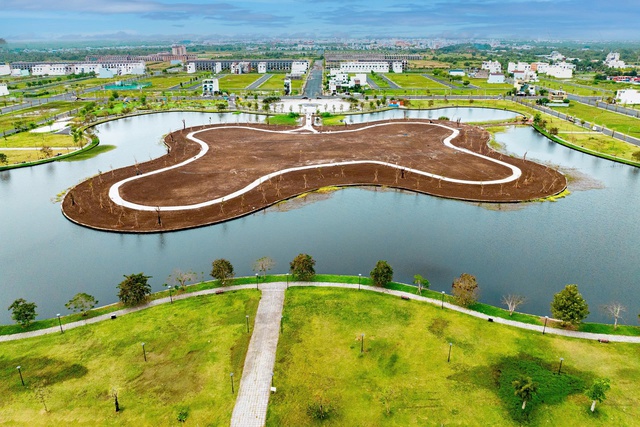
The central park is being revitalized to foster community living for residents.
Alongside the central park, internal roads, drainage systems, scenic routes, and community amenities are being developed in phases. These efforts demonstrate that Happy Home Ca Mau is not merely providing housing but is creating a vibrant urban living space, aligned with long-term residency trends for locals, high-skilled workers, and foreign experts.
According to industry experts, the current focus on infrastructure and living environment development is a prudent approach, suited to the current market conditions. This lays a solid foundation for urban projects like Happy Home Ca Mau to play a vital role in shaping Ca Mau’s urban development in the years to come.
Luxury Villa and Townhouse Prices in Hanoi Surge Past $30,000/m²
In West Hanoi, villa prices remain steady at $14,000–$16,000 per square meter, with select luxury projects surpassing $30,000 per square meter. Meanwhile, in the East Hanoi area along Ring Road 2–3, terraced houses typically range from $7,200 to $8,800 per square meter, while villas fluctuate between $10,000 and $12,800 per square meter.
Which Areas in Hanoi Are Forecast to Be the “Hotspots” for Investment in 2026?

According to Mrs. Đỗ Thị Thu Hằng, areas such as Đông Anh and Tây Hà Nội are emerging as highly promising destinations in the near future, benefiting directly from the ring roads and cross-city connectivity axes. Meanwhile, the medium-term outlook is gradually shifting southward, expanding opportunities across the city.
Chinese Conglomerate Leader Expresses Unique Aspiration After Partnering with Vingroup on Tu Lien Bridge and Securing Major Projects in Vietnam

China’s leading construction conglomerate has set its sights on a transformative investment in Ca Mau, Vietnam, with a commitment to inject a minimum of VND 130 trillion over the next five years. This ambitious plan underscores the group’s dedication to making a lasting impact on the region’s development and infrastructure.
Ho Chi Minh City Seeks Strategic Investor for Binh Quoi – Thanh Da Urban Development Project
Ho Chi Minh City has officially issued a document outlining the selection process for strategic investors in the new urban area of Binh Quoi – Thanh Da, spanning over 400 hectares. This initiative is being implemented under the special mechanism of Resolution 260 by the National Assembly.
Exciting News for Homebuyers in Bac Ninh
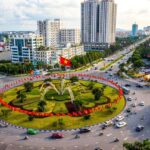
In the coming period, Bac Ninh is set to welcome a wave of new urban developments and social housing projects, significantly expanding the housing supply across the region.