The Vietnamese automobile market in 2025 witnessed significant fluctuations in the B-segment sedan category. According to data compiled by the Vietnam Automobile Manufacturers’ Association (VAMA) and Xe Nhật Thành Công, a total of 38,939 B-class sedans were sold throughout the year. This figure represents a 16% decline compared to the same period in 2024.
Two out of the top three best-selling models in 2025 were familiar names from Japanese brands. Specifically:
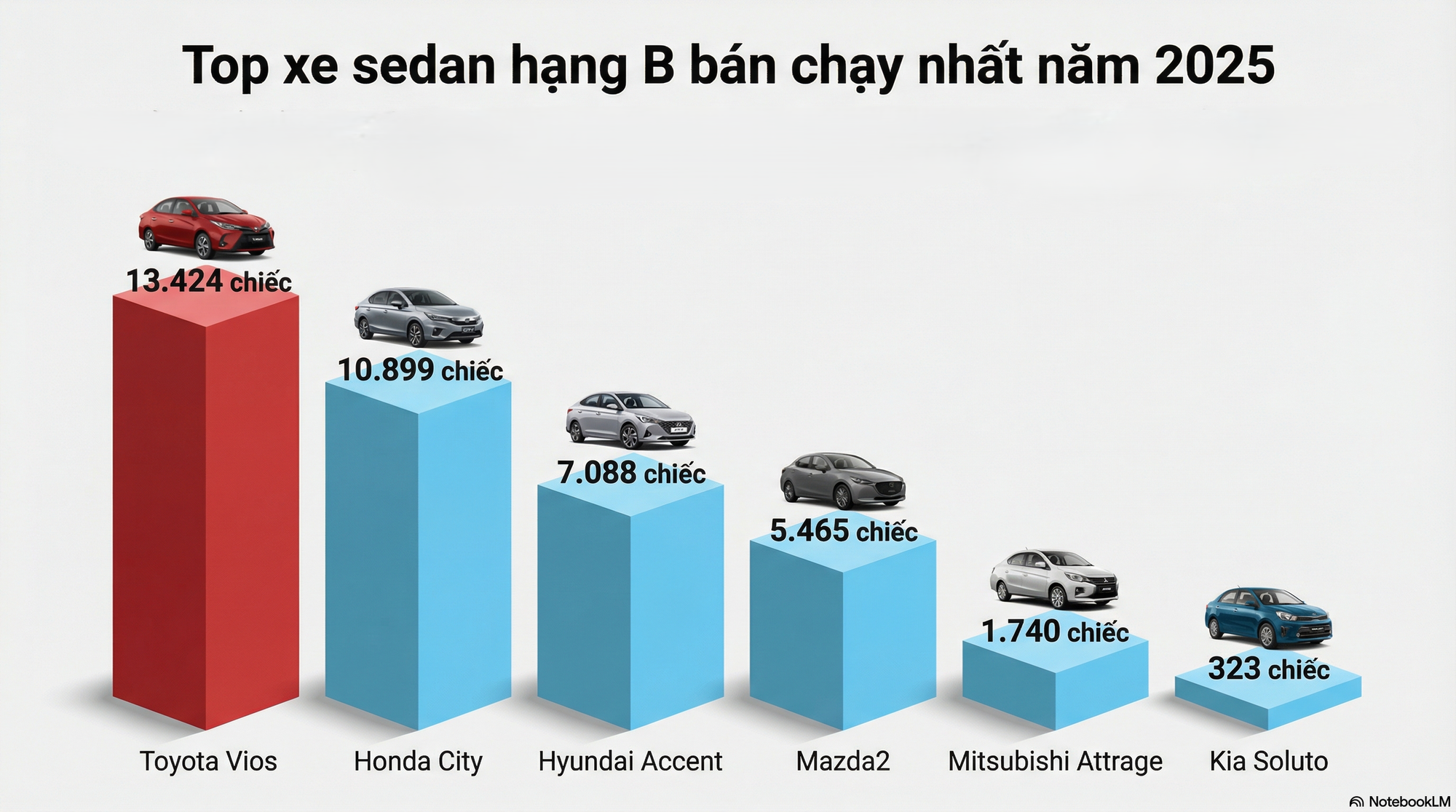
Toyota Vios ended 2025 as the segment leader, achieving total sales of 13,424 units. This model maintained consistent sales throughout the year, with monthly figures consistently exceeding 1,000 units from May onwards. In December alone, Toyota’s sedan recorded its highest monthly sales of the year, reaching 1,972 units. Despite retaining the top position, Vios’s total sales were still below the 14,000-unit mark achieved in 2024.
Honda City also made notable strides in this year’s rankings. With 10,899 units delivered to customers, it secured the second position in the segment. Honda City maintained steady performance, with sales remaining relatively flat compared to the previous year. During the second half of 2025, the model consistently sold over 1,000 units monthly, narrowing the sales gap with Vios to just a few hundred units at certain points.
In contrast, Hyundai Accent experienced a sales decline. The model sold only 7,088 units in 2025, less than half of Vios’s total. Compared to 2024, Accent’s sales plummeted by nearly 50%. After a stable start in the first few months, the South Korean model’s sales began to decline from the third quarter, with monthly figures dropping to between 300 and 500 units.
Among other contenders, Mazda2 maintained a stable customer base, selling 5,465 units—a slight increase from 2024 despite the segment’s overall decline. Meanwhile, models like Mitsubishi Attrage and Kia Soluto struggled to attract buyers. Both models sold fewer than 2,000 units for the year, with Attrage reaching 1,740 units and Soluto only managing 323 units.
Market trends in 2025 highlight a shift in consumer preference toward Japanese brands. While models like Vios, City, and Mazda2 maintained or slightly grew their market share, South Korean representatives lost ground. The segment’s 16% decline, amidst record-breaking overall market sales, underscores the waning popularity of sedans in Vietnam, as consumers increasingly favor high-clearance, multi-purpose vehicles.
Additionally, the rise of electric vehicles like VinFast’s VF 5 and VF 6 has further squeezed the market share of B-class sedans, which traditionally relied heavily on service-oriented buyers and first-time car-buying families.
Honda Vietnam, Dominating 83% of the Motorcycle Market, Seeks Support for Eco-Friendly Production and Usage

Honda Vietnam currently holds approximately 83% of the motorcycle market share and 9% of the automobile market share in Vietnam, contributing over 11,880 billion VND to the state budget in 2025.
Toyota Revolutionizes Electric Vehicles: Transforming EVs into Grid Power Generators – Here’s How

Toyota is pioneering bidirectional charging technology through pilot projects, enabling electric vehicles to supply power back to the grid during emergencies.
VinFast, Brainchild of Pham Nhat Vuong, Celebrates Positive News from Strategic Market

Just four months after entering the Indian market, VinFast has surpassed the 1,000-vehicle sales milestone.
Why Car Supply is Rising While Consumer Demand Remains Weak

Chinese automobiles are flooding the market, yet consumer uptake remains disappointingly low.
VinFast Shatters Records: Delivers 175,000 Vehicles in Landmark Year

This marks an unprecedented record in Vietnam’s automotive market, surpassing even the previous benchmark set by a foreign car manufacturer by a twofold margin.