To assess the five-year implementation results and their impact on workers, and to propose necessary improvements and amendments, the Vietnam General Confederation of Labor (VGCL) organized a scientific seminar titled “Evaluating Five Years of Implementing the 2019 Labor Code” on January 15-16 in Hanoi.
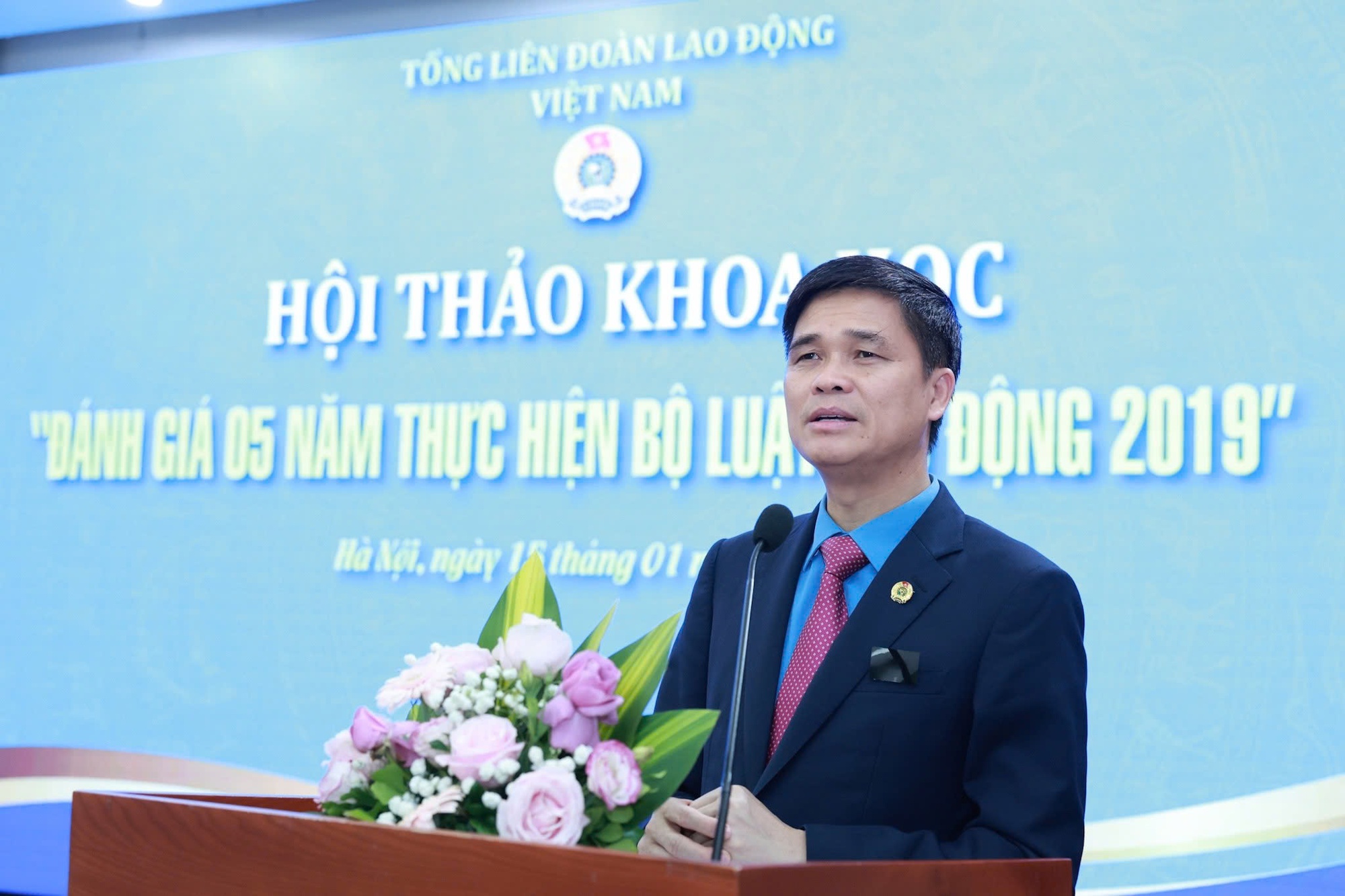
Mr. Ngo Duy Hieu, Vice Chairman of VGCL, speaking at the seminar. Photo: Hai Nguyen
According to Mr. Ngo Duy Hieu, Vice Chairman of VGCL, the 2019 Labor Code, effective from January 1, 2021, introduced several progressive and groundbreaking changes. These include expanding its scope to cover workers without formal employment relationships, enhancing flexibility in labor contract negotiations, execution, and termination, promoting wage flexibility through dialogue and negotiation, and introducing more adaptable regulations on working hours, rest periods, and overtime.
Despite these achievements, the evolving context over the past five years has highlighted the need for further evaluation and refinement of the 2019 Labor Code. Mr. Hieu emphasized that rapid advancements in science and technology will significantly impact the workforce and labor relations, altering the nature of work and management practices. This necessitates a more flexible and modern legal framework for labor.
VGCL leaders noted that economic development and international integration are driving significant changes, requiring a fairer approach to workers’ rights regarding wages, bonuses, social security, and working conditions. As Vietnam deepens its global integration, it must align with international labor standards, particularly the conventions of the International Labour Organization (ILO).
“Through practical implementation, the 2019 Labor Code has revealed certain limitations that require review and improvement,” stated Mr. Ngo Duy Hieu.
Working Hours and Rest Periods: A Right, Not a Benefit
During the seminar, experts discussed critical issues related to workers’ rights, including working hours, rest periods, minimum wage regulations, gender equality in labor laws, labor contract improvements, and dispute resolution mechanisms.
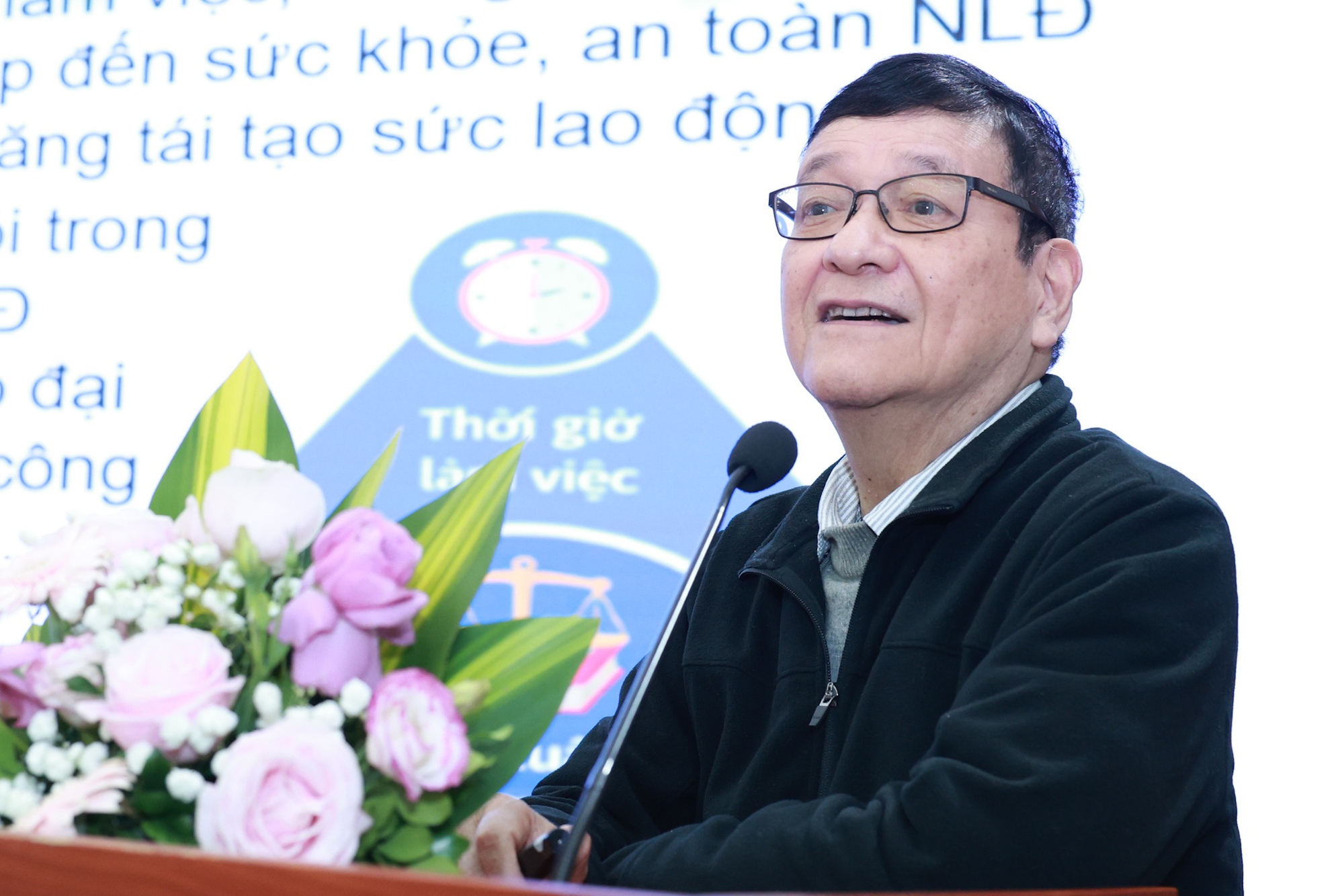
Prof. Le Van Trinh, Chairman of the Occupational Safety and Health Association, proposed reducing standard working hours from 48 to 44 hours weekly, eventually targeting 40 hours. Photo: Hai Nguyen
Prof. Le Van Trinh, Chairman of the Occupational Safety and Health Association, proposed a gradual reduction in standard working hours from 48 to 44 hours per week, with a long-term goal of 40 hours, aligning with international trends and Vietnam’s development. He also advocated for stricter enforcement of break times and annual leave to prevent accidents and health deterioration. “Working hours and rest periods are workers’ rights, not mere benefits,” Prof. Trinh asserted.
Mr. Nguyen Huy Khanh, Vice Chairman of the Hanoi Confederation of Labor, suggested revising the minimum hourly wage regulations. For instance, if the government encourages a 40-hour workweek, the maximum monthly hours would be 160. The minimum hourly wage could be calculated by dividing the monthly minimum wage by 160, ensuring fair compensation based on productivity and work quality.
Dr. Pham Thi Thu Lan, former Vice Director of the Institute for Workers and Trade Unions, emphasized the need to define “a living minimum wage suitable for each period” in the revised 2019 Labor Code. The current law’s omission of “a living wage” has led to minimum wage calculations aimed at poverty alleviation rather than meeting evolving living standards. “The upcoming revision should explicitly state ‘a living minimum wage suitable for each period’ to ensure regular adjustments based on appropriate components for each era,” Dr. Lan argued.