Stratospheric Air Wind Energy System (SAWES) S2000, the world’s first megawatt-scale airborne wind energy system designed for urban areas, successfully completed its maiden test flight in Yibin, Sichuan Province, southwestern China, as reported by the Global Times on January 6th.
First Flight “Harvesting Electricity from the Sky”
During the trial, the system ascended steadily to an altitude of approximately 2,000 meters, generating 385 kilowatt-hours of electricity directly fed into the local power grid. This test marked the first time the S2000 airborne wind energy system, or SAWES, demonstrated its ability to produce electricity under real-world conditions.
Invented and designed by Beijing Linyi Yunchuan Energy Technology Company, the S2000 is the world’s first megawatt-scale airborne wind power system intended for use near urban areas.
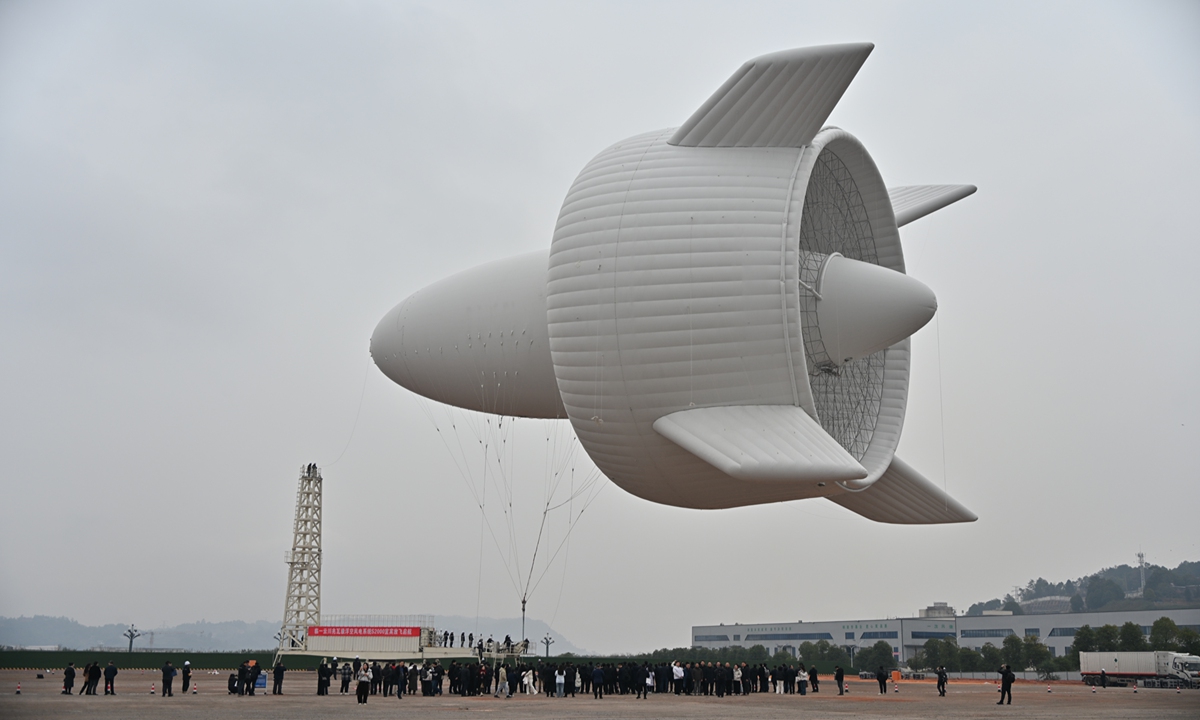
The Stratospheric Air Wind Energy System S2000 (SAWES) – the world’s first urban megawatt-scale wind power system – completed its test flight on January 5, 2026. Photo: Tao Mingyang/Global Times
Visually, the S2000 resembles a fairytale hot air balloon, featuring a large envelope floating above the ground with an integrated power generation structure. The system measures approximately 60 meters in length, 40 meters in width, and 40 meters in height.
According to the Global Times, during the Yibin trial, the S2000 took about 30 minutes to ascend. Once it reached the target altitude, it maintained stable hovering while operating the power generation equipment, a critical milestone for future commercial deployment.
How Does S2000 Capture High-Altitude Winds?
As explained by Weng Hanke, Chief Technology Officer at Linyi Yunchuan, the S2000 system relies on a helium-filled balloon to lift a lightweight wind turbine generator to higher atmospheric layers. At these altitudes, winds are typically stronger and more consistent than those near the ground.
After takeoff, the system converts wind energy into electricity, transmitting it back to the ground via a tether cable. This cable also helps control the rig’s position and stability during operation. This method allows the system to access wind resources that conventional ground-based turbines cannot reach.
Weng Hanke noted that the company is targeting two primary use cases. “One is for off-grid areas like border outposts, where it can serve as a relatively stable traditional energy source. The other is to complement existing ground-based wind systems, creating a three-dimensional approach to energy supply.”
Smart Design Enhances Efficiency and Output
Research cited by Tide News shows that wind energy increases with the cube of wind speed. This means even small increases in wind speed at higher altitudes can result in exponentially greater electricity production compared to ground-based turbines, while maintaining low carbon emissions and environmental friendliness.
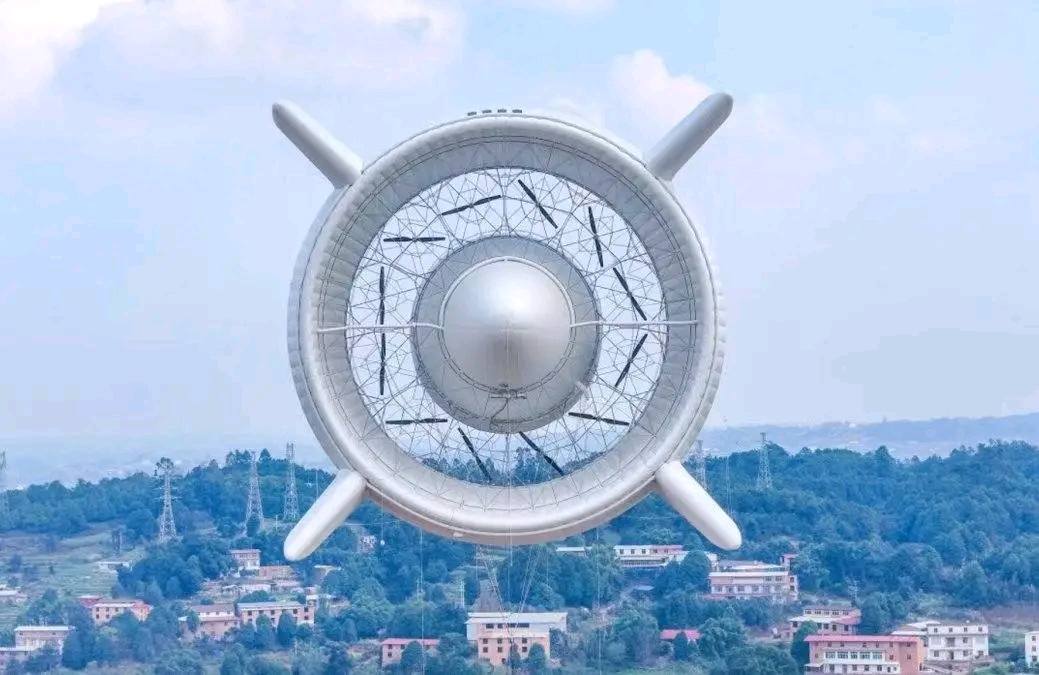
To maximize this advantage, the S2000 employs a duct design to concentrate airflow. The duct, formed by the space between the main envelope and the ring-shaped wing, channels and compresses wind before it reaches the turbines, enhancing overall energy capture efficiency.
“It’s like wrapping the wind from all sides, confining the airflow within this duct to capture as much wind as possible by the blades. We’ve installed 12 wind turbines on this duct,” Weng Hanke told Hunan TV.
Thanks to its aerodynamic design and a total volume of nearly 20,000 cubic meters, the system boasts a maximum rated capacity of up to 3 megawatts, according to company data.
According to China’s National Energy Administration, as of November 2025, the country’s total installed power generation capacity reached 3.79 trillion kilowatts, up 17.1% year-on-year. Installed wind power capacity reached 600 million kilowatts, up 22.4% year-on-year.
Weng Hanke emphasized that the key to commercializing the SAWES lies in whether the costs of production, deployment, retrieval, and power transmission from the airborne system can be offset—or even surpassed—by the electricity it generates.