Scientists in the United States are tackling a colossal engineering challenge: constructing massive super-cooled vessels to hold liquid argon for a pivotal physics experiment. The task at hand is to contain over 15,000 tons of liquid argon at a chilling -186 degrees Celsius.
A Critical Experiment
This endeavor is part of the Deep Underground Neutrino Experiment (DUNE), a groundbreaking project where detectors will be submerged in gigantic tanks of frozen liquid argon, positioned deep underground. Liquid argon is an odorless, colorless rare gas denser than air, comprising approximately 1% of Earth’s atmosphere.
“By placing the DUNE detectors underground in South Dakota, they will significantly reduce cosmic background radiation,” explains Vincent Basque, a researcher at Fermilab.
“This allows us to study neutrinos sent from Fermilab’s beam in Illinois with high precision, detect neutrinos from astrophysical sources like the sun or a nearby supernova, and search for other extremely rare processes.”
The team also highlights that DUNE is the most sensitive experiment ever conceived to explore the origins of the universe through the properties of neutrinos, the first particles emitted after the Big Bang.
The experiment must shield its particle detectors from the constant cosmic rays bombarding Earth, which would otherwise overwhelm the relatively weak signals it aims to capture. Thus, DUNE researchers will construct and operate these detectors at the Sanford Underground Research Facility in Lead, South Dakota, beneath a mile of rock that will absorb most cosmic rays.
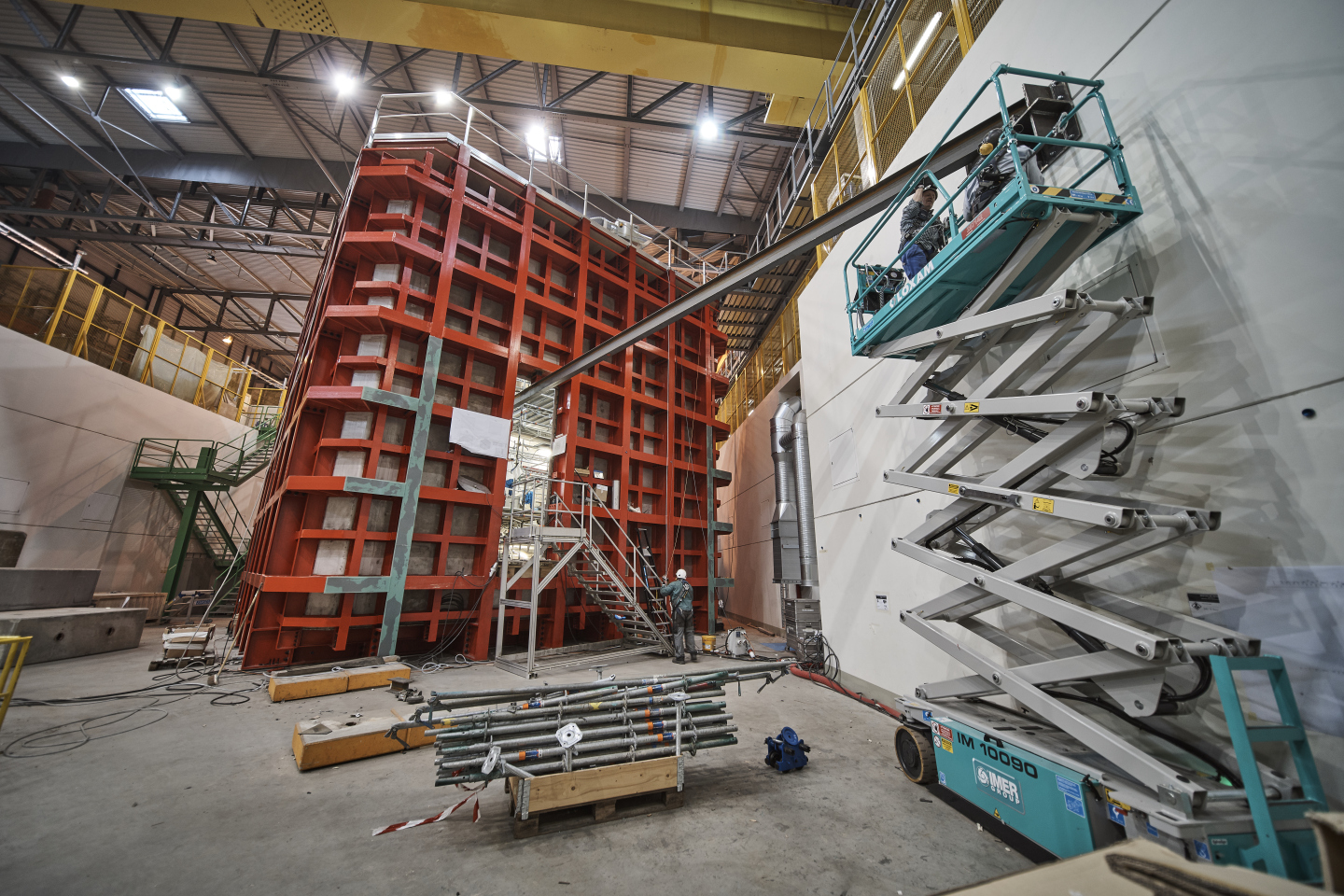
The team is currently preparing to install two multi-kiloton detector modules using variations of liquid argon time projection chamber (LArTPC) technology. International partners hope to contribute two additional modules in the coming years. Each module will be housed in a cryostat, a thermally insulated vessel approximately 14,158 cubic meters in size—roughly equivalent to five Olympic swimming pools.
5,000 Individual Pieces
Rather than being available at local hardware stores, CERN has contracted GTT, a company specializing in designing cryogenic equipment for transporting liquefied natural gas, to engineer these vessels. GTT has designed smaller cryogenic systems for CERN experiments since 2007. CERN, Europe’s largest nuclear research center and a collaborator in the DUNE project, is contributing the cryostats for the experiment.
“This is the first time we’ve undertaken a project of this magnitude,” says Lluís Miralles Verge, head of the cryogenic system project team at CERN. “The DUNE LArTPC cryostats will be installed in caverns accessible only via a deep tunnel. To achieve this, we require meticulous design and logistics planning.”
The team reveals that to ensure complete liquid and vapor tightness, in addition to proper insulation and support structures, the DUNE cryostats are constructed in multiple layers.
GTT’s proven membrane cryostat design features an inner membrane layer to contain the liquefied gas. All components will be transported down the shaft in pieces and assembled within the detector cavern, starting with the outer structure. Completing the interior sections of the DUNE cryostats requires over 5,000 individual pieces.
“The DUNE prototypes at CERN are invaluable,” notes David Montanari, DUNE cryogenic system project manager. “They’ve demonstrated that the sensor components, cryogenic vessels, and cooling systems work together seamlessly, giving us confidence that the remote DUNE detector’s cryogenic system will operate flawlessly.”