What is Stopping and Parking a Vehicle?
According to Article 18 of the 2024 Traffic Order and Safety Law, stopping and parking a vehicle are defined as follows:
– Stopping a vehicle refers to the temporary stationary state of a vehicle for the necessary time to allow passengers to board or alight, load or unload cargo, inspect the vehicle’s technical condition, or perform other activities.
When stopping, the engine must remain on, and the driver must not leave the driver’s seat, except to close or open the vehicle door, load or unload cargo, or inspect the vehicle’s technical condition. In such cases, the parking brake must be engaged or other safety measures must be taken.
– Parking a vehicle refers to the stationary state of a vehicle without any time limit. When parking, the driver may only leave the vehicle after engaging the parking brake or taking other safety measures. On slopes, the vehicle must be turned toward the curb, and the wheels must be chocked.
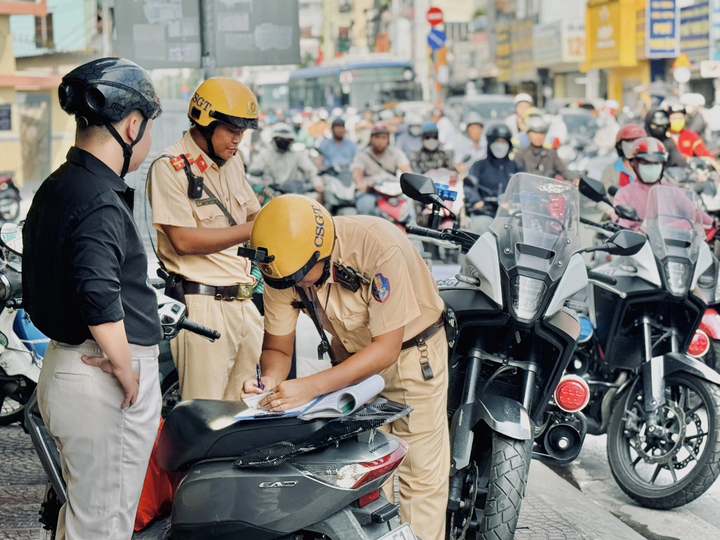
Illegal parking of motorcycles on sidewalks incurs a fine of 400,000 – 600,000 VND.
– When stopping or parking on the road, drivers must comply with the following regulations:
+ Signal to inform other road users when entering or exiting a stopping or parking position;
+ Avoid obstructing pedestrians and other vehicles.
– Drivers are prohibited from stopping or parking in the following locations:
+ On the left side of a one-way street;
+ On curves or near the top of hills with obstructed visibility;
+ On bridges, except where permitted by traffic organization;
+ Under overpasses, except in designated stopping or parking areas;
+ Parallel to another vehicle already stopped or parked on the road;
+ Within 20 meters of a vehicle parked in the opposite direction on narrow streets, or within 40 meters on roads with one lane for motor vehicles in one direction;
+ In pedestrian crossings;
+ Within 5 meters of an intersection or road junction;
+ At passenger pick-up or drop-off points;
+ Within 5 meters of the entrance or exit of an organization’s premises with a designated access road;
+ On road sections with width sufficient for only one lane of motor vehicles;
+ Within the safety zone of a railway;
+ Blocking road signs or traffic signals;
+ On roads designated for buses, over drainage manholes, telephone or high-voltage cable chambers, fire hydrant access points, or on road surfaces and sidewalks in violation of the law.
– On highways, drivers may only stop or park on the road shoulder or in areas outside the carriageway. If the shoulder is narrow or non-existent, vehicles must be stopped or parked as close as possible to the right edge of the road in the direction of travel.
– On urban roads, drivers may only stop or park on the right side of the road or sidewalk in the direction of travel. The nearest wheel must not be more than 0.25 meters from the curb or sidewalk and must not obstruct or endanger other road users.
– In case of technical failure or other unavoidable circumstances requiring parking that occupies part of the carriageway or is in a prohibited area, drivers must use emergency lights or place warning signs behind the vehicle to alert other road users.
Penalties for Illegal Motorcycle Parking
The fine for illegal motorcycle parking on sidewalks in 2026 is based on Article 7, Clause 2(d) of Decree 168/2024/NĐ-CP, which states:
Fines and license point deductions for motorcycle drivers violating traffic regulations…
2. A fine of 400,000 to 600,000 VND is imposed for the following violations:
a) Stopping or parking on the carriageway of non-urban roads with a shoulder;
b) Exceeding the speed limit by 5 to 10 km/h;
c) Driving too slowly without keeping to the right side of the road, causing obstruction;
d) Stopping or parking on the road in a manner that obstructs traffic; gathering three or more vehicles on the road or in a tunnel; parking or leaving vehicles on the road or sidewalk illegally.
Thus, illegal parking of motorcycles on sidewalks results in a fine of 400,000 to 600,000 VND.
Illegal parking on sidewalks not only causes inconvenience and safety hazards to the community but also leads to heavy fines for violators. To avoid violations and act responsibly toward the community, everyone must raise awareness and strictly adhere to traffic regulations.
What Does the Traffic Police Department Say About the Regulation Requiring Child Seats for Children Under 10 in Cars?

According to the Traffic Police Department, recommendations for using child car seats have been in place for many years, and many drivers have already complied.