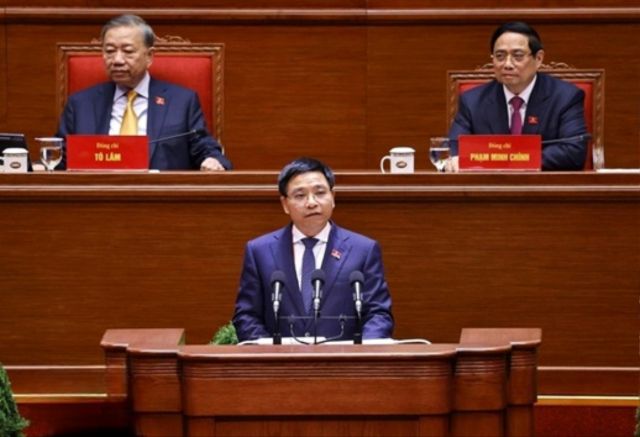
Minister of Finance Nguyen Van Thang presenting his speech – Photo: TTXVN
|
On the afternoon of January 21st, continuing the discussion session on the documents of the 14th National Congress of the Party, on behalf of the Party Committee of the Ministry of Finance, Party Central Committee Member, Secretary of the Party Committee, and Minister of Finance Nguyen Van Thang presented a discussion on “Perfecting institutions and laws on mobilizing and utilizing financial resources to meet the requirements of rapid and sustainable national development.” This aims to further clarify the strategic breakthrough solutions in perfecting institutions to unlock all resources and realize the nation’s development aspirations in the new phase.
Creating strong and comprehensive changes in building and perfecting institutions
According to Minister Nguyen Van Thang, the 13th Party Congress continues to identify institutional breakthroughs as one of the three strategic breakthroughs, emphasizing the role of institutional perfection in guiding national development. Specifically: “Continue to strongly renew thinking, build, and perfect synchronous institutions for sustainable development in economics, politics, culture, society, and the environment… promptly remove difficulties and obstacles; unleash all potentials and resources, creating new momentum for the rapid and sustainable development of the country.”
In Resolution No. 66-NQ/TW, the Politburo continues to emphasize that building and enforcing the law is “the breakthrough of breakthroughs,” a key task that needs to be one step ahead to pave the way for national development in the new era.
Implementing these directives, the Party Committee of the Ministry of Finance has led the entire sector to concentrate the highest resources, renew thinking, and create strong and comprehensive changes in building and perfecting institutions.
The Ministry of Finance has submitted to the Politburo for the issuance of Resolution No. 68-NQ/TW on private economic development and Resolution No. 79-NQ/TW on state-owned economic development. It has also submitted for issuance and issued under its authority 929 legal normative documents, including 65 laws and resolutions of the National Assembly, to remove bottlenecks, meet new development requirements, and enhance the competitiveness of the economy, focusing on three main areas:
First, creating a business investment environment, unlocking all social resources, and improving capital efficiency through fundamental and synchronous amendments to laws on investment, state-owned enterprise capital management, and planning. Maximizing the reduction of business conditions, promoting decentralization, and empowering localities and enterprises, ensuring the principle that enterprises are allowed to do what the law does not prohibit.
Reforming and simplifying administrative procedures, modernizing management to enhance state management efficiency, reduce time and costs, and maximize convenience for citizens and businesses. Resolving prolonged stalled projects and building a legal framework linked to new economic models such as free trade zones and new-generation industrial parks.
Second, mobilizing and effectively using national financial resources: Advising on the perfection of the tax legal system towards simplicity, modernity, and alignment with international practices; shifting thinking from “management” to “service,” linked to comprehensive digital transformation and artificial intelligence (AI) application.
This has mobilized the largest-ever resources for the state budget while maximizing tax exemptions, reductions, extensions, and deferrals to support the recovery and development of businesses during and after the COVID-19 pandemic. It helps nurture revenue sources and guides the development of priority areas to restructure the economy, innovate the growth model, and strive for digital economy development to reach at least 30% of GDP by 2030 according to Resolution 57 of the Politburo.
Third, developing the capital market and creating a framework for new economic models, proactively building a synchronous legal framework aligned with the development trends of the times.
New economic models such as the International Financial Center, securities market development, pilot cryptocurrency market, free trade zones, and new-generation industrial parks with tax investment incentives aim to attract high-quality foreign investment and enhance internal capacity and competitiveness. This promotes rapid and sustainable development linked to digital and green transformation.
Establishing a controlled trial mechanism for new business models to ensure safe and transparent development. Under the Party’s leadership, with the participation of the entire political system from central to local levels, and the support of the people and business community, financial and budgetary institutions have contributed to the nation’s achievements as reported to the Congress.
Notably, the registered capital of enterprises increased by 37.6% compared to 2020; state budget revenue for the entire period is estimated at nearly 9.9 million billion VND, exceeding the target and 1.4 times higher than the previous term. Total public investment capital reached about 3.4 million billion VND, an increase of nearly 55% compared to the previous term.
The stock market was upgraded, with market capitalization increasing 1.9 times compared to 2020. The International Financial Center and new-generation free trade zones were established and put into operation.
Concentrating the highest resources to remove bottlenecks
Alongside the achievements, with a spirit of “self-reflection and self-correction,” the Party Committee of the Ministry of Finance seriously recognizes that there are still some “bottlenecks” that need to be further addressed in the coming time.
First, how to ensure that financial and budgetary laws keep pace with the requirements of the scientific and technological revolution.
Second, uneven policy implementation capacity, with some issues being resolved slowly and inefficient capital use.
Third, the scale of the capital market is not yet commensurate with its true potential and has not become the main medium and long-term capital mobilization channel for the economy.
The 2026-2030 period is when our country accelerates, breaks through, and enters a new era to realize the aspiration of becoming a developed, high-income country by 2045.
The Party Committee of the Ministry of Finance highly agrees with the goals, visions, directions, and key tasks for the 2026-2030 period outlined in the draft Resolution, especially the goal of an average GDP growth rate of 10% or higher, ensuring sustainable development. GDP per capita by 2030 is expected to reach about 8,500 USD, with total social investment capital averaging about 40% of GDP.
Focusing on comprehensive and synchronous institutional perfection for rapid and sustainable national development
To realize these goals, the draft Resolution identifies the task of focusing on comprehensive and synchronous institutional perfection for rapid and sustainable national development, with economic institutions as the core.
This is a mandate for the finance sector to continue renewing thinking, methods, and taking more decisive actions in building and perfecting institutions to mobilize and use financial resources more effectively, meeting the requirements of rapid and sustainable national development. This focuses on six key task groups.
First, advising on the issuance of all guiding documents, new laws, and resolutions approved by the National Assembly in the first quarter of 2026, as directed by the General Secretary, to quickly bring the Party’s breakthrough policies into life.
Second, advising on the institutionalization and effective implementation of Party resolutions on the development of economic sectors, turning development aspirations into actions and specific results. This includes strongly restructuring governance and capital in state-owned enterprises to enhance operational efficiency, especially in investment projects, ensuring both financial efficiency and guiding roles.
Affirming and promoting the leading role of the state-owned economy, developing the private sector into a key driver of the economy, supporting the development and market expansion of the collective economy and cooperatives, and attracting and effectively using foreign investment. This builds and strengthens a solid foundation for development, enhancing strategic autonomy and comprehensive national strength in the new era.
Third, continuing to perfect and implement an expanded fiscal policy with focus and priorities, closely and harmoniously coordinated with monetary and other policies to ensure high growth targets, financial security, and macroeconomic stability.
Continuing to restructure and improve public investment efficiency, concentrating resources on breakthrough, transformative, and situation-changing projects. Applying economic thinking in selecting and implementing each project, ensuring that the number of projects using central budget capital nationwide does not exceed 3,000, to attract and guide investment resources from other economic sectors.
Fourth, developing a deep, modern, and integrated securities market as the main medium and long-term capital mobilization channel for the economy, effectively attracting international investment funds. Continuing to perfect the legal framework for new economic models and financial products such as knowledge-based economy, circular economy, carbon market, green bonds, and digital assets.
Fifth, regularly reviewing and comprehensively evaluating the effectiveness of issued policies to promptly perfect them according to development requirements, thoroughly removing bottlenecks and effectively implementing planning with a long-term vision.
Strengthening regional and sectoral linkages, applying and digitizing the entire public service process in the financial sector, minimizing administrative procedures and unreasonable business conditions. Ensuring a transparent and fair competitive environment to create development momentum, forming growth poles, key economic regions, and new-generation special economic zones on par with regional and global standards.
Sixth, continuing to strengthen policy communication, propaganda, dissemination, and law enforcement to bring policies into life, creating consensus among the people and business community. Closely linking law-making and enforcement, enhancing policy implementation discipline.
To successfully achieve the strategic goals of the 14th Party Congress, the Party Committee of the Ministry of Finance commits and affirms the highest political determination, continuously striving to promote collective intelligence, unity, and creative innovation in law-making and enforcement. This aims to build a stable and synchronous financial and budgetary policy system.
Additionally, proactively creating space for new growth drivers to break through, contributing to the nation’s entry into a new era of national aspirations for peace, independence, democracy, prosperity, civilization, happiness, and steady progress toward socialism.
– 20:10 21/01/2026
Digital Assets from 2026 and Beyond: Proactive Integration, Risk Management, and Development for National Interests

Starting in 2026, the central challenge will no longer be whether to develop the digital asset market, but rather how to do so in a way that maximizes innovative potential while ensuring absolute systemic security, safeguarding the legitimate rights of citizens, and maintaining national financial stability.
2026 Investment Outlook: Real Estate Sector – Unlocking Massive Growth Potential (Part 2)
A robust influx of FDI is transforming gateway provinces into investment hotspots. Coupled with a plentiful supply of standout projects, this trend is poised to fuel significant growth in the industrial real estate sector in the coming period.
WinCommerce Targets 764 New Stores, Aims for $1.6 Billion Revenue by 2025

In 2025, WinCommerce, a Masan Group subsidiary and the powerhouse behind WinMart supermarkets and WinMart+/WiN convenience stores, reached a pivotal milestone.
Belgian CEO Embraces “I Am Hai Phong,” Forecasts Unstoppable Growth in Vietnam’s Sector for Next 7-10 Years

Mr. Bruno Jaspaert proactively persuaded the EU delegation to stay in Hai Phong instead of opting for an overnight stop in a nearby coastal city, allowing them to immerse themselves in the local experience.
Upcoming Launch of the International Financial Center in Vietnam
Prime Minister emphasizes the need for Ho Chi Minh City and Da Nang to clearly define their roles and complement each other in the operation of the International Financial Center.