Over 113 years after the Titanic tragedy, American scientists have developed truly “unsinkable” metal tubes—ordinary aluminum transformed to float indefinitely, even when punctured with large holes, submerged for extended periods, or subjected to the harsh, turbulent conditions of the open sea.
This breakthrough marks the closest realization yet of the dream of an “unsinkable ship,” a vision humanity has cherished since that fateful April day in 1912.
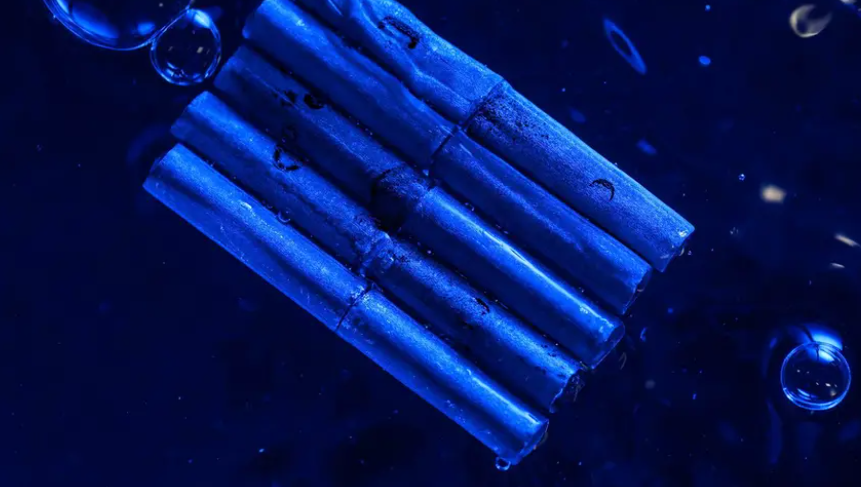
Image by University of Rochester / J. Adam Fenster
Led by Chunlei Guo, a professor of optics and physics and senior scientist at the University of Rochester’s Laboratory for Laser Energetics, the research team used lasers to etch microscopic patterns onto the inner surface of aluminum tubes, creating countless micro and nano-scale indentations.
This surface becomes superhydrophobic, repelling water rather than absorbing it. When submerged, the tubes automatically retain a stable air pocket, similar to how water striders or fire ants create floating rafts during floods. This air pocket is the key to their continuous buoyancy, requiring no external pumping mechanisms.
The most significant innovation lies in the intelligent design. By adding a central partition, the air pocket remains trapped even when the tube is pushed vertically, flipped, or vigorously shaken. Previous superhydrophobic discs by the same team lost stability when tilted excessively, but the tubular shape and partition have completely transformed their performance.
The tubes were tested for weeks in wave-simulating environments mimicking the open sea—their buoyancy remained unaffected. Even when punctured with multiple holes, they continued to float, as the air pocket was retained in undamaged sections. When multiple tubes are combined, they support each other with remarkable efficiency.
This contrasts sharply with the Titanic, once deemed “unsinkable” but reliant on watertight compartments. When its hull was breached, water flooded multiple compartments, causing it to sink rapidly.
Now, this new technology turns a weakness into a strength: the more holes it has, the more it floats, thanks to its natural air-retaining mechanism, which doesn’t depend on perfect sealing.
The potential applications of this floating metal are vast. Assembled into large rafts, they could serve as foundations for safer ships, floating bridges, offshore oil rigs, or durable buoys.
Notably, these rafts move naturally with ocean waves, opening possibilities for attaching wave energy generators—a clean, sustainable power source. The technology is scalable and applicable to various metals and sizes.
Published in Advanced Functional Materials, this invention, though still in the lab phase, represents one of the most practical and promising approaches to turning the century-old dream of an “unsinkable ship” into a tangible technical reality.