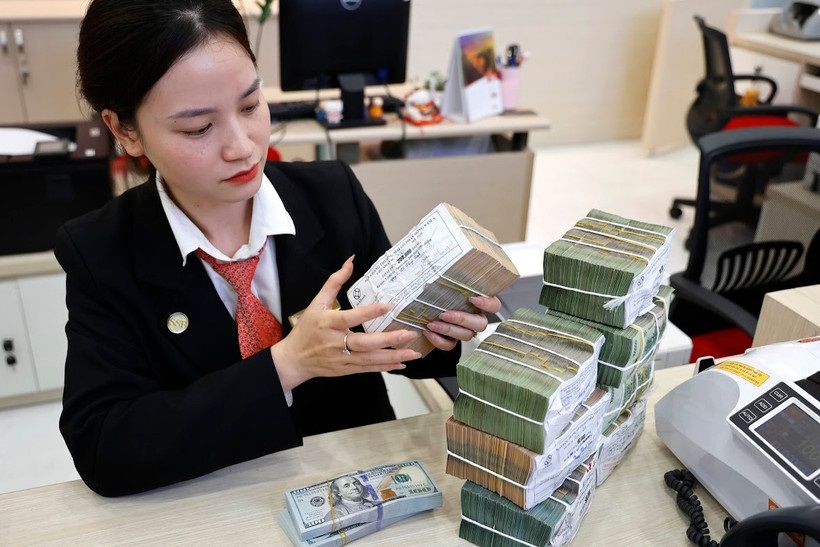
Signals from the wave of increased deposit interest rates. (Photo: Vietnam+)
|
The deposit market has continued to heat up since the beginning of the year, with numerous commercial banks adjusting their savings interest rates upward, particularly for medium and long-term deposits. This development reflects the growing pressure on system liquidity amidst faster credit growth compared to mobilization, ushering in a new cycle of interest rate adjustments.
According to experts, the impact of the rising deposit interest rate wave is twofold: it both supports banks in consolidating capital and poses significant challenges regarding capital costs and lending rates in 2026.
The race to attract deposits heats up again
The competition for idle capital among residents has escalated, with many banks aggressively raising savings interest rates to their highest levels in months. Several banks have listed rates exceeding 7.5%/year, even reaching 8%-9%/year for large deposits or online deposits, setting a new interest rate benchmark in the market.
ABBank was among the early adjusters, increasing deposit rates across various terms. Notably, the online deposit rate for a 6-month term reached 6.5%/year, with an additional 1.2%/year during the promotional period, bringing the effective interest rate to 7.7%/year.
NCB went even further, offering an additional 2%/year for customers making online savings deposits with terms of 6 months or more, applicable until January 31, 2026. Consequently, the 6-8 month term rate reached 8.2%/year; the 9-11 month term rose to 8.25%/year; and the 12-36 month term stood at 8.3%/year.
Additionally, several other banks, including VPBank, MSB, Bac A Bank, LPBank, VCBNeo, BaoViet Bank, and MBV, have collectively adjusted their rates upward by 0.3%-0.5%/year, indicating that the trend is no longer localized but has spread across the entire market.
Commenting on the wave of increased deposit interest rates, Professor Tran Ngoc Tho (University of Economics Ho Chi Minh City) noted that this race is occurring with clear segmentation. Smaller banks with limited mobilization capacity, low non-term deposit ratios (CASA), or weaker brands are forced to offer higher rates, often accompanied by additional interest programs for online deposits or daily deposits.
According to Mr. Tho, the effective interest rates at many banks have been pushed to the 6.7%-6.8%/year range for common terms, with some reaching 7.6%-8%/year depending on the branch and deposit amount. The core reason is that liquidity competition is gradually turning into a survival competition, as some banks must retain cash flow amidst restructuring pressures and the need to rebuild market confidence.
Moreover, as mobilization costs rise faster than asset repricing, banks’ net interest margins (NIM) are narrowing. Under normal conditions, banks can compensate by increasing lending rates. However, the current lending rate adjustment room is limited by three factors: businesses’ tolerance, macroeconomic stability goals, and intense competition in credit activities.
Notably, since late December 2025, all four state-owned commercial banks—the Big4—have collectively adjusted their interest rate schedules upward. According to Mr. Tran Ngoc Tho, this move indicates that competition is no longer confined to joint-stock banks but has extended to the market-leading “giants.”
The Big4’s interest rate hike not only strongly attracts residents’ deposits but also reflects the banking system’s growing demand for medium and long-term capital. This signals that interest rates are unlikely to return to the low levels of the previous period.

Experts believe that interest rates are entering a selective adjustment phase after a long period of low rates. (Photo: Vietnam+)
|
Economist Le Xuan Nghia predicts that deposit interest rates will struggle to maintain current levels and are likely to rise by an additional 0.5%/year in 2026. The primary reason is the pressure from the gap between credit growth and capital mobilization at commercial banks.
Some other experts also believe that interest rates are entering a selective adjustment phase after a long period of low rates. This adjustment reflects a new economic cycle, where capital demand is recovering more clearly, while ensuring liquidity safety and capital balance is increasingly prioritized.
Will lending rates remain unchanged?
Alongside the rise in deposit interest rates, lending rates in the market are also beginning to inch upward. Many banks have increased lending rates by 1%-2%/year compared to the end of 2025.
To date, over 20 banks have announced their average lending rates for December 2025. Most recorded increases compared to the previous month and the beginning of the year, aligning with the recent surge in deposit interest rates.
Among the Big4, except for VietinBank, the other three banks—Agribank, Vietcombank, and BIDV—all reported higher average lending rates in December 2025 compared to the previous month. Agribank’s average lending rate was 6.93%/year, up 0.24% from the previous month and 0.13% from the beginning of the year. Vietcombank recorded 5.8%/year, up 0.1% from November 2025 and the beginning of the year, while BIDV reached 5.6%/year, up 0.13% from the previous month but slightly down from the beginning of the year.
 Market-wide credit growth in the first six months remained high at 10%. (Photo: Vietnam+)
|
In the private banking sector, GPBank led in average lending rate increases compared to January 2025, rising by 2.13%/year. Following were LPBank, Techcombank, BVBank, Sacombank, and ACB. Conversely, some banks like PGBank, OCB, Viet A Bank, Saigonbank, and BaoViet Bank recorded declines in average lending rates compared to the beginning of the year.
Average lending rates reflect the general trend of credit levels at commercial banks but do not fully capture the interest rates applied to specific loans.
Experts argue that the upward trend in lending rates is an inevitable consequence of the deposit interest rate hike wave since late 2025, amidst significantly faster credit growth compared to mobilization. According to the State Bank, by the end of 2025, credit grew by about 19%, while capital mobilization increased by only 14.1%, placing significant pressure on system liquidity.
In 2026, the State Bank plans to target credit growth at around 15%, with flexible adjustments based on actual developments, to control inflation, stabilize the macroeconomy, and ensure the safety of credit institutions.
VDSC Securities also forecasts that lending rates will gradually rise to a new level following the increase in deposit interest rates. Except for preferential credit packages directed by the Government, such as social housing loans, low-interest programs are likely to narrow, or applicable interest rates will be higher than before./.
Thuy Ha
– 14:27 22/01/2026
Billion-Dollar Profits Announced by Major Banks

Banks with robust business operations and high profitability enjoy greater lending capacity, providing more flexibility to maintain stable interest rates.
What is the Highest Savings Interest Rate at Military Bank (MB) in January 2026 After the Recent Surge?

Following a significant surge in December 2025, MB Bank now offers the highest savings interest rate of 6.4% per annum. This rate applies to individual customers depositing 1 billion VND or more at branches in the Central and Southern regions, with terms ranging from 24 to 60 months and interest paid at maturity. Meanwhile, for branches in other regions, the highest rate currently stands at 6.3% per annum.
What Are the Concerns When Loan Interest Rates Rise?
As interest rates on deposits rise, lending rates across banks are also establishing a new baseline. According to experts, interest rates are unlikely to reverse and surge significantly in 2026, as the State Bank remains committed to maintaining stability to support economic growth.
Vietnam’s Economy in 2026: Navigating Tight Credit Margins and Fiscal Pivot to Drive Growth

In 2026, Vietnam embarks on a pivotal phase with the launch of its Socio-Economic Development Plan for 2026–2030, a period critical to sustaining high and sustainable growth. Amid this backdrop, macroeconomic policy management faces a complex challenge: balancing growth support with macroeconomic stability, inflation control, and financial system resilience.
Massive Capital Inflow Returns: Brokerages Highlight Stocks Poised for January Breakout
The formation of a higher low price structure indicates that institutional money has begun re-entering the market, providing crucial support and reigniting investor interest.