The Ministry of Construction has recently submitted a proposal to businesses regarding the Ho Chi Minh City – Can Tho – Ca Mau railway project. Prior to this, the Ministry received two proposals from businesses concerning the investment in a railway line connecting Ho Chi Minh City with the Mekong Delta region.
According to the Ministry of Construction, the Can Tho – Ca Mau section of this railway has been approved by the Prime Minister and included in the adjusted Railway Network Plan for the 2021-2030 period, with a vision towards 2050, as per Decision No. 2404/QD-TTg dated October 29, 2025. The Ministry is prepared to schedule a meeting with investors to discuss the project in detail and clarify the proposals.
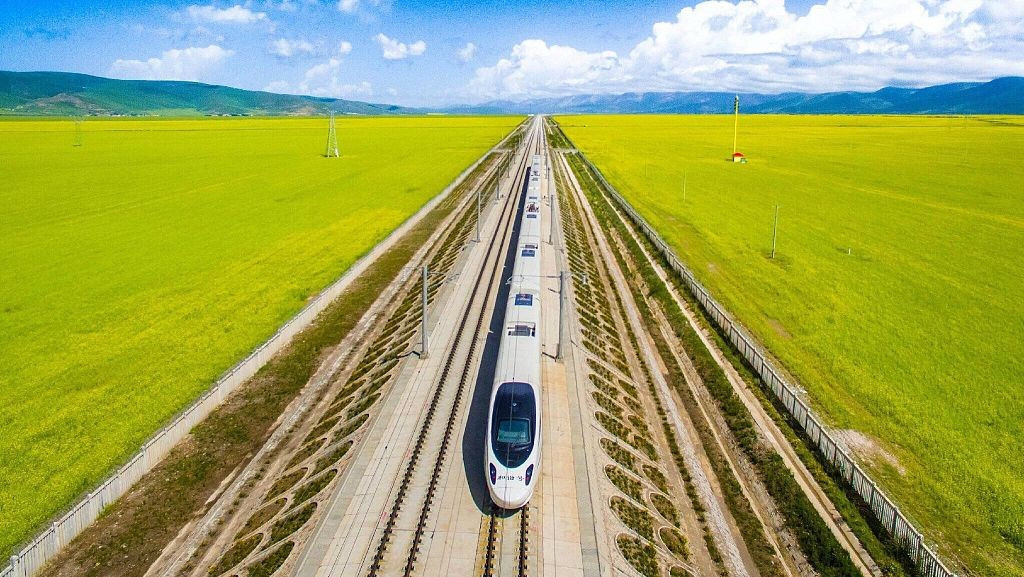 The Ministry of Construction has received two proposals from businesses regarding the high-speed railway project connecting Ho Chi Minh City, Can Tho, and Ca Mau. Illustrative image: CGTN.
|
The proposed railway line is expected to start at Thu Thiem Station in Ho Chi Minh City, connecting with the North-South railway line, and end at Dat Mui Station in Ca Mau. The route will pass through six provinces, including Ho Chi Minh City, Dong Thap, Vinh Long, Can Tho, An Giang, and Ca Mau, and is anticipated to drive new development in the Dong Thap Muoi region and the Long Xuyen Quadrangle.
Technically, the businesses propose a double-track, electrified railway with a gauge of 1,435 mm, accommodating both passenger and freight trains, and a design speed of 200-250 km/h. They are also considering a speed range of 300-350 km/h. The businesses believe that a speed range of 200-250 km/h is optimal for ensuring efficient passenger transport while meeting freight demands on this critical regional connection.
 Businesses propose a design speed of 200-250 km/h for the Ho Chi Minh City – Can Tho – Ca Mau railway. Illustrative image: Asia Train.
|
Regarding the Ho Chi Minh City – Can Tho section, the Ministry of Construction notes that this is a new national railway project with a large scale and significant investment. The Ministry has assigned the My Thuan Project Management Board to prepare a pre-feasibility study report.
Preliminary research indicates that the line will start at An Binh Station in Di An City, Binh Duong Province (now part of Ho Chi Minh City), and end at Can Tho Station in Hung Phu Ward, Can Tho City, with a total length of over 175 km, passing through five provinces: Ho Chi Minh City, Tay Ninh, Dong Thap, Vinh Long, and Can Tho.
The study proposes a new mixed-use passenger and freight railway with a gauge of 1,435 mm, electrification, and an operating speed of approximately 160 km/h. The preliminary investment for Phase 1 is estimated at over 173,640 billion VND (equivalent to 7.16 billion USD), including compensation, support, and resettlement costs of around 45,675 billion VND, with contingencies included.
Phase 2 is expected to require an additional 64,970 billion VND (equivalent to 2.7 billion USD, excluding financial costs), bringing the total project investment to approximately 238,616 billion VND, or 9.84 billion USD.
|
According to the Railway Network Plan for the 2021-2030 period, with a vision towards 2050, by 2030, Vietnam will have 11 new railway lines in addition to the existing 7 lines, with a total length of approximately 3,207 km, an increase of 2 lines compared to the previous plan. In the upcoming phase, the government prioritizes investment in the North-South high-speed railway, the Lao Cai – Hanoi – Hai Phong and Bien Hoa – Vung Tau lines, and the development of lines connecting seaports, airports, and the two major transport hubs of Hanoi and Ho Chi Minh City. The total land requirement for railway development by 2030 is estimated at nearly 21,887 hectares, with a total investment of around 1,540 trillion VND, sourced from the state budget, non-state funds, and other legal channels. |
Lộc Liên
– 13:02 25/01/2026
Urgent Review and Upgrade Proposals for Phased-Investment Highways: Ministry of Construction’s Call to Action

The Ministry of Construction is urging local authorities, businesses, and relevant investors to submit their review documents and investment proposals by February 6, 2026. These submissions should outline plans to upgrade and complete existing and ongoing expressway projects that, despite being developed in phases, currently fail to meet national technical standards for highways.
Leadership Shakeup at Vietnam Airports Corporation

Vietnam Airlines Corporation (ACV) has announced changes to its Board of Directors. Mr. Dao Viet Dung has been relieved of his position as a Board member to focus on his role as the dedicated Deputy Secretary of ACV’s Party Committee. Concurrently, Mr. Nguyen Tien Viet, Deputy General Director of ACV, has been appointed as a new member of the Board of Directors.
Ministry of Construction Responds to 13 Businesses Seeking Participation in North-South High-Speed Railway Project

The Ministry of Construction has recently issued an official response to businesses regarding their proposals to participate in the implementation of the North-South High-Speed Railway Project.
Unveiling the Capabilities of the New Developer Behind the $67 Billion North-South High-Speed Rail Megaproject

The new investor behind the $67 billion high-speed rail megaproject is a subsidiary of the Ministry of Construction.
Vietnam’s $16 Billion Mega-Project Sees New Developments, Related Stocks Surge
Vietnam Airlines Corporation has been appointed as the lead investor for Phase 2 of the Long Thanh International Airport project.