The Land Registration Office under Ho Chi Minh City’s Department of Agriculture and Rural Development (DARD) has issued a public advisory regarding essential considerations for real estate transactions.
According to the Land Registration Office, investigations by the Ho Chi Minh City Police Department into recent real estate-related cases have revealed that many residents remain unaware of critical legal requirements when engaging in property transactions.
Specifically, numerous individuals have voluntarily entered into transactions involving mortgages, collateral, or transfers of land use rights for projects lacking official land ownership certificates. These transactions often rely solely on preliminary agreements, internal memorandums, payment receipts, developer confirmations, verbal assurances, or unregistered brokers.
A common issue is the confusion between “legally recognized land use rights” and “actual possession and use,” leading to misplaced trust in the legal validity of incomplete project land. Consequently, residents risk significant assets and funds in transactions for projects not yet eligible for transfer, resulting in prolonged civil disputes.
Of particular concern are residential projects developed by infrastructure companies, where delayed issuance of land ownership certificates has facilitated underground transactions, exposing participants to severe legal risks.
 Launch event of a residential project in Ho Chi Minh City. Photo: K.0 |
To mitigate violations and protect residents, the Ho Chi Minh City Land Registration Office emphasizes three key points:
First, under Article 45 of the 2024 Land Law, land users may only exercise rights such as transfer, lease, mortgage, inheritance, donation, or capital contribution through land use rights if all legal conditions are met. These include holding a valid Certificate of Land Use Rights; absence of unresolved disputes; no seizure or enforcement measures; validity within the usage period; and no temporary restrictive measures.
For developers transferring land with completed infrastructure in real estate projects, additional compliance with the Law on Real Estate Business and the Housing Law is mandatory.
Second, when conducting real estate transactions, residents must thoroughly verify legal conditions to minimize risks. This involves cross-checking actual land details (area, location, purpose, term, encumbrances, disputes, zoning, or seizures) against the Certificate of Land Use Rights.
For project land, due diligence on the developer’s legal status, technical infrastructure, transfer eligibility, and regulatory compliance documents is essential. Future housing purchases require official notices confirming sale eligibility. Transactions must use standardized, notarized contracts with timely registration of changes.
Third, many housing projects lacking legal clearance are still marketed by developers or secondary investors through deposits, reservations, preliminary agreements, capital contributions, or informal arrangements.
Due to limited financial capacity, some developers proceed with transactions despite incomplete land allocation or financial obligations, violating regulations. Such agreements offer minimal legal protection, exposing buyers to risks like unissued certificates, prolonged disputes, and difficulty recovering payments.
By Anh Phương
– 09:41 29/01/2026
SIP Closes 2025 with Record-High Results, Lending Over 4.9 Trillion VND to Partners
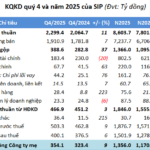
Despite lacking explosive growth, SIP concluded 2025 with record-high business results, driven by steady increases in its utility and industrial park segments, both of which significantly surpassed initial targets.
Groundbreaking Ceremony for Nationally Accredited School Funded by Corporate Sponsorship in Thuận Giao Ward

On January 28, 2026, the groundbreaking ceremony for Binh Chuan 3 Primary School was held in Thuan Giao Ward, Ho Chi Minh City. This project is implemented through a public-private partnership, fully funded and executed by Phat Dat Real Estate Development Corporation (HOSE: PDR), with a total investment value of approximately 145 billion VND. The aim is to construct a modern primary school that meets national standards, gradually aligning with international benchmarks.
Ho Chi Minh City Officially Launches Condominium Management and Operation Association

The Homeowners’ Community Management Organization (HCMO) serves as the vital bridge between policy and residents, proactively mitigating potential disputes within communities.
HoREA Proposes Airbnb Management in Condominiums: What’s New Compared to Previous Regulations?

HoREA has moved beyond merely suggesting the regulation of short-term apartment rentals over outright bans. Instead, they are advocating for the explicit inclusion of a detailed management mechanism within the decree guiding the Housing Law, ensuring uniform application nationwide.
Ho Chi Minh City Continues to Apply Land Price Table Under the 2024 Land Law Pending the Issuance of Coefficient K

While awaiting the issuance of the new land price adjustment coefficient, Ho Chi Minh City will continue to apply the current Land Price Table for calculating land use fees and financial obligations, ensuring the rights and interests of both citizens and businesses.