In a January 28, 2026 submission regarding amendments to Decree 95/2024/ND-CP, the Ho Chi Minh City Real Estate Association (HoREA) proposed adding a dedicated chapter on the management of short-term apartment rentals for accommodation purposes. This chapter would outline specific conditions, responsibilities, and oversight mechanisms.
This marks a significant shift from previous recommendations, which primarily highlighted practical challenges and advocated for “regulation over prohibition.”
Central to HoREA’s position is its interpretation of the purpose of condominium use. The association repeatedly emphasizes that the 2023 Housing Law only prohibits using condominiums for “non-residential purposes,” while short-term tenants still use the units for living, differing only in the duration of their stay.
In a May 2025 document submitted to authorities, HoREA cited the Ministry of Justice’s Legal Document Review Board, which deemed the prohibition of rentals under 30 days “illogical and legally unsound,” as long-term rentals are permitted. The board argued that “property owners who do not reside in their units have the right to rent them out, a right protected under the Civil Code.”
This interpretation was reinforced by the Ministry of Construction in late 2024, which clarified that current laws do not prohibit property owners from renting out residential units, including through platforms like Airbnb, provided they meet legal requirements for housing and tourism accommodation services.
However, since Decision 26/2025/QD-UBND took effect in Ho Chi Minh City in late February 2025, most condominium management boards have enforced a complete ban on short-term stays, effectively halting Airbnb operations.
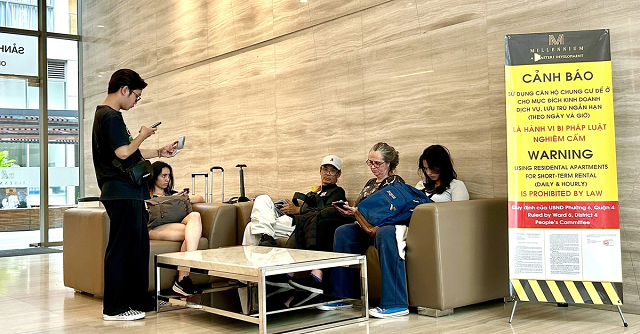
Numerous Ho Chi Minh City condominiums have posted signs prohibiting short-term stays following the implementation of Decision 26/2025/QD-UBND.
|
HoREA attributes this stringent approach to a long-standing legal vacuum.
The association candidly acknowledges that short-term rental activities, which surged since 2015, have operated for over a decade without clear regulations under the Housing Law. This has led to “tax losses, social issues, resident-landlord disputes, and potential long-term reductions in affordable housing supply if left unchecked.”
HoREA stresses the need for a regulatory framework to “ensure a balance of interests and foster a safe, healthy, and sustainable real estate market.”
In April and June 2025 proposals, HoREA suggested regulatory conditions such as business registration, guest reporting, fire safety compliance, adherence to condominium rules, and cooperation with building management.
The association also highlighted that 24 older Ho Chi Minh City condominiums alone host approximately 8,740 short-term rental units, representing nearly VND 43.7 trillion in investment. The abrupt halt in operations has left many landlords struggling with mortgage payments and threatens the livelihoods of thousands of workers.
By June 2025, even the Ho Chi Minh City Department of Tourism acknowledged the growth of short-term rentals in condominiums, which cater to diverse international, professional, and labor needs. The department is studying a dedicated regulatory policy, with completion expected by 2027.
However, HoREA argues that relying on local policies is insufficient, as short-term rentals remain “implicitly banned” during the interim, causing significant market harm.
This prompted the association to shift its advocacy to the national level.
In its latest January 28, 2026 submission, HoREA proposed adding a specific section to Decree 95 to regulate short-term condominium rentals.
Under the proposal, rental units must meet minimum standards for infrastructure, services, and fire safety as per tourism and housing safety laws. Owners must register their businesses, fulfill tax obligations (even via platforms like Airbnb or Booking), sign rental contracts, report guest stays, and coordinate with building management to maintain order.
Notably, HoREA suggests higher management fees for short-term rentals compared to permanent residents, to offset infrastructure costs and mitigate conflicts of interest.
Compared to earlier recommendations, this proposal goes beyond the “regulate, don’t ban” principle, offering a detailed legal framework within the decree.
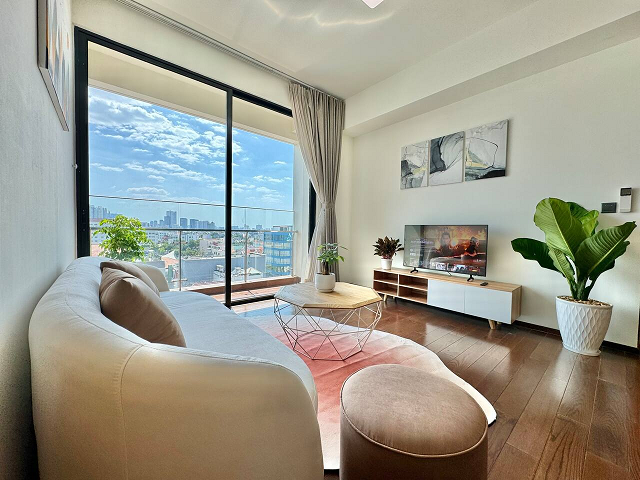
HoREA advocates for incorporating short-term rental regulations into the Housing Law decree to ensure nationwide consistency.
|
Alongside legal arguments, HoREA presents economic impact data.
A May 2025 Oxford Economics report revealed that Airbnb contributed approximately VND 16.2 trillion to Vietnam’s GDP in 2024 and supported over 64,100 jobs across various service sectors. International guests accounted for 82% of total Airbnb stays.
HoREA asserts that these figures demonstrate short-term rentals are no longer a niche activity but a vital component of the tourism-service economy.
Throughout its year-long advocacy, HoREA acknowledges Airbnb’s challenges but rejects prohibitive measures.
The association consistently emphasizes the need for rigorous regulation to ensure security, order, and resident rights, while respecting the lawful property rights of unit owners.
Expert: Tightening Short-Term Rental Rules Boosts Long-Term Condo Value
Banning Short-Term Rentals: Perspectives from the Ground
How Does Airbnb Operate Globally?
– 14:18 30/01/2026
Ho Chi Minh City Continues to Apply Land Price Table Under the 2024 Land Law Pending the Issuance of Coefficient K

While awaiting the issuance of the new land price adjustment coefficient, Ho Chi Minh City will continue to apply the current Land Price Table for calculating land use fees and financial obligations, ensuring the rights and interests of both citizens and businesses.
Sago Food Scandal: Oil Trading Company Accused of Supplying Expired Meat to Schools Just 5 Months After Entering School Meal Business

Business registration data reveals that the company recently accused of supplying buffalo meat mislabeled as beef to schools was originally a fuel trading enterprise. It transitioned to the food industry less than six months ago.
Ho Chi Minh City Announces Official Pricing Framework for Public Service Housing

Our comprehensive pricing framework includes operational management fees, maintenance costs, and property management expenses for official residence rentals.
What Makes Khai Hoan Prime the Spotlight of the South in 2026?

As we step into 2026, Khải Hoàn Prime has captured market attention by successfully completing key legal procedures while maintaining a robust construction pace in the thriving South Saigon area. This region continues to demonstrate strong demand for both residential and investment opportunities, solidifying its position as a prime destination.
Northern Investors’ “Southern Expansion”: Unlocking New Growth Opportunities in Ho Chi Minh City’s Thriving Western Hub

The recent “Infrastructure Focus – Investment Highlights” event in Hanoi has painted a vivid picture of capital shifting from the North to the Southern market. Among the standout destinations is the Western Gateway of Ho Chi Minh City (formerly Long An), with the LA Home urban area emerging as a focal point. This area is drawing significant attention due to its strategic advantages, leveraging both infrastructure development cycles and an integrated eco-industrial urban model.