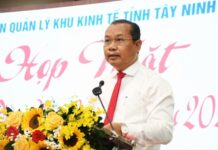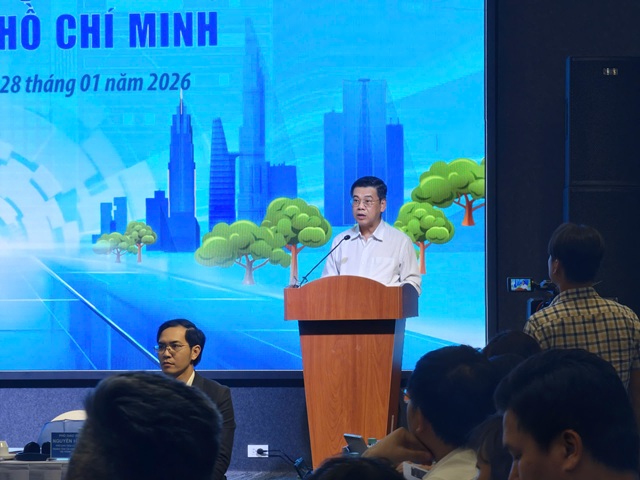
Mr. Nguyen Van Dung, Member of the City Party Committee and Vice Chairman of the People’s Committee of Ho Chi Minh City (HCMC)
|
At the conference, Mr. Nguyen Van Dung, Member of the City Party Committee and Vice Chairman of the People’s Committee of Ho Chi Minh City (HCMC), emphasized that the establishment of the Vietnam International Financial Center (VIFC) in HCMC marks the beginning of a long-held strategic vision. This initiative concretizes Resolution XIII of the Party Congress, which aims to develop an international financial hub in Vietnam.
On December 19, 2025, the Prime Minister chaired a conference announcing the formation of the Center and officially launched its Management Board. In just over a month of operation, the Board has worked tirelessly to streamline its organizational structure and infrastructure.
Regarding operational facilities, Mr. Dung noted that the Board is currently operating from the 6th floor of the HCMC Innovation and Startup Center. Simultaneously, phase 2 infrastructure at 8 Nguyen Hue Street is being finalized, with plans for a large-scale completion in the Thu Thiem New Urban Area in the near future.
The Management Board is focused on two key tasks. First, based on National Assembly Resolution 22 and 8 Government Decrees, it is finalizing a unified operational framework for international financial centers in both HCMC and Da Nang. Second, it is developing and refining the Strategic Development Plan for the Vietnam International Financial Center in HCMC.
The draft strategy has received input from various government ministries, with a core objective of establishing a robust foundation within the first five years (2026–2030), setting the stage for future breakthroughs.
During the consultation workshop, Ms. Nguyen Huyen Dieu, Deputy Director of the Monetary Policy Department at the State Bank of Vietnam (SBV), shared that the SBV has advised the Government to issue Decree No. 329, which regulates banking activities at the financial center and includes provisions for anti-money laundering.
Recently, the SBV received the draft Strategic Development Plan for the Vietnam International Financial Center in HCMC from the Management Board for feedback. The plan sets ambitious targets: by 2035, to become a regional financial hub and rank among the top 75 global financial centers; and by 2045, to achieve international financial center status. In Fintech, the goal is to rank within the top 25 in the Asia-Pacific region and 3rd in ASEAN by 2035.
The solution framework must align with National Assembly Resolution 22 and the 8 recently issued Government Decrees. According to Ms. Dieu, the draft strategy outlines 7 development pillars and should encompass the entire ecosystem—infrastructure, living conditions, human resources—not just financial and banking products. Clear responsibility allocation is essential: defining roles for the Management Board, the HCMC People’s Committee, and central government ministries to establish appropriate timelines and targets.
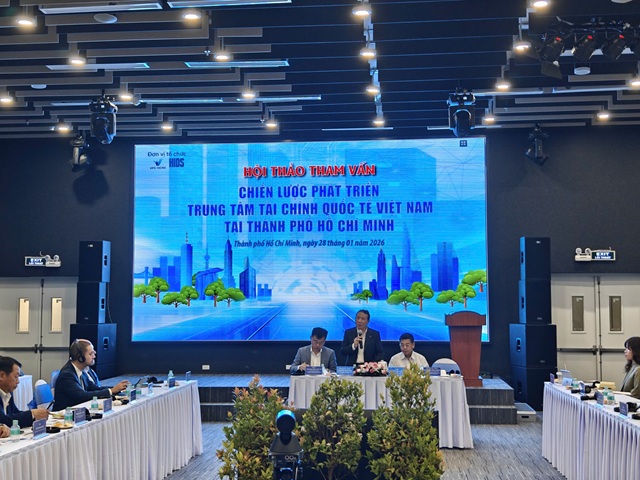
Consultation Workshop on the “Strategic Development Plan for the Vietnam International Financial Center in HCMC” held on the afternoon of January 28, 2026.
|
Aiming to become a regional financial hub within 3–5 years
Mr. Arnaud Ginolin, Managing Director and Member of the Board of Directors at The Boston Consulting Group (BCG), noted that building a global International Financial Center (IFC) is a long-term journey.
Currently, the HCMC IFC is in its early stages, with a key goal of becoming a regional financial hub within 3–5 years. This requires expanding financial products for international investors in Vietnam and offering services to countries in Asia and Southeast Asia.
However, the path to developing an IFC is highly competitive. Over the past 5–10 years, many countries have established international financial centers, but not all have achieved global status, with some remaining at an intermediate level.
According to BCG, to advance to a global IFC, centers typically choose one of two paths: aggressively diversifying their product portfolio or specializing deeply in certain areas before gradually expanding. For HCMC, a diversified product development strategy in the initial phase is more suitable, before aiming for global IFC status in the next 10–15 years.
Dr. Can Van Luc, Chief Economist at BIDV and Member of the Advisory Group for the Steering Committee on Building and Developing HIFC-HCMC, stressed the need to identify and address specific bottlenecks. First, for traditional financial services (banking, securities, insurance), the biggest barrier is in banking. The required charter capital of VND 3,000 billion to establish a subsidiary or branch in the IFC is feasible for large banks (Big 4) but challenging for mid-sized and smaller commercial banks.
Dr. Luc suggested working with the SBV to create a flexible capital contribution roadmap. Instead of requiring immediate full payment of VND 3,000 billion, allow phased contributions over 3–5 years.
For securities and insurance, due to lower capital requirements, there is less concern, and efforts can focus on attracting investment.
Second, for Investment Funds and Startup Support, the banking system currently struggles to fund innovative startups due to high-risk appetite. The HCMC IFC must become a true platform for this sector by developing the capital market, particularly venture capital funds. Special incentives are needed to attract these funds to establish a presence here, as only venture capital can bridge the gap left by banks and drive innovation.
Third, a strong connection between the IFC and the Ho Chi Minh City Stock Exchange (HOSE) is essential to promote green bonds, green stocks, and green credit. Mechanisms must be established so that listed companies see clear economic and brand benefits from issuing green financial instruments through the IFC.
Fourth, with Vietnam’s import-export turnover exceeding USD 700 billion, domestic supply chain financing remains underdeveloped. The IFC should lead in capturing this market, linking financial services with logistics, free trade zones, and leveraging the future potential of the Can Gio International Transshipment Port. This will be HCMC’s core competitive advantage over other centers.
Fifth, for commodity exchanges and new products, leverage Decree 158 (amending Decree 51) and new mechanisms to enhance operations. Dr. Luc proposed piloting derivatives trading for strategic energy commodities like gasoline and natural gas.
For gold trading, a unified approach with the SBV is needed: whether to integrate gold trading on a unified commodity exchange or establish a separate gold exchange. Dr. Luc favors integration to optimize infrastructure and oversight.
– 21:27 28/01/2026
Festive Season Inspections: Major Food Industry Giants in Ho Chi Minh City Under Scrutiny

The Ho Chi Minh City People’s Committee has officially launched a comprehensive inspection plan for Tet and Spring Festival food safety in 2026, targeting over 1,300 establishments in the detailed checklist.
The Reverie Saigon Yacht Owned by Truong My Lan Listed for Sale Again at Nearly $2 Million

In addition to this yacht, the Ho Chi Minh City Civil Judgment Enforcement Department has also decided to reduce the prices of two other assets: the THALIA and ELECTRA vessels. Both ships, manufactured in Poland in 2017, feature a sleek white design. The new starting price for each vessel has been adjusted to approximately 4.8 billion VND.
Can Gio to Become Ho Chi Minh City’s New Sustainable Tourism Icon and Top Attraction

According to Ha Van Sieu, Deputy Director of the Vietnam National Administration of Tourism, with the infrastructure boost and the emergence of Vinhomes Green Paradise, capable of accommodating 40 million visitors annually, Can Gio is poised to transform into an iconic destination and a new growth hub for Ho Chi Minh City.
Unveiling the Current State of Detached House Supply in Ho Chi Minh City
The average entry-level price across the entire Ho Chi Minh City market has plummeted by over 50%, dropping from $13,014/m² to $6,330/m².
Downtown Retail Spaces “Lock Up” Near Tet, Rental Prices Plummet
Prime real estate locations across Ho Chi Minh City remain vacant, despite significant rental price reductions, as both landlords and tenants opt to wait.