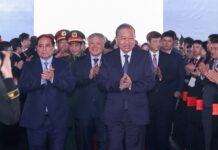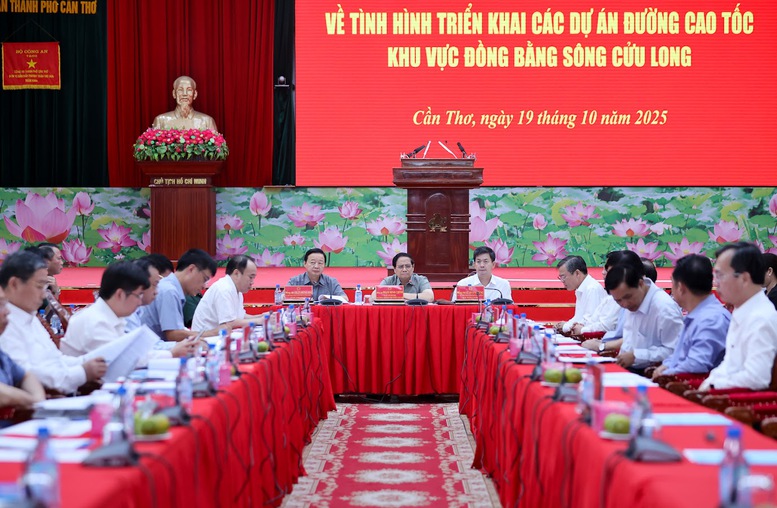
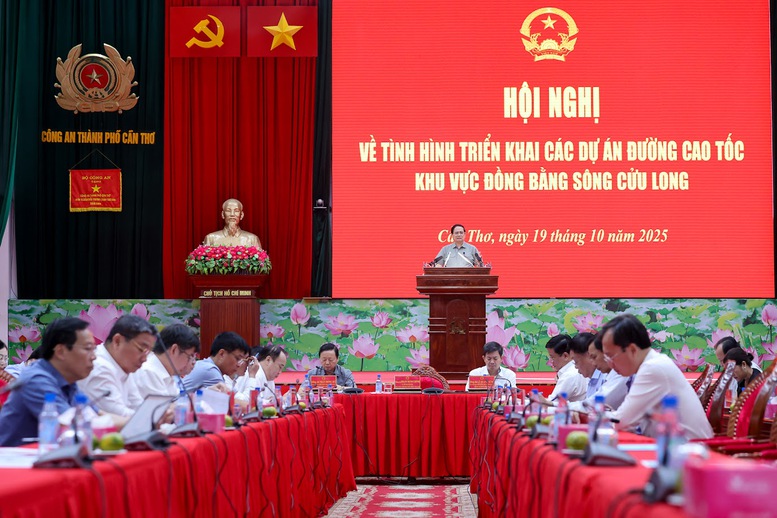
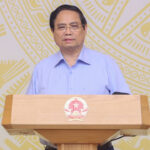
Prime Minister Pham Minh Chinh chaired a conference on the implementation progress of expressway projects in the Mekong Delta region – Photo: VGP/Nhat Bac
The conference was attended by Deputy Prime Minister Tran Hong Ha, leaders of ministries, central agencies, secretaries, and chairpersons of Mekong Delta localities, project management boards, and contractors.
Currently, in the Mekong Delta region, the Ministry of Construction and local authorities are implementing 11 expressway projects/components with a total length of 434.7 km.
Of these, the Ministry of Construction manages 5 components with a total length of 211.77 km, including 4 projects scheduled for completion in 2025 with a length of 191.17 km (Can Tho – Hau Giang and Hau Giang – Ca Mau: 110.87 km; Cao Lanh – Lo Te: 28.8 km; Lo Te – Rach Soi: 51.5 km). The My An – Cao Lanh project, which started in July 2025, is planned for completion in 2028 with a length of 26.6 km.
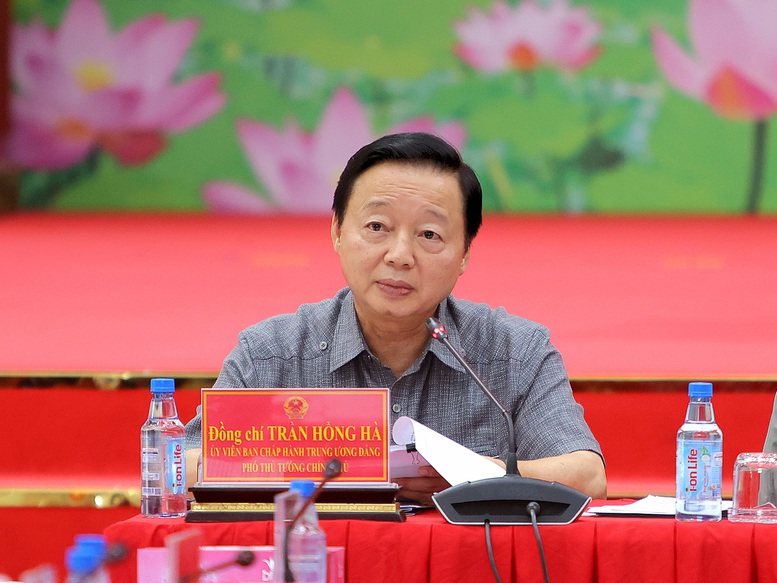
Deputy Prime Minister Tran Hong Ha speaks at the conference – Photo: VGP/Nhat Bac
Localities manage 6 components with a total length of 216.93 km. Component 1 of Cao Lanh – An Huu, managed by Dong Thap Province, is scheduled for completion in 2025 with a length of 16 km. The remaining 5 projects are set for completion in 2026 and will be fully operational by 2027, totaling 200.93 km.
These 5 projects have been directed by the Prime Minister to accelerate progress, specifically: Chau Doc – Can Tho – Soc Trang Component 1 (57 km) managed by An Giang Province, to be completed by December 19, 2025; Components 2, 3, and 4 of Chau Doc – Can Tho – Soc Trang (132.5 km) managed by Can Tho City, and Component 2 of Cao Lanh – An Huu (11.43 km) managed by Dong Thap Province, to be completed by April 30, 2026.
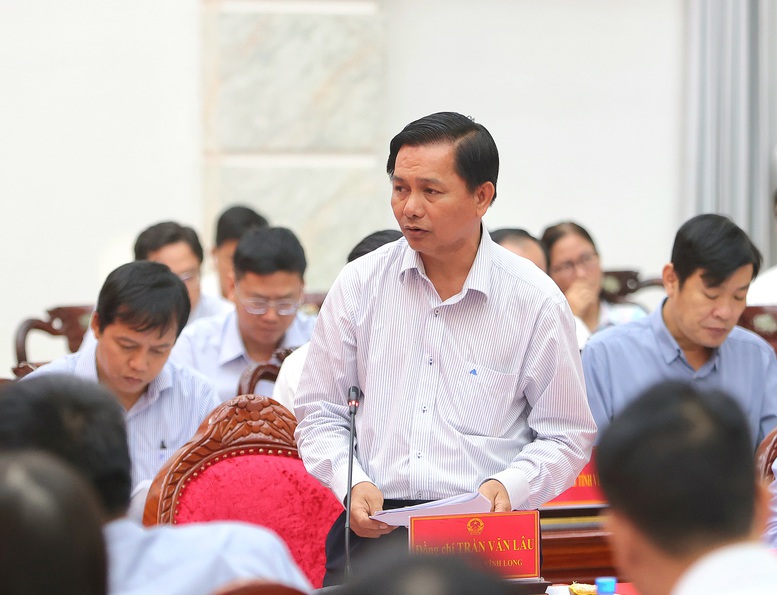
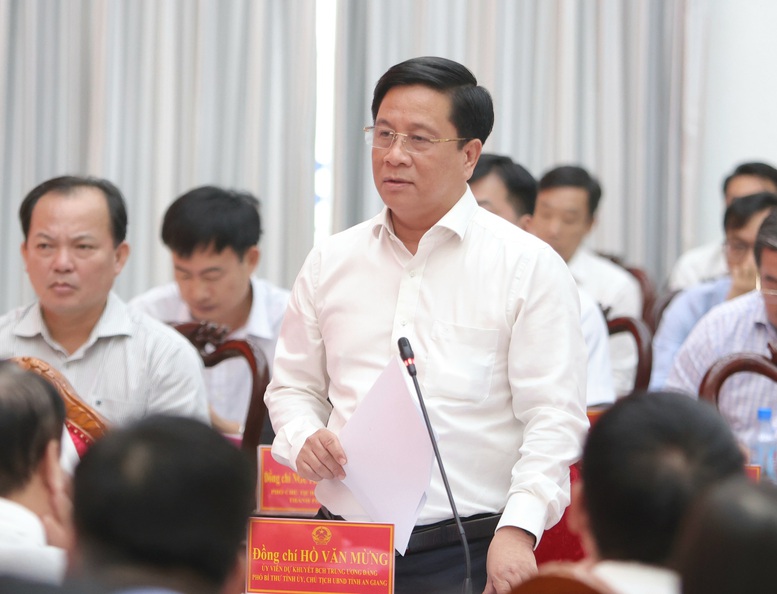
Delegates report at the conference – Photo: VGP/Nhat Bac
Land clearance for the projects is nearly complete, with many achieving 100%. For construction materials, the Prime Minister and Deputy Prime Minister Tran Hong Ha have closely monitored and directed ministries, agencies, and localities to resolve bottlenecks, accelerating mine licensing. Material supply now largely meets project demands.
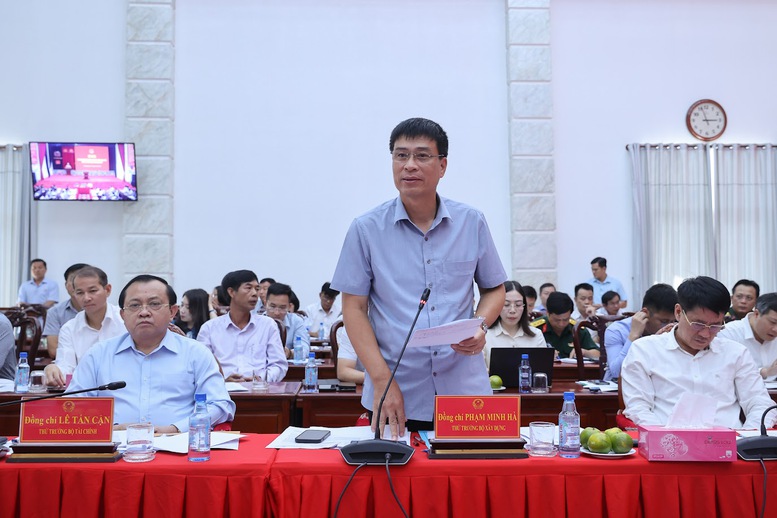
Deputy Minister of Construction Pham Minh Ha reports at the conference – Photo: VGP/Nhat Bac
According to the Ministry of Construction, localities have licensed the extraction of 63.31 million m³ of sand (compared to the required 54.2 million m³), but extraction capacity still falls short of project needs. For stone materials, the total requirement is 8.6 million m³, with 5.5 million m³ already sourced.
Localities have effectively supported resettlement and improved livelihoods for affected residents. Security and social order around project areas remain stable.
To ensure project completion, investors have developed detailed plans and urged contractors to increase machinery, manpower, and resources, implementing “3 shifts, 4 teams” schedules.
Progress includes: Cao Lanh – Lo Te at 92%, expected completion by December 19, 2025; Lo Te – Rach Soi at 99%, expected completion by late October 2025; Can Tho – Ca Mau at 75%; Cao Lanh – An Huu Component 1 at 68%, Component 2 at 53.4%; Chau Doc – Can Tho – Soc Trang Component 1 at 62%, Components 2, 3, and 4 averaging 45%.
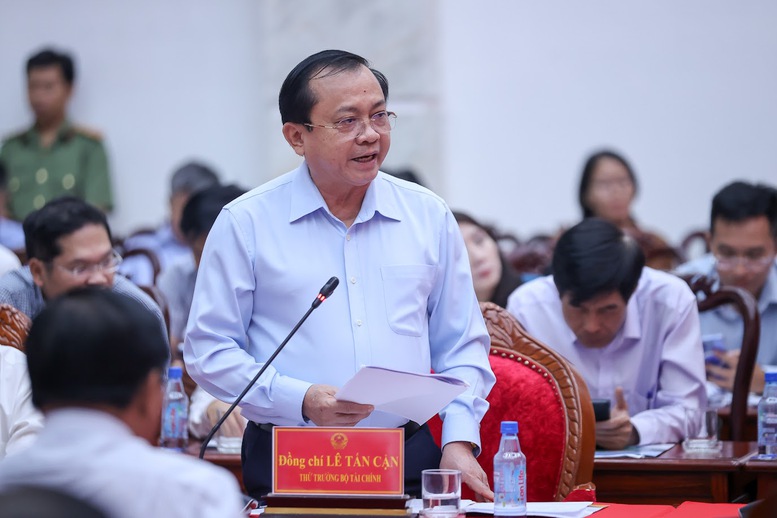
Deputy Minister of Finance Le Tan Can reports at the conference – Photo: VGP/Nhat Bac
The My An – Cao Lanh project, which began in July 2025, is being accelerated by the Ministry of Construction to complete the final 4 km, ensuring connectivity with Cao Lanh – An Huu Component 1 at the An Binh intersection.
The Government has tasked the Ministry of Defense with investing in the Ca Mau – Dat Mui expressway and the Hon Khoai Port connector. Urgent measures are being implemented to expedite these projects, with groundbreaking in August 2025 and ongoing efforts to connect Ca Mau to Dat Mui, forming a national north-south expressway network.
Reports at the conference highlighted the timely resolution of challenges and support for ministries, agencies, and localities in advancing key Mekong Delta projects.
Despite progress, challenges remain in southern transportation projects, particularly the Can Tho – Ca Mau and Chau Doc – Can Tho – Soc Trang expressways, including local management of large-scale projects, weak soil foundations, resource shortages, land clearance issues, and material supply delays.
With expressways, airports, and ports, the Mekong Delta will reap benefits sooner
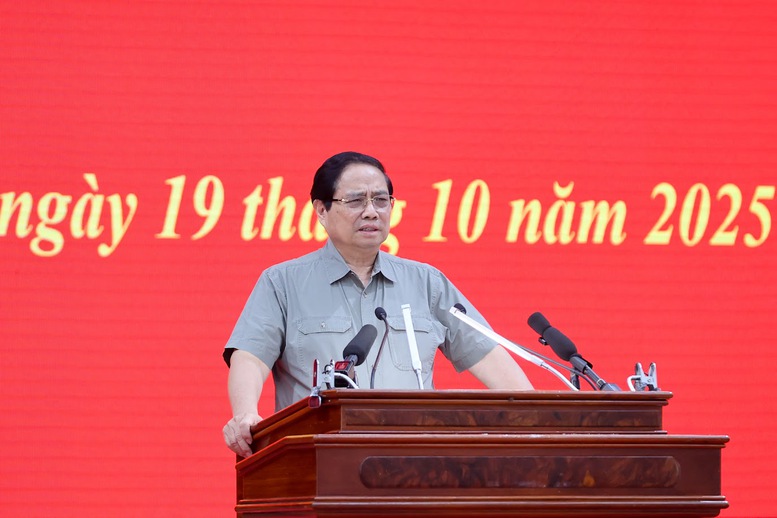
Prime Minister Pham Minh Chinh emphasized that strategic infrastructure, including transportation, is a bottleneck for the Mekong Delta – Photo: VGP/Nhat Bac
Prime Minister Pham Minh Chinh stressed that strategic infrastructure, alongside skilled labor, is a critical bottleneck for the Mekong Delta. Both areas must be prioritized, accelerated, and boldly addressed.
In recent years, the Party and State have focused on the Mekong Delta, ensuring commitments are met effectively. Approximately 1,300 km of expressways are planned, with ongoing projects including the Hon Khoai Port and upgrades to Phu Quoc and Ca Mau airports. The Tran De Port is also under study.
The Ministry of Finance reports that infrastructure investment in the Mekong Delta for this term totals nearly 600 trillion VND, the highest among economic regions.
The Prime Minister urged exceeding targets for Mekong Delta expressway projects, contributing to the 2025 goal of 3,000 km of expressways – Photo: VGP/Nhat Bac
The Prime Minister called for surpassing targets in Mekong Delta expressway projects, aiming to exceed the 2025 goal of 3,000 km of expressways. This is a political mandate and a responsibility to the region and its people, ensuring rapid and sustainable development. By 2026, the region is expected to have 600 km of expressways.
With determined efforts, material and funding shortages are largely resolved, though localized material shortages persist. The Prime Minister urged stakeholders to act patriotically, responsibly, and efficiently, with less talk and more action.
The Ministry of Construction must ensure contractors meet schedules, completing the Can Tho – Ca Mau mainline by December 19, 2025, and the Cao Lanh – Lo Te and Lo Te – Rach Soi projects by October 2025. Non-compliant contractors will face penalties.
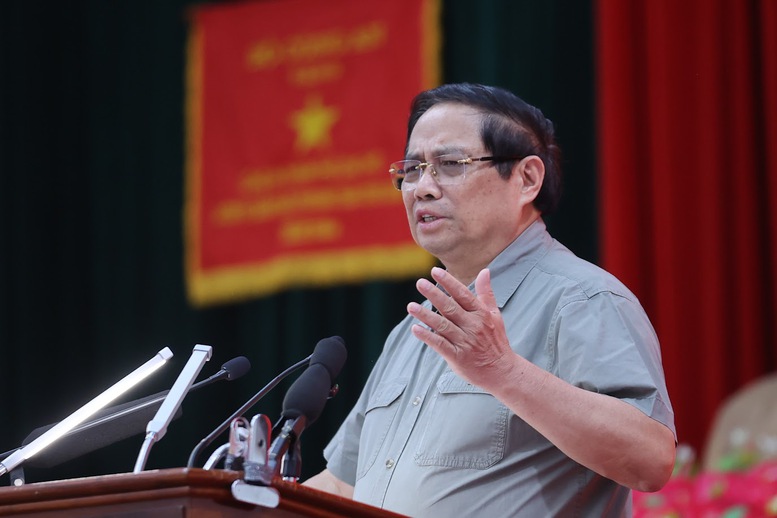
The Prime Minister directed inspections to prevent violations in construction material supply – Photo: VGP/Nhat Bac
The Ministry of Defense is accelerating the Ca Mau – Dat Mui expressway and Hon Khoai Port connector, while supporting sea sand extraction for localities.
Local authorities must address project challenges, ensure smooth operations, and support residents affected by land acquisition, providing better living conditions.
Can Tho, An Giang, and Dong Thap provinces must ensure contractors meet obligations, maintain progress, and guarantee project quality. Dong Thap will monitor land subsidence for the Cao Lanh – An Huu project and secure material supplies. An Giang will expedite procedures for the Chau Doc – Can Tho – Soc Trang connector to border gates.
The Prime Minister directed resolving land clearance issues for power projects by October and ensuring material supply through increased mining capacity and flexible allocation, with direct licensing to contractors. Ministries will guide mining capacity and address bottlenecks.
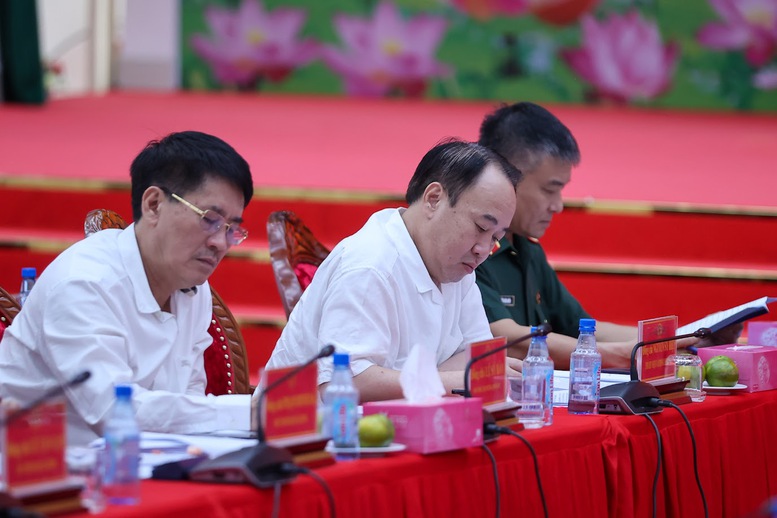
Conference delegates – Photo: VGP/Nhat Bac
The Prime Minister emphasized inspecting and penalizing violations in material supply, preventing market manipulation, and ensuring domestic material use. Environmental and safety concerns during extraction must also be addressed.
While accelerating progress, project quality, safety, and aesthetics must be maintained. Best practices should be shared, and forced preloading techniques considered to shorten construction times without compromising quality.
The Prime Minister assigned specific tasks to ministries to support APEC 2027 preparations, restart the Can Tho Cancer Hospital project, and implement a 1 million hectare high-quality, low-emission rice program in the Mekong Delta.
“With clear thinking, high determination, and bold action, we will overcome transportation and infrastructure bottlenecks. The sooner expressways, airports, and ports are completed, the sooner the Mekong Delta and its people will benefit,” the Prime Minister concluded.
Central Government Urged to Allocate $36 Million for Erosion Control in Dong Thap
During a meeting with Deputy Prime Minister Mai Văn Chính, the People’s Committee of Đồng Tháp Province requested the Government to consider and provide approximately 830 billion VND in support for urgent measures to address two critically severe landslide areas along the Tiền River, located in Thường Phước Commune and Cao Lãnh Ward.
Can Tho 2030: The Southwest Region’s Hub and the Quantum Leap of Core Real Estate

Can Tho is poised for a transformative leap, aiming to become a national growth hub by 2030. With simultaneous upgrades in infrastructure, economy, and urbanization, a golden opportunity emerges for the core urban real estate market—particularly in areas adjacent to the city’s new administrative center.
Prime Minister Inspects Delayed Hospital and Social Housing Projects in Can Tho

Following a constituent engagement program, Prime Minister Pham Minh Chinh inspected the Hung Phu Ward Administrative Center on October 19th. He also surveyed the Nam Long 2 social housing project and urged progress on the long-delayed Can Tho Oncology Hospital project.
The Mekong Delta Aims for Water Resource Autonomy in All Adverse Scenarios by 2050
Deputy Prime Minister Tran Hong Ha has signed a decision approving the Mekong River Basin Irrigation Master Plan, spanning from now until 2030 with a vision towards 2050. This plan aims to empower Vietnam’s largest delta region with complete water resource autonomy under all circumstances, effectively managing droughts, saltwater intrusion, and flooding. Ultimately, it seeks to secure sustainable livelihoods for tens of millions of residents.
Prime Minister: Every Completed Project Brings Joy and Happiness to the People
Every home that rises and every project that reaches completion brings joy, excitement, and happiness to the people, contributing to the nation’s development. This was the powerful message emphasized by the Prime Minister, highlighting the profound impact of progress on the well-being and prosperity of the community.