Manual Implementation: A Hassle for Citizens
Across the country, local authorities are simultaneously building land databases, a key task in the national administrative reform and digital transformation process. The goal is to create a centralized, unified, synchronized, and multi-purpose land information system capable of connecting and sharing data nationwide. This is considered a crucial step to enhance state management efficiency, increase transparency in the real estate market, and facilitate citizens in all land-related transactions and procedures.
In Hanoi, the “90-day Land Data Cleansing Campaign” (from September 1 to November 30, 2025) is underway. According to the plan, all land plots in the city will be reviewed, standardized, and assigned a unified identification code, ensuring linkage with population, household, and property information.
Numerous wards and communes in Hanoi have announced the implementation of this campaign. Citizens are required to submit photocopies of their ‘red books’ (land use right certificates) and citizen ID cards to neighborhood heads, apartment management boards, or commune/ward task force members.
However, despite its good intentions, this approach has drawn criticism from citizens for being outdated and relying on manual declaration, causing inconvenience.
Ms. Phuong Linh (Hoang Liet Ward) shared that her neighborhood head provided a “Data Collection Form” requiring detailed information about the land user, land use right certificate details (certificate number, land address, and notes if the certificate is lost or mortgaged to a bank), and even reasons if the land user fails to provide information.
According to Ms. Linh, in this digital age, asking citizens to submit photocopies manually is unsafe and unsuitable. “Moreover, if the goal is to cleanse land data, officials should visit households to verify actual land usage, as many certificates don’t match reality. Simply collecting photocopies and re-entering old data is a waste of time and won’t ensure accuracy,” she added.
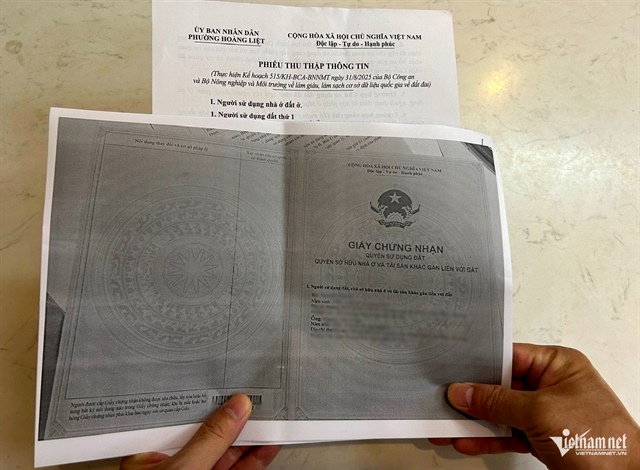
Many wards and communes in Hanoi require citizens to submit photocopies of their ‘red books’ and ID cards to neighborhood heads during the “90-day Land Data Cleansing Campaign”. Photo: N.L |
In some wards, like Thanh Liet, the announcement states: “If citizens fail to provide information or cooperate in time, affecting their legal rights and interests, they will be held responsible.”
Attorney Nguyen Thanh Ha, Chairman of SBLaw, commented that land use right certificates are issued based on data from land management authorities. Requiring citizens to submit photocopies of their ‘red books’ increases their burden unnecessarily, as the data should already be available with the authorities.
According to the attorney, citizens should only be asked to provide their certificates if the authorities have lost or unclear data.
“Even public administrative procedures like driver’s license renewal, which previously required physical presence, are now done electronically. Instead of submitting photocopies, citizens could provide digital copies of their ‘red books’, making data updates more efficient,” he suggested.
A Setback for Administrative Reform?
Attorney Diep Nang Binh, Head of Tinh Thong Luat Law Firm, believes that building a unified national land database is a significant step in administrative reform, promoting transparency, reducing costs, and benefiting citizens and businesses.
However, in many localities, citizens are still asked to submit photocopies of their ‘red books’, despite this data being digitized. This outdated practice contradicts the spirit of the digital government.
Mr. Binh emphasizes that land data cleansing is essential for digital transformation, helping to complete legal records, identify and correct errors in land user information, area, and land use rights changes.
Standardized data is a powerful tool for effective management and supervision in land pricing, taxation, planning, and dispute resolution. According to Article 166(5) of the 2024 Land Law, electronic data has equivalent legal value to paper records, enabling online public services without physical documents, as per Decree 45/2020.
Article 129(2) of the 2024 Land Law requires digital land records to include copies of land use right certificates.
Circular 10/2024 of the Ministry of Natural Resources and Environment (now Ministry of Agriculture and Environment) mandates that land registration offices scan and store electronic copies when issuing, reissuing, or copying certificates from the original.
Additionally, Decree 45/2020 prohibits government agencies from requesting citizens to provide data already available in the system.
“Requiring photocopies of ‘red books’ duplicates work already done by authorities, violates regulations, and goes against administrative reform,” Attorney Binh asserted.
Two new decrees clearly prohibit requesting resubmission of digitized records.
Decree 118/2025 (Article 17, Clause 1(i)) strictly forbids officials from asking citizens to resubmit records or documents already in the system.
Decree 192/2025 (Article 4, Clause 1(b)) prohibits government agencies from adding extra requirements beyond regulations.
“If land certificate data exists in the database, officials must check the system and not request photocopies. Non-compliance may result in disciplinary action or compensation for citizen inconvenience,” Attorney Binh warned.
In cases where data isn’t digitized, the 2024 Land Law (Article 18, 42 of Circular 10/2024) requires land registration offices to scan originals and add them to the system.
“The legal process is for citizens to present their original ‘red books’, which officials verify, scan, and digitally sign as PDFs on the spot, returning the original and storing the electronic copy,” he explained.
Attorney Diep Nang Binh stressed that photocopies lack legal value and require verification with originals, while digitally signed scans are official, faster, and more accurate. If localities lack equipment, the law allows on-site digitization services, ensuring citizens only need to visit once, without photocopying or notarization.
Nguyen Le
– 10:00 20/10/2025
Are Local Authorities Out of Touch with Modern Times by Requiring Citizens to Photocopy Land Certificates?

According to numerous experts and legal professionals, mandating citizens to submit photocopies of their land-use right certificates to local authorities for land data standardization contradicts the essence of administrative reform.
Crafting the 2026-2030 Five-Year Plan: Bold Action, Seamless Coordination, Feasibility, and Efficiency to Achieve 10%+ Annual GDP Growth

Prime Minister Pham Minh Chinh signed and issued Directive No. 31/CT-TTg on October 18, 2025, regarding the development of the 5-year Socio-Economic Development Plan for the period 2026-2030.
Striving for an Average GDP Growth Rate of 10% Annually During 2026-2030

Prime Minister Pham Minh Chinh has signed and issued Directive No. 31, outlining the framework for the Socio-Economic Development Plan for the 2026-2030 period. The directive emphasizes that the key performance indicators of this five-year plan must be feasible, clear, aligned with current realities, and closely tied to the overarching 10-year strategy spanning 2021-2030.
BAOVIET Bank: Positive Credit Growth in the First Nine Months

With a modern retail banking development strategy deeply rooted in digital transformation, BAOVIET Bank (BAOVIET Bank Joint Stock Commercial Bank) achieved impressive business results in the first nine months of 2025. The bank recorded reasonable credit growth, strengthened risk management efficiency, and positive profit growth compared to the same period last year.
KienlongBank Surges Ahead with Strategic Milestones, Shattering 30-Year Profit Records and Leading Market Momentum

KienlongBank (Kien Long Commercial Joint Stock Bank; UPCoM: KLB) has recently unveiled its Q3 2025 business results, reporting a consolidated pre-tax profit of VND 616 billion. Key performance indicators, including total assets, mobilized capital, and outstanding loans, have all surged significantly, nearing annual targets. This impressive growth underscores the bank’s robust management capabilities and clear strategic direction.