According to the Hanoi E-Portal, on the afternoon of October 21, the Department of Construction hosted a workshop on the comprehensive plan titled “Reducing Traffic Congestion in Hanoi for the Period 2025-2030 and Beyond.” During the event, delegates engaged in discussions and research to propose innovative short-term and long-term solutions to refine the plan.
Representing the consulting unit for the comprehensive report, Dr. Nguyễn Đình Thạo from the University of Transport and Communications in Hanoi and the project lead, outlined the current state of traffic in the city, proposed solutions to the congestion issue, and estimated the minimum funding required for implementation.
The plan highlights that Hanoi’s traffic density is 8.2 times higher than the national average. Notably, the population density in the capital is unevenly distributed, with a high concentration in the inner city areas. Some districts, such as the former Đống Đa, have an extremely high density of up to 38,000 people per square kilometer.
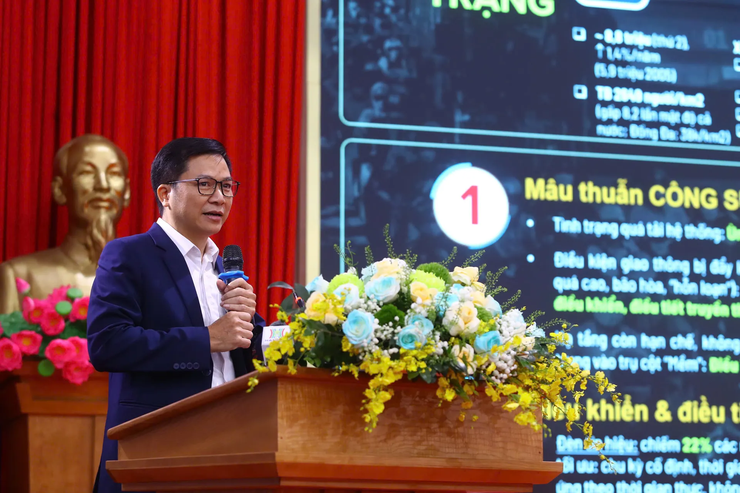
Dr. Nguyễn Đình Thạo from the University of Transport and Communications in Hanoi, lead of the comprehensive plan “Reducing Traffic Congestion in Hanoi for the Period 2025-2030 and Beyond,” presenting at the workshop on October 21 (Photo: Hanoi E-Portal)
Dr. Thạo noted that Hanoi has approximately 9.2 million motorized vehicles. Of these, the city manages over 8 million vehicles (1.1 million cars and 6.9 million motorcycles) and about 1.2 million personal vehicles (cars and motorcycles) from other provinces and cities.
Significantly, the annual vehicle growth rate is around 4-5%, with some years reaching up to 10%, far exceeding the annual infrastructure expansion rate of 0.3-0.5%. Consequently, the land area allocated for transportation is only 12.13% of the urban construction land (compared to the planned target of 20-26%), and the area for static traffic is less than 1% (planned target is 3-4%), meeting only 8-10% of the city’s parking needs.
Regarding public transport, the public passenger transport rate is 19.5% of the demand (well below the planned target of 30-55%), with 153 bus routes, 1 BRT bus route, and 2 urban railway segments totaling 21.5 km in operation.
These figures indicate a severe imbalance between supply (system capacity) and demand (traffic needs, primarily personal transportation, especially motorized vehicles like motorcycles and cars).
The city’s transportation system is operating beyond its capacity and is unsustainable, leading to significant traffic congestion and air pollution, causing economic losses and directly impacting public health and the city’s civility.
“Without improvements, the city risks facing a more severe situation, approaching a ‘traffic disaster’ similar to what major Southeast Asian cities like Bangkok, Manila, and Jakarta have experienced,” the plan warns.
To address these challenges, the consulting unit proposed 11 solution groups with 116 specific measures and tasks. These focus on enhancing infrastructure, traffic organization, public transport, shared mobility, non-motorized transport, congestion control, and communication to change the behavior and awareness of road users.
The plan also suggests developing urban rail systems and public passenger transport, applying information technology in traffic management, and strengthening inspections and violation handling.
The consulting unit estimates that Hanoi needs a minimum of nearly 1.4 quadrillion VND (approximately 53 billion USD) to implement the congestion reduction plan. For the 2025-2030 period, the estimated cost is around 569.04 trillion VND, with 57.1% allocated to urban rail development and 37.8% to road infrastructure. For the 2031-2035 period, the estimated cost is about 828.068 trillion VND, with 79.2% for urban rail and 17.6% for road infrastructure.
Prime Minister: Maximizing Deployment of Highly Skilled Officials for Railway Projects

Prime Minister Pham Minh Chinh has urged relevant agencies to maximize resource mobilization, particularly by deploying highly skilled, capable, and responsible officials and civil servants to lead specialized tasks in railway projects and infrastructure development. He also emphasized the need to review and establish appropriate mechanisms, policies, and incentives to ensure effective implementation.
Unveiling the Progress of Sunshine Group’s Luxury Noble Crystal Projects in Hanoi

At the vibrant developmental poles of Hanoi, West Tay Ho and Long Bien, Sunshine Group is accelerating the completion of two prestigious projects: Noble Crystal Tay Ho WorldHotels Residence and Noble Crystal Long Bien. These developments promise to unveil the most luxurious and sophisticated living spaces currently available in the capital.
Navigating Ho Chi Minh City: Important Notice for Commuters at Mỹ Thủy Roundabout Starting Today
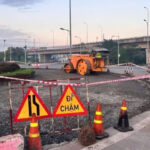
The construction unit will barricade two-thirds of the lanes at the Mỹ Thủy roundabout in Cát Lái Ward, Ho Chi Minh City, to facilitate road repairs.
National Highway 13: A $600 Million Expansion to a 60-Meter Wide Roadway
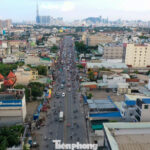
Stretching nearly 6 kilometers along National Highway 13, the segment from Bình Triệu Bridge to Vĩnh Bình is perpetually congested, constrained by its narrow 4-6 lane configuration despite being a vital artery and home to a dense population. By 2026, this critical route will be expanded to a 60-meter width, alleviating the chronic pressure on Ho Chi Minh City’s northeastern gateway.
Son Hai Group Sponsors 100% Rapid Completion of Quang Tri Road in Just 20 Days

A groundbreaking rural road project in Quảng Trị, sponsored and executed by Sơn Hải Corporation, has been completed in a remarkable 20-day timeframe, setting a new standard for efficiency and execution.