Today, the National Assembly discussed in groups the draft Resolution outlining mechanisms and policies to address challenges in implementing the Land Law.
The draft resolution adds four scenarios where the state can reclaim land, three of which are for socio-economic development in the national and public interest. Compensation prices and resettlement land prices will be calculated based on land price tables and adjustment coefficients.
Delegate Pham Duc An (Chairman of Da Nang City People’s Committee) noted that land prices, as per the Land Law, require consultation for each specific plot, causing delays in land clearance.
He questioned whether the draft resolution’s land price table could fully resolve compensation and land clearance issues, stating, “I believe it cannot.”
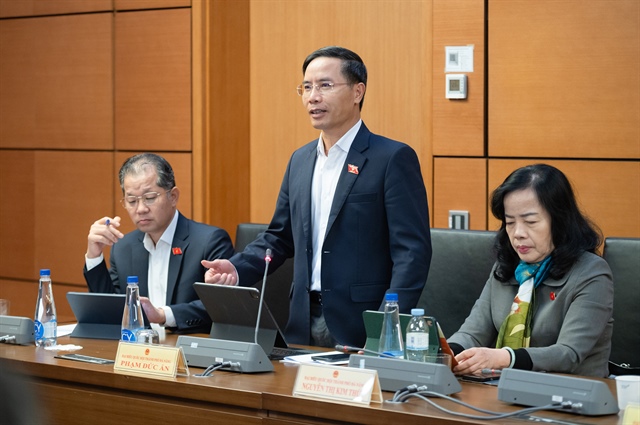
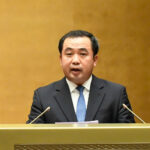
Chairman of Da Nang City People’s Committee Pham Duc An speaks. Photo: Pham Thang |
“Uncontrolled land prices have severe economic consequences,” the Chairman asserted.
He explained that if state-set land prices do not align with market rates, residents may feel disadvantaged and resist land handover, leading to complaints and lawsuits. He suggested that alongside land price tables, tax mechanisms should regulate real estate prices for stability. This would address concerns of residents whose land is reclaimed, ensuring no one feels disadvantaged compared to others.
Regarding state land reclamation, Delegate Pham Duc An found the listed cases incomplete.
Land reclamation decision-makers should also determine temporary relocation
Chief Justice of the Supreme People’s Court Nguyen Van Quang agreed with adding land reclamation cases but deemed it “inappropriate” as the National Assembly holds decision-making authority. He argued that current development demands may introduce unforeseen cases.
He proposed granting the National Assembly Standing Committee authority to decide on land reclamation cases for flexibility, warning, “We will always lag behind reality otherwise.”
On resolution feasibility, the Chief Justice highlighted the clause: “For other projects, if over 75% of land users agree to reclamation before compensation approval, land can be reclaimed.”
He questioned the clause’s practicality, asking, “Do residents ever agree to reclamation before compensation plans are approved?”
“Residents typically assess compensation plans to ensure their rights before agreeing,” Chief Justice Nguyen Van Quang stated.
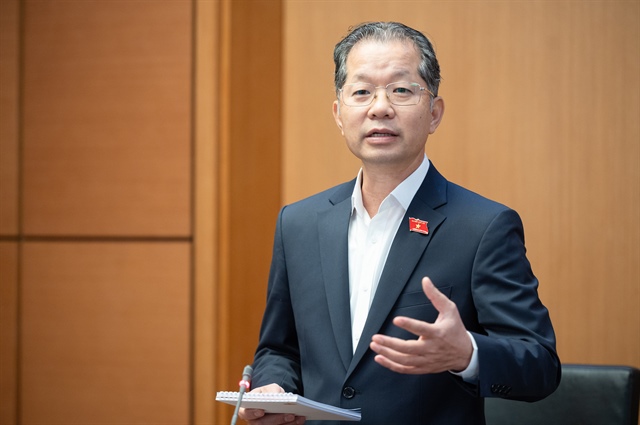
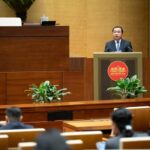
Chief Justice of the Supreme People’s Court Nguyen Van Quang speaks. Photo: National Assembly |
On reclamation authority, he noted inconsistencies. Clause 4, Article 3 assigns provincial People’s Committees to arrange temporary relocation, duration, and funding when reclaiming land without a resettlement plan.
Clause 5, Article 3 allows commune-level People’s Committee chairpersons to reclaim land based on project or compensation progress.
“Land reclamation decisions should include relocation arrangements. Commune-level authorities should decide on temporary relocation details to ensure accountability,” he argued.
However, given current commune-level capabilities, he suggested provincial authorities handle relocation decisions initially.
Regarding land price determination, Chief Justice Nguyen Van Quang emphasized its significance.
“Previously, 3-4 land pricing methods caused implementation issues. During Land Law revisions, this was extensively discussed. Now, compensation prices will be based on land price tables and coefficients,” he explained.
He predicted this approach would curb “price inflation,” stating, “Market-based pricing only drives prices up.”
He urged detailed guidelines for local implementation.
Tran Thuong
– 13:22 19/11/2025
Crafting Hyper-Localized Land Valuation Tables: A Thua-Level Approach
The draft resolution by the National Assembly outlines that land price tables will be structured based on land type, area, and location. For regions with digital cadastral maps and land price databases, pricing will be detailed down to individual land plots. Provincial People’s Councils will determine, publish, and implement these land price tables starting January 1, 2026, with provisions for amendments and updates as necessary.
Proposed Addition of Three Scenarios for State Land Reclamation
At the 10th session, the Government proposed to the National Assembly the addition of three scenarios where the State may reclaim land for socio-economic development in the interest of national and public welfare.
Proposed Resolution on Mechanisms and Policies to Implement Resolutions 71 and 72 Submitted to the National Assembly on November 17th
The National Assembly will review the presentation, evaluation reports, and engage in group discussions regarding two draft Resolutions on mechanisms and policies to implement Resolutions 71 and 72 of the Politburo.
Parliament Deliberates on 15 Bills During Fifth Working Week
As of November 17th, the 15th National Assembly enters its 5th week of the 10th session, tackling a hefty legislative agenda with deliberations and feedback on 15 draft laws.
Vingroup to Pay Over VND 8,000 Billion in Land Compensation for Project in Billionaire Pham Nhat Vuong’s Hometown
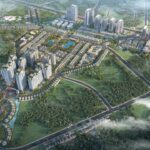
In November, officials are expected to finalize the land and asset inventory, followed by the verification of land origins and the development and publication of compensation plans.