A pilot initiative in Ho Chi Minh City could pave the way for a new development trajectory for Vietnam’s entire economy. |
Amidst these challenges, a pressing question arises: What must Ho Chi Minh City do to become a true driving force, a new growth pole for a new development model? The answer is increasingly clear: the city needs to be designated as a “national sandbox” for pioneering green and digital models.
As Prime Minister Pham Minh Chinh stated, Ho Chi Minh City should be ready to pioneer as a sandbox for green economy, green finance, smart urban development, and particularly as an international financial center. On a national scale, Vietnam is also prepared to become a “green and digital sandbox” for the region.
Why a “National Sandbox”?
Ho Chi Minh City is simultaneously facing three major pressures: maintaining its role as the growth engine, addressing pollution, infrastructure overload, and declining living environment quality, and transitioning its development model amidst the global shift towards a green and digital economy.
A city with over 14 million inhabitants and dense economic activity like Ho Chi Minh City simply cannot sustain a growth model reliant on cheap labor, resource exploitation, and energy consumption, trading off the environment as before. Without model innovation, the city will both lag in competition and pay an increasingly high price for environmental degradation, traffic congestion, and social issues.
In this context, Ho Chi Minh City’s unique advantages become the most compelling reason to select it as the “national sandbox” for the green economy and green finance. It is home to the most dynamic business ecosystem in the country, capable of rapidly adopting and testing new business models.
It is also the leading technology and innovation hub, where digital solutions, artificial intelligence, and data analytics can be directly applied to measure emissions, optimize energy, and design green financial products. The dense financial, banking, and fintech system enables the city to test new financial instruments, from green credit and green bonds to ESG-based investment models. Against this backdrop, the city government’s pioneering spirit and bold actions make Ho Chi Minh City the ideal candidate to test breakthrough mechanisms and policies.
Establishing a green economy and green finance sandbox in Ho Chi Minh City is thus not just about “solving the city’s own problems,” but also creating an institutional laboratory for the entire nation. If the mechanisms and models here prove effective, they can be quickly systematized, elevated to national policies, and replicated in other localities. In other words, a successful pilot in Ho Chi Minh City could open a new development trajectory for Vietnam’s entire economy.
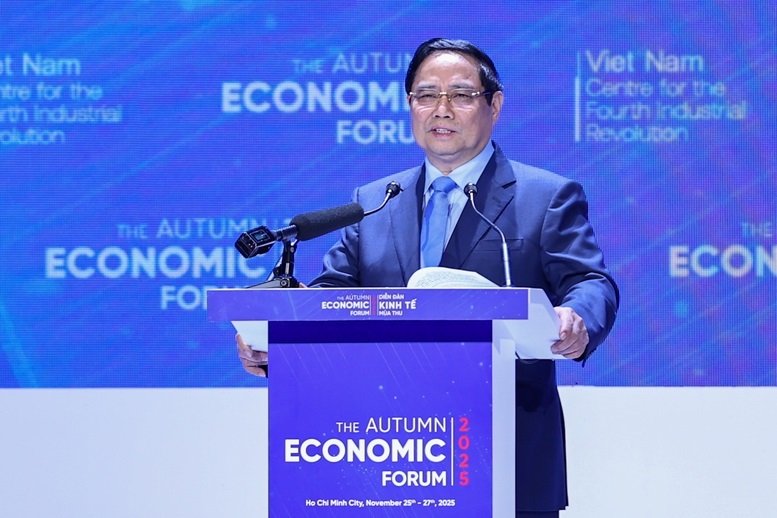 Prime Minister Pham Minh Chinh believes Ho Chi Minh City should pioneer as a sandbox for green economy, green finance, smart urban development, and the upcoming international financial center – Photo: VGP/Nhat Bac
|
Institutional Bottlenecks Holding Back Businesses
The Autumn Economic Forum highlighted an inescapable reality: Vietnamese businesses want to go green, but there remains a gap between aspiration and execution due to a legal framework that hasn’t kept pace with new development demands.
The first bottleneck is the lack of clear green business identification criteria. Without criteria, banks don’t know how to assess green credit, and businesses don’t know if they meet ESG standards.
Second, green activity incentives remain fragmented, lacking coordination and strength to change market behavior. Many businesses want to invest in clean technology but delay due to insufficient policy incentives when comparing costs and benefits.
Third, Vietnam lacks a true green financial market. From green bonds and credit to green investment funds or blended finance models (combining public and private capital for renewable energy, green transport, and circular urban projects), all remain in pilot stages. There is no synchronized legal framework, no specific risk monitoring mechanism, and no emission data infrastructure – core conditions for a transparent and efficient market.
Finally, linkages between the state, businesses, scientists, and the financial system remain disjointed. Green transition requires multi-sector coordination: scientists provide solutions, businesses implement, banks supply capital, and the state creates the legal framework.
These challenges collectively show that individual measures cannot untangle each knot. They demand a broad, flexible, and safe institutional space for genuine model testing. This need makes the green economy and green finance sandbox in Ho Chi Minh City the optimal solution to “unlock innovation” and create a replicable model for the nation.
Green Economy and Green Finance Sandbox: Institutional Tool for a New Era
As the traditional development model reaches its limits, a new institutional framework is essential to pave the way for innovation. The green economy and green finance sandbox is such a tool: a controlled legal testing space where Ho Chi Minh City can apply forward-looking mechanisms beyond current regulations. The 3-5 year period is not just for piloting but provides an institutional buffer to test new models, assess impacts, and refine policies before national scaling.
The sandbox’s key value is not just “doing differently,” but doing quickly, flexibly, and based on real-world impact assessments. This is how leading countries like Singapore, UAE, and South Korea have shortened policy cycles, reduced testing costs, and achieved growth model breakthroughs.
For Ho Chi Minh City, a green sandbox should start with the most impactful areas:
1. Green credit and green bonds: Develop separate criteria, fast-track approval mechanisms, and interest rate incentives to unlock capital flows.
2. Pilot carbon market: Carbon pricing, carbon credit trading, and standardized emission data – essential foundations for Net-zero commitments.
3. Green PPPs in public transport, renewable energy, and waste management to attract private investment in transformative infrastructure projects.
4. Green fintech: Test green payment models, ESG credit scoring, and supply chain emission tracking technologies.
5. Green industrial parks and circular cities: Pilot superior incentives to attract clean technology businesses and promote zero-waste models.
When implemented within the sandbox framework, these areas will create a synchronized institutional-technology-finance ecosystem, helping Ho Chi Minh City swiftly and substantively transition from a traditional to a green and digital growth model.
 Developing a green economy and green finance sandbox in Ho Chi Minh City not only benefits the city but also offers three strategic values for the nation. |
Strategic Benefits for the Nation
Developing a green economy and green finance sandbox in Ho Chi Minh City not only benefits the city but also offers three strategic values for the nation.
First, creating new growth momentum. Green finance and clean technology are the world’s “growth engines.” The sandbox will enable Vietnam to attract priority capital from international financial institutions while fostering new industries – renewable energy, smart cities, and circular economy.
Second, strengthening the 2050 Net-zero commitment with tangible solutions. Net-zero commitments cannot rely on vague policies but must be based on emission measurement, pricing, and management tools. The sandbox allows earlier, faster, and more accurate testing of these tools, laying the foundation for Vietnam’s entry into the global carbon market.
Third, elevating national stature. In the race for quality investment, countries with the earliest green and digital institutional frameworks will gain an edge. A successful sandbox in Ho Chi Minh City will position Vietnam among regional leaders in institutional innovation, building trust with global corporations and reshaping the national brand in the green era.
Concluding the forum dialogue, Prime Minister Pham Minh Chinh emphasized the shared spirit of this transition: “This forum converges intelligence, strengthens trust, and enhances unity – green and digital in harmony, towards the future, sharing benefits.” This is also the spirit of Ho Chi Minh City’s green economy and green finance sandbox: an open institutional space to connect all stakeholders, unlock resources, and drive transformative change for the entire economy.
Conditions for Sandbox Success
For Ho Chi Minh City’s green economy and green finance sandbox to be more than a slogan and truly become a “national institutional laboratory,” several foundational conditions must be met.
First, a superior national legal framework specifically for the green sandbox is essential. The National Assembly and Government must grant Ho Chi Minh City the authority to “do differently” and “do first” in areas from credit mechanisms, taxation, PPPs, to carbon markets. Without a broad and clear legal space, all pilot efforts will be hindered by the very barriers the sandbox aims to remove. This framework must clearly define objectives, scope, timelines, monitoring mechanisms, and scaling mechanisms to ensure both flexibility and safety.
Second, digital data infrastructure must become the “backbone” of the green sandbox. Ho Chi Minh City needs to develop and operate shared databases on emissions, green projects, green businesses, and digital platforms connecting banks, investors, and regulators. Only when data becomes transparent, measurable, and verifiable can green credit, green bonds, or carbon markets operate reliably and sustainably.
Third, high-quality green and digital human resources are irreplaceable. The green sandbox will require a generation of managers, financial experts, technologists, and environmental scientists who understand the languages of finance, technology, and climate simultaneously. This can only be achieved if the city heavily invests in training, talent attraction, and creates an environment for experimentation, learning from mistakes within the sandbox framework.
Finally, extensive international cooperation is the “catalyst” to shorten the learning curve. Ho Chi Minh City cannot and need not reinvent the wheel for lessons the world has already learned. Close collaboration with WEF, World Bank, ADB, IFC, climate funds, and leading global financial and technology centers will help the city access international standards, advanced financial tools, and long-term capital for green projects. Then, the city’s green sandbox will not just be a local pilot but a node in the global innovation network for green economy and green finance.
A Strategic Choice Paving the Way for the Future
Transforming Ho Chi Minh City into a national sandbox for the digital economy, green economy, and green finance is not just a local initiative but a national institutional breakthrough. It is an opportunity to help Vietnam shift from extensive to intensive development, from resource-intensive to value-based, from high emissions to green, circular, and sustainable development.
With its scale, capacity, and aspirations, Ho Chi Minh City can fully play the role of an institutional laboratory, opening the way for a greener, more modern, and competitive Vietnam in the era of ascent.
Dr. Nguyen Si Dung
– 06:09 01/12/2025
Accelerating Infrastructure: Ho Chi Minh City Urges Faster Progress on Multiple Highways and Metro Projects

Ho Chi Minh City mandates the timely handover of all land areas, strictly prohibiting any actions that hinder construction, to ensure the punctual completion of critical infrastructure projects.
CEO Vu Cuong Quyet: Skyrocketing Property Prices Pose Significant Concerns for Real Estate Professionals

Following a series of sharp price hikes, the real estate market typically enters a phase of price corrections and stagnation, according to Mr. Vu Cuong Quyet, CEO of Dat Xanh Northern Region. Consequently, he anticipates a shift toward sustainable development and steady growth in the market.
Ho Chi Minh City’s New Land Price Chart: Peak Rates Surpass 687 Million VND/m², Significant Surge in Binh Duong
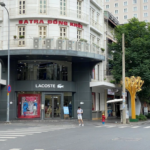
The anticipated land price list for Ho Chi Minh City in 2026 is expected to mirror the 2025 rates, with prime locations like Nguyen Hue, Le Loi, and Dong Khoi streets maintaining their premium value at 687 million VND per square meter.
T&T Homes Unveils Its First Sales Gallery in Ho Chi Minh City

On November 28, 2025, T&T Homes, the esteemed real estate brand under T&T Group, proudly unveiled its first Sales Gallery in Ho Chi Minh City. This milestone signifies a new chapter in the brand’s expansion into the Southern market, while reinforcing its commitment to delivering standardized consulting services and elevating customer experiences through cutting-edge technology and advanced virtual reality simulations.
Exciting News: Multi-Billion Infrastructure Projects Nearing Completion, a Major Boost for Western Ho Chi Minh City’s Real Estate Market
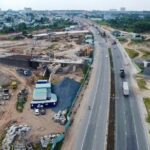
One of the key drivers propelling the real estate development in the western region of Ho Chi Minh City over the past years has been the robust investment in inter-regional transportation infrastructure.