Maximizing Rare Earth Export Restrictions
On the morning of December 1st, the National Assembly discussed the draft Law on Amendments and Supplements to the Law on Geology and Mineral Resources. During the final session, Minister of Agriculture and Environment Tran Duc Thang stated that the law was enacted in 2024 and has recently come into effect.
According to the Minister, this revision primarily aims to address immediate bottlenecks and challenges related to national key projects and strategies for managing, exploiting, and utilizing rare earth resources for national development.
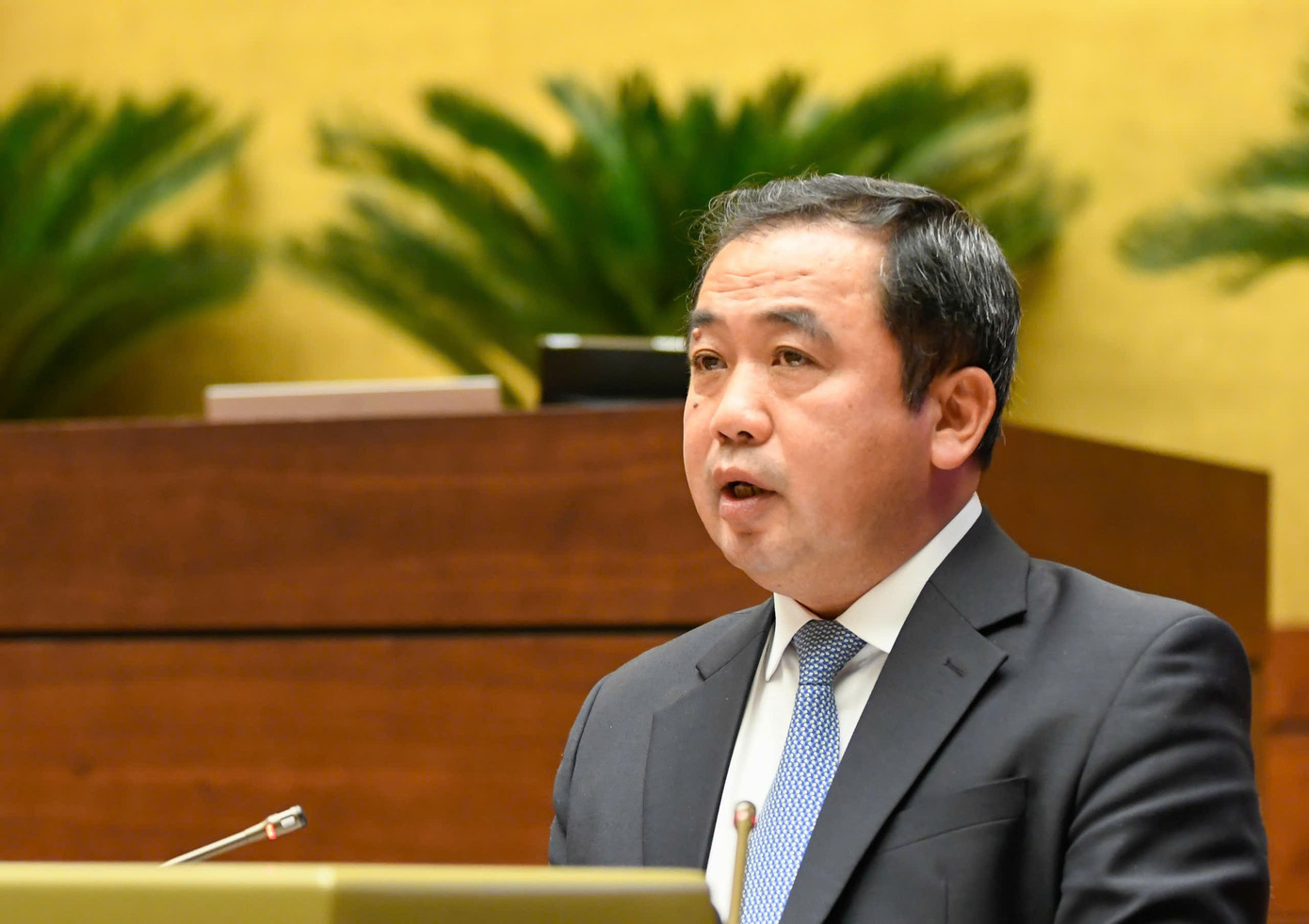
Minister of Agriculture and Environment Tran Duc Thang. Photo: Nhu Y
Regarding the mechanism for granting mineral exploitation permits for public works and key projects, many delegates suggested carefully considering the scope of eligible projects and decision-making authority to prevent loopholes and exploitation.
In response, Minister Tran Duc Thang clarified that the expansion of deep mining is only applicable to existing operational mines, without requiring additional planning for those specific mines. “Only new exploration and mining projects must fully comply with planning requirements,” he emphasized.
During the discussion, significant attention was given to the management of rare earth minerals. The Minister noted that Vietnam ranks second or third globally in rare earth reserves, distributed across 21 provinces and cities.
The Ministry of Agriculture and Environment has comprehensively identified mining areas and is implementing strict management measures. Additionally, the ministry is leading the development of a National Rare Earth Strategy, expected to be approved by early 2026.
“After identifying mining locations, the next critical step is to organize deep processing to maximize value for the nation. The draft law dedicates a separate chapter to rare earths, providing a foundation for government regulations to establish a closed-loop value chain and minimize raw exports,” the Minister explained.
Addressing Mineral Planning Shortcomings
During the session, delegates raised concerns about criteria for designating non-auction areas for mineral exploitation rights. The Minister explained that the draft law outlines specific principles and criteria to ensure stable raw material supplies for urgent projects and mineral processing initiatives—sectors with significant economic and social impact.

The Minister announced a forthcoming National Rare Earth Strategy. Photo: Nhu Y
Using cement plants as an example, the Minister noted that once investment permits are granted, associated raw material mines cannot be auctioned, as it would be impractical. “This provision addresses such specific scenarios,” he added.
The law also delegates detailed regulations on conditions and procedures for designating non-auction areas to the government. The designation process will involve collaboration among the Ministry of Agriculture and Environment, Ministry of Industry and Trade, Ministry of Finance, Ministry of Defense, Ministry of Public Security, and local authorities.
The goal, according to the Minister, is to thoroughly assess market demand, resource utilization efficiency, investor capacity, environmental impact, and community livelihoods, thereby fostering domestic deep processing chains.
“This approach mitigates risks from the outset by establishing non-auction areas, preventing policy exploitation, especially for strategically vital minerals. We are also attentive to delegates’ concerns about potential mechanism abuse leading to losses,” the Minister explained.
Regarding mineral reserve planning, the Minister emphasized that these areas are reserved for 50 years. Within these zones, only Level I projects are prohibited; Level II and lower projects can proceed normally.
Addressing Prime Minister’s Decision 866 on mineral planning through 2030, the Minister acknowledged its “significant shortcomings.” He noted that this issue has been addressed in responses to constituents and awaits the passage of the Planning Law. Afterward, the Ministry of Agriculture and Environment will submit new regulations.
“We anticipate resolving the issues in Decision 866 by January 2026,” the Minister affirmed.