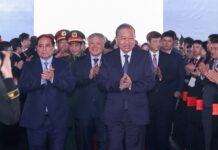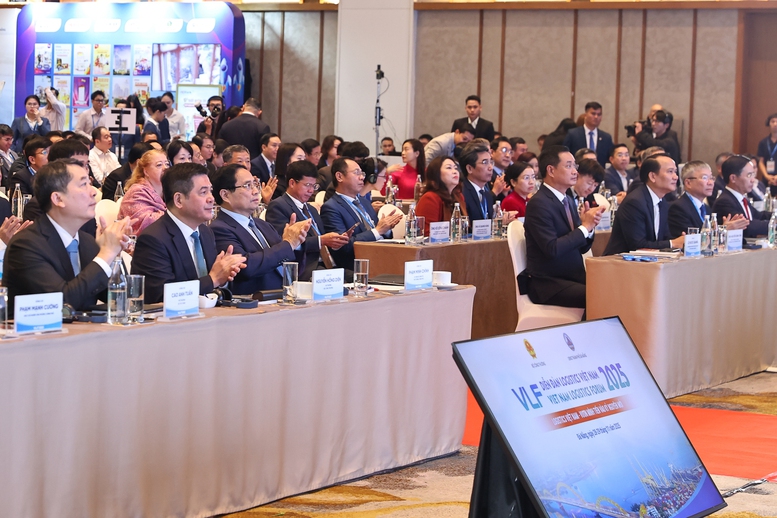
Prime Minister Pham Minh Chinh and delegates at the Vietnam Logistics Forum 2025 – Photo: VGP/Nhat Bac
On the morning of November 29th, in Da Nang, Prime Minister Pham Minh Chinh attended and delivered a speech at the Vietnam Logistics Forum 2025, themed: “Vietnam Logistics – Rising into the New Era.”
Also attending the forum were Minister of Industry and Trade Nguyen Hong Dien, Secretary of the Da Nang City Party Committee Le Ngoc Quang, leaders and representatives from various central ministries, local management agencies, industry associations, logistics service businesses, import-export companies, research institutes, universities, and international organizations in Vietnam.
At the forum, Prime Minister Pham Minh Chinh witnessed the signing ceremony of cooperation agreements between agencies and businesses. The Da Nang Logistics Association and Dong Nai Logistics Association were also officially launched.
Logistics industry must grow 1.5 times faster than GDP
Speaking at the event, Prime Minister Pham Minh Chinh highly appreciated the 13th organization of the forum, aiming to promote the rapid and sustainable development of the logistics industry – a vital sector in the circulation of goods and a key pillar in enhancing national competitiveness.
The forum was held in Da Nang, a strategically located city with a deep-water seaport system, an international airport, and a position on the North-South traffic axis as well as the East-West Economic Corridor, connecting countries in the Greater Mekong Subregion (GMS). Recently, the Prime Minister approved the pilot establishment of the first free trade zone in Da Nang.
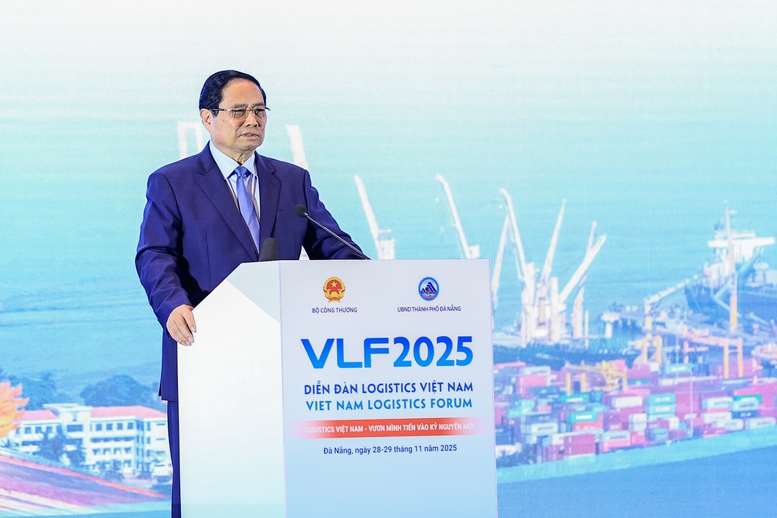
The Prime Minister outlined eight key tasks for logistics development – Photo: VGP/Nhat Bac
Along with the establishment of the International Financial Center here (in December 2025), the development of industrial and logistics infrastructure will be a driving force for Da Nang to surge ahead, becoming a regional and international financial, economic, and logistics hub, radiating development to the North Central region, the Central Coast, and the entire country.
The Party and State have paid great attention and issued many important policies to develop the logistics industry. Resolutions of the Politburo, institutions, mechanisms, and policies enacted by the National Assembly and the Government on regional development all include content on logistics. The implementation of these policies has yielded positive results.
First, the growth rate of logistics services has been rapid and stable, averaging 14-16%/year, directly contributing 4.5-5% to annual GDP. According to the World Bank’s 2023 report, Vietnam ranks 43rd out of 139 countries in the Logistics Performance Index (LPI) and is among the top 5 in ASEAN, alongside Singapore, Malaysia, Thailand, and Indonesia.
Second, logistics costs have decreased to around 16% of GDP (from over 20% in 2014), saving billions of USD annually for import-export businesses.
Third, the logistics infrastructure system has been synchronously invested in, particularly seaports, airports, highways, and logistics centers in key economic regions such as Ho Chi Minh City, Hai Phong, Quang Ninh, Da Nang, and Can Tho.
Fourth, the logistics business sector has grown stronger with over 34,000 enterprises. Many have deeply integrated into the global supply chain and applied advanced technology in operational management.
Fifth, free trade agreements have created a favorable environment for Vietnam’s logistics to integrate deeply, expand international service markets in terms of: Market – Infrastructure (international standards) – Supply chain – Cooperation, investment – Human resources and international technical standards.
Sixth, these achievements have directly enhanced the competitiveness of goods, reduced import-export costs, promoted international trade growth, and facilitated domestic goods circulation, with international trade reaching approximately $900 billion in 2025.
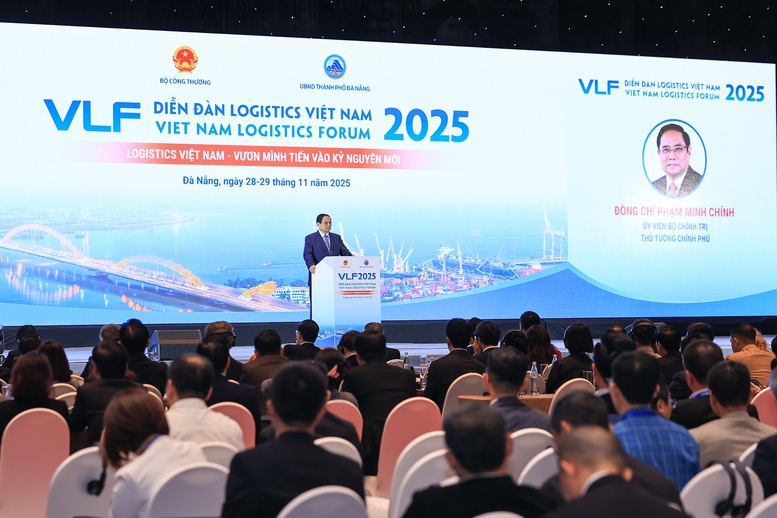
According to the Prime Minister, the achievements are not yet commensurate with Vietnam’s geo-political and economic advantages, and the logistics industry still has much room for development – Photo: VGP/Nhat Bac
Alongside these achievements, the Prime Minister noted that Vietnam’s logistics industry still faces challenges, with six bottlenecks. Logistics costs in Vietnam remain high compared to regional countries (Singapore at 8%, Malaysia at 12%, and the global average around 11%). Regional connectivity and infrastructure linkages are incomplete and vulnerable to natural disasters.
Most logistics businesses are small-scale with weak competitiveness, and there is a lack of large enterprises. A national-level logistics center for international goods transit has not been established. The industry also lacks high-quality, professionally trained human resources suitable for the international work environment.
Logistics institutions have not yet specified new types of logistics services for e-commerce, green logistics, and special logistics. Digital transformation and green transition in logistics lack a shared database and unified measurement standards.
The Prime Minister emphasized that these limitations require a shift in development thinking, moving from “supporting small-scale logistics” to “developing modern, smart logistics” as a key economic sector. This aims to maximize local potential, promote regional and international economic linkages, and position logistics services as a driving force for socio-economic development. The shift is from a “management” mindset to “creation and service” in line with the Logistics Development Strategy recently issued by the Prime Minister.
According to the Prime Minister, Vietnam’s achievements are not yet commensurate with its geo-political and economic advantages, and the logistics industry still has significant development potential. To contribute to the goal of achieving an average GDP growth rate of over 10%/year for the next five years, all sectors and localities must achieve double-digit growth.
Specifically, the logistics industry must grow at an average rate 1.5 times higher than GDP, with the value-added ratio of logistics services in GDP reaching 6-7%; the average annual growth rate reaching 15-16%; and logistics costs as a percentage of GDP reduced to the global average of 11-12%…
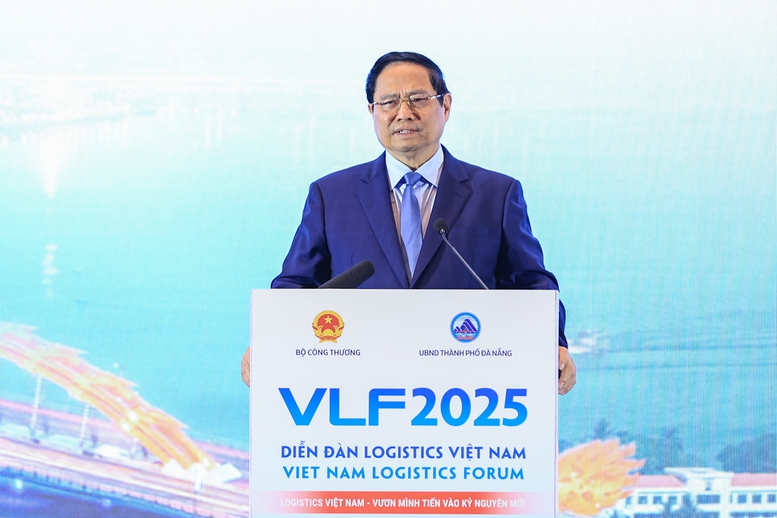
Prime Minister: Making Vietnam a leading logistics service hub in Southeast Asia, Asia, and the world – Photo: VGP/Nhat Bac
The Government adheres to the “5 Clear” action philosophy
Outlining eight key tasks for logistics development, the Prime Minister first requested the completion of logistics institutions and policies to ensure stability, synchronization, transparency, feasibility, and a significant reduction in administrative procedures and barriers to lower compliance costs for citizens and businesses.
Second, develop green, digital, smart, and modern logistics infrastructure. Connect the logistics database with the National Single Window. Strengthen international cooperation on green logistics, low-carbon logistics, and maintain a high value-added ratio of around 20-25% by 2030.
Third, train human resources for green, digital, smart, and modern development, alongside developing large, multinational logistics enterprises participating in the global value chain.
Fourth, establish mechanisms to mobilize resources for developing green, digital, modern, and smart logistics; promote public-private partnerships, combining state and private resources, domestic and foreign investment, direct and indirect capital, and loans…
Fifth, ensure smart logistics management through connectivity among businesses, management agencies, customs, banks, insurance, and transportation; encourage innovation, startups, especially digital technology startups, transportation connection platforms, warehouse management, and e-commerce.
Sixth, synchronously develop related services supporting the logistics industry, such as banking, insurance, financial centers, securities, healthcare, and education…
Seventh, link and connect Vietnam’s logistics with regional and international systems, with a vision and action plan to create strength through connectivity, cooperation for mutual benefit, and dialogue to build trust.
Eighth, apply science, technology, innovation, and digital transformation in the logistics industry, which is an objective requirement and a top strategic priority. The Prime Minister emphasized that agriculture helped the country escape poverty, industry made it a middle-income country, and science, technology, innovation, and digital transformation will make Vietnam a developed, high-income country.
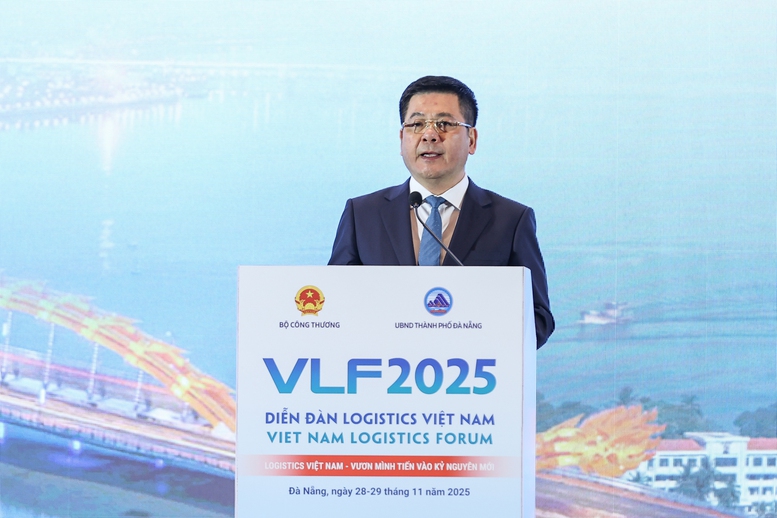
Minister of Industry and Trade Nguyen Hong Dien speaking at the forum – Photo: VGP/Nhat Bac
Regarding specific tasks for ministries, sectors, and localities, the Prime Minister directed the Ministry of Industry and Trade to urgently guide and coordinate with relevant ministries, sectors, localities, associations, and logistics businesses to implement the Logistics Development Strategy for the 2025-2035 period, with a vision to 2050.
The Ministry of Finance must streamline the organization and operation of the National Steering Committee on ASEAN Single Window, National Single Window, and Trade Facilitation (Committee 1899); enhance the effectiveness of inter-sector coordination from central to local levels to promptly restructure supply chains and domestic and international logistics services. This aims to shift the growth model towards efficiency and higher value-added, with infrastructure development as the foundation, smart logistics services as the driver, and green, digital, and modern development as the focus.
The Ministry of Finance, together with the State Bank, should research and develop financial, credit, and green logistics development funds to encourage and promote digital and green transformation among logistics businesses in the coming years.
The Ministry of Construction should continue leading and closely coordinating with the Ministry of Industry and Trade and localities to implement transport planning, ensuring effective connectivity with logistics centers nationwide. This includes linking logistics center planning with seaport, dry port, and bonded warehouse planning, and completing infrastructure for roads, railways, inland waterways, maritime, and aviation…
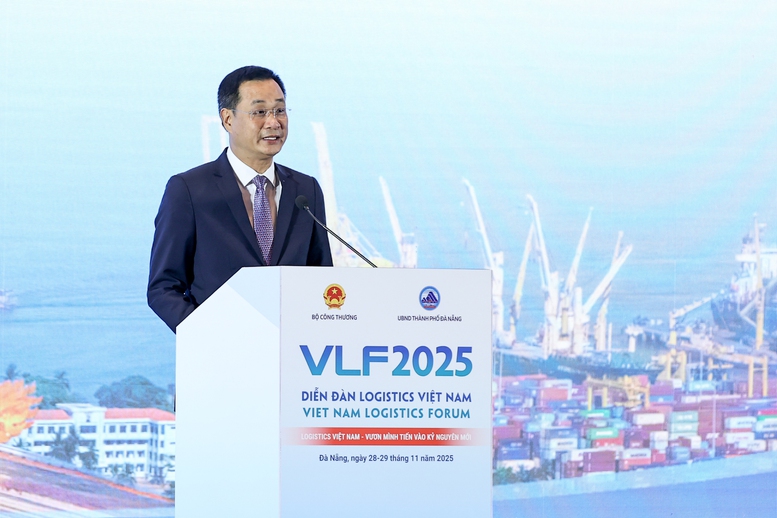
Secretary of the Da Nang City Party Committee Le Ngoc Quang speaking at the forum – Photo: VGP/Nhat Bac
Based on the planning, localities should focus on practical, prioritized investments, avoiding dispersion. They should clearly identify key investment priorities to effectively implement breakthrough projects, fostering regional, domestic, and international connectivity.
Localities like Hai Phong and Da Nang should leverage their potential, advantages, and policy mechanisms to develop logistics with a leading and exemplary spirit. Da Nang, in particular, should develop and capitalize on the first free trade zone in the country, complete infrastructure, and promote logistics services to help the city and the nation keep pace with regional and global development trends. It should proactively plan regional logistics centers, attract investment, implement “smart logistics city” models, and leverage the advantages of the free trade zone.
All ministries, sectors, and localities must focus on building a national logistics database, connecting it with the National Single Window, electronic C/O, digital customs, smart ports, and digital multimodal transportation. They should increase the rate of online administrative procedures, improve the quality of online public services, and enhance citizen satisfaction. Logistics should be prioritized in the National Digital Transformation Strategy, promoting comprehensive digital transformation in logistics to best serve businesses and citizens.
All relevant stakeholders should cooperate in logistics investment based on the principles of “equality, mutual development, shared benefits and responsibilities towards society, workers, and environmental protection; harmonized interests, shared risks.”
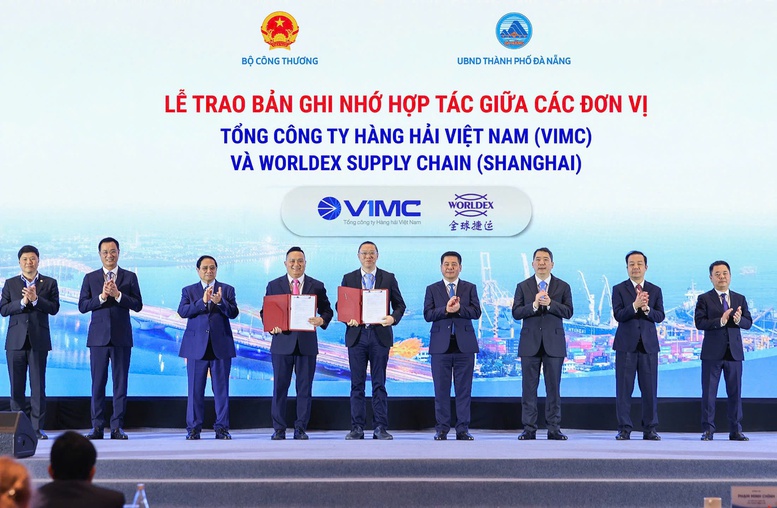
Prime Minister Pham Minh Chinh witnesses the signing of cooperation agreements between agencies and businesses – Photo: VGP/Nhat Bac
Emphasizing the philosophy “Proactive State, Pioneering Businesses, Public-Private Partnership, National Development, People’s Happiness,” the Prime Minister stated that the Government is committed to: Maintaining political stability and socio-economic stability; shifting the administrative apparatus from management to service and development facilitation; continuing the three strategic breakthroughs in institutions, infrastructure, and human resources; developing green supply chains, reducing compliance costs and input costs; building a healthy, fair, equal, transparent investment and business environment with stable, creative policies, high competitiveness, and predictability; encouraging and creating space for creativity, protecting legitimate rights and interests of all entities; continuing to invest in and develop modern spatial planning and infrastructure, adapting to climate change.
The Government adheres to the “5 Clear” action philosophy: “Clear Institutions – Clear Infrastructure – Smart Management – Common Practices – Mutual Understanding” to make logistics a key economic sector. This aims to realize the goal of ranking Vietnam among the top 30 countries in the Logistics Performance Index (LPI) by 2035.
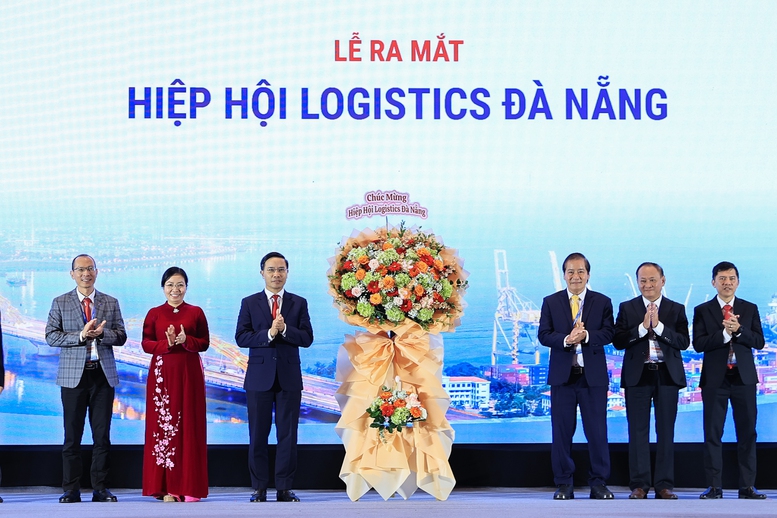
Launch of the Da Nang Logistics Association – Photo: VGP/Nhat Bac
With the spirit of “Saying and Doing, Committing and Delivering, Acting and Achieving,” “Turning the Impossible into Possible,” the Prime Minister hopes logistics businesses will continue to innovate management, link chains, promote digital and green transformation. They should uphold the spirit of “Self-Reliance, Innovation, Creativity, Cooperation,” and strive to reach regional and global levels. The Vietnam Logistics Business Association (VLA), Vietnam Logistics Human Resources Development Association (VALOMA), and local logistics associations should act as bridges, providing policy input, training support, and promoting logistics services in international markets.
Vietnam has the potential for logistics to develop rapidly, integrate, and lead in the region if we have a “broad vision,” “think big and act boldly,” based on the principles that “resources come from vision and thinking, momentum from innovation and creativity, strength from people and businesses.” We must harness intelligence, value time and decisiveness to turn challenges into opportunities, intentions into actions, and potential into products.
The Prime Minister is confident that with the synchronized efforts of the entire political system, close coordination among ministries, sectors, localities, international organizations, and businesses, all parties will listen, understand, share visions and actions, work together, and share successes, joys, and pride. This will successfully build a national logistics ecosystem, making Vietnam a leading logistics service hub in Southeast Asia, Asia, and the world.
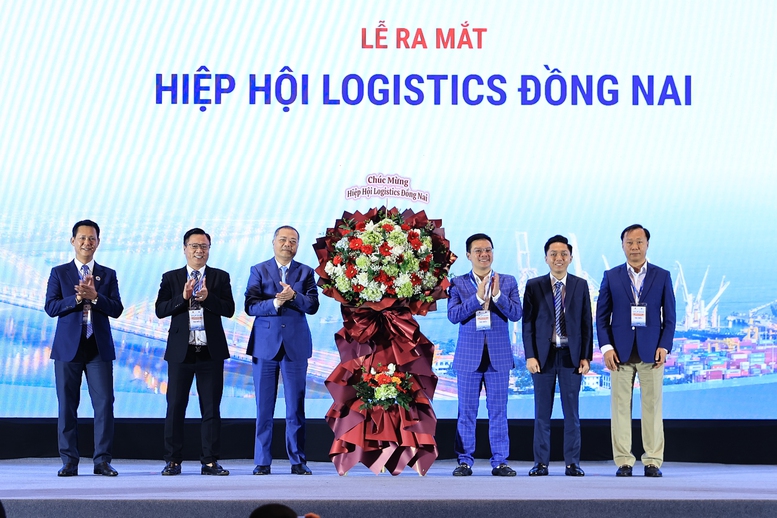
Launch of the Dong Nai Logistics Association – Photo: VGP/Nhat Bac
The Prime Minister welcomed the proposal for a National Logistics Day and instructed relevant agencies to follow legal procedures to submit it to the competent authorities.
Da Nang Offers Over 400 Prime Investment-Ready Land Plots
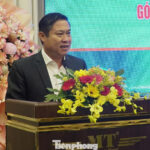
Mr. Huynh Tan Quang, Director of the Land Fund Development Center, shared this information during the seminar titled “Effective Management and Exploitation of Public Land Fund – New Development Momentum for Da Nang” held on November 29th.
Emerging Urban Corridor: Economic Hub Development from Da Nang Airport to Chu Lai
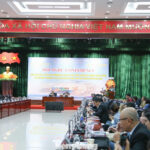
Da Nang City has identified the eastern region, stretching from Da Nang Airport to Chu Lai Airport, as the foundation for a coastal urban corridor and a key socio-economic hub. This strategic area will drive development and support growth in the western region.
Prime Minister: Logistics Growth Must Outpace GDP by 1.5 Times, Drastically Cutting Costs
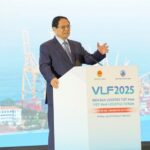
Logistics, hailed as the lifeblood of the economy, has been thrust into the spotlight by Prime Minister Phạm Minh Chính. He has set ambitious targets for the sector, demanding annual growth of 15-16%, a contribution of 6-7% to GDP, and a reduction in logistics costs below the current 16%.
Da Nang Surges Ahead: Hoa Xuan Emerges as a Real Estate Magnet

Following its merger with Quang Nam, Da Nang entered a pivotal phase for its new development trajectory, connecting two key economic regions. The city has transitioned from operating as a single-polar center to embracing a multi-polar growth model, fostering new investment hubs.
Exclusive Update: Progress on Đà Nẵng’s Most Anticipated Social Housing Projects in the City Center
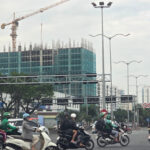
A surge in social housing projects is revitalizing Da Nang’s real estate landscape. Construction sites are buzzing with activity after a period of stagnation, fueled by the entry of numerous developers and the continuous approval of new projects. This renewed momentum promises a substantial and well-structured social housing fund for Da Nang residents in the near future.