Speaking at the seminar, Mr. Hoàng Ngọc Bách, Head of Division 4, Department of Cyber Security and High-Tech Crime Prevention (A05), stated that A05’s role is to collaborate with banks to combat high-tech crimes. Despite notable successes in recent years, current solutions are struggling to keep pace with advancements in technology, criminal tactics, and sophistication.

Mr. Hoàng Ngọc Bách, Head of Division 4, Department of Cyber Security and High-Tech Crime Prevention (A05), speaking at the seminar
Financial crimes today are predominantly cross-border. Most cases involving accounts and card payments have a clear international element. A prime example is Skimming (stealing card data at ATMs), which was rampant between 2016 and 2019 but significantly declined during the COVID-19 pandemic due to travel restrictions. This highlights the reliance of such crimes on foreign perpetrators.
Card-related crimes have not disappeared but have evolved into more sophisticated forms, targeting the vast credit card user base. Mr. Hoàng Ngọc Bách noted that high-tech criminals are meticulously studying ATM systems to launch direct attacks. Recently, the U.S. reported incidents of Jackpotting, where ATMs are manipulated to dispense cash automatically. While not yet widespread in Vietnam, financial institutions should proactively prepare for such threats, as these methods often originate from abroad.
Additionally, cardholders remain insufficiently vigilant about protecting their personal information. Many customers hand their cards to staff for swiping without verifying if their data is compromised. The rise of online payments (e-commerce) requires only basic details like name, card number, CVV/CVC, and expiration date, creating significant risks. Foreign criminals can even steal card chips, attach them to other devices, and drain funds rapidly.
Mr. Hoàng Ngọc Bách revealed that criminals, including foreigners, are exploiting Vietnam to steal funds from foreign cards. They use specialized printers to encode stolen card data onto blank cards, then use local POS terminals to withdraw money fraudulently.
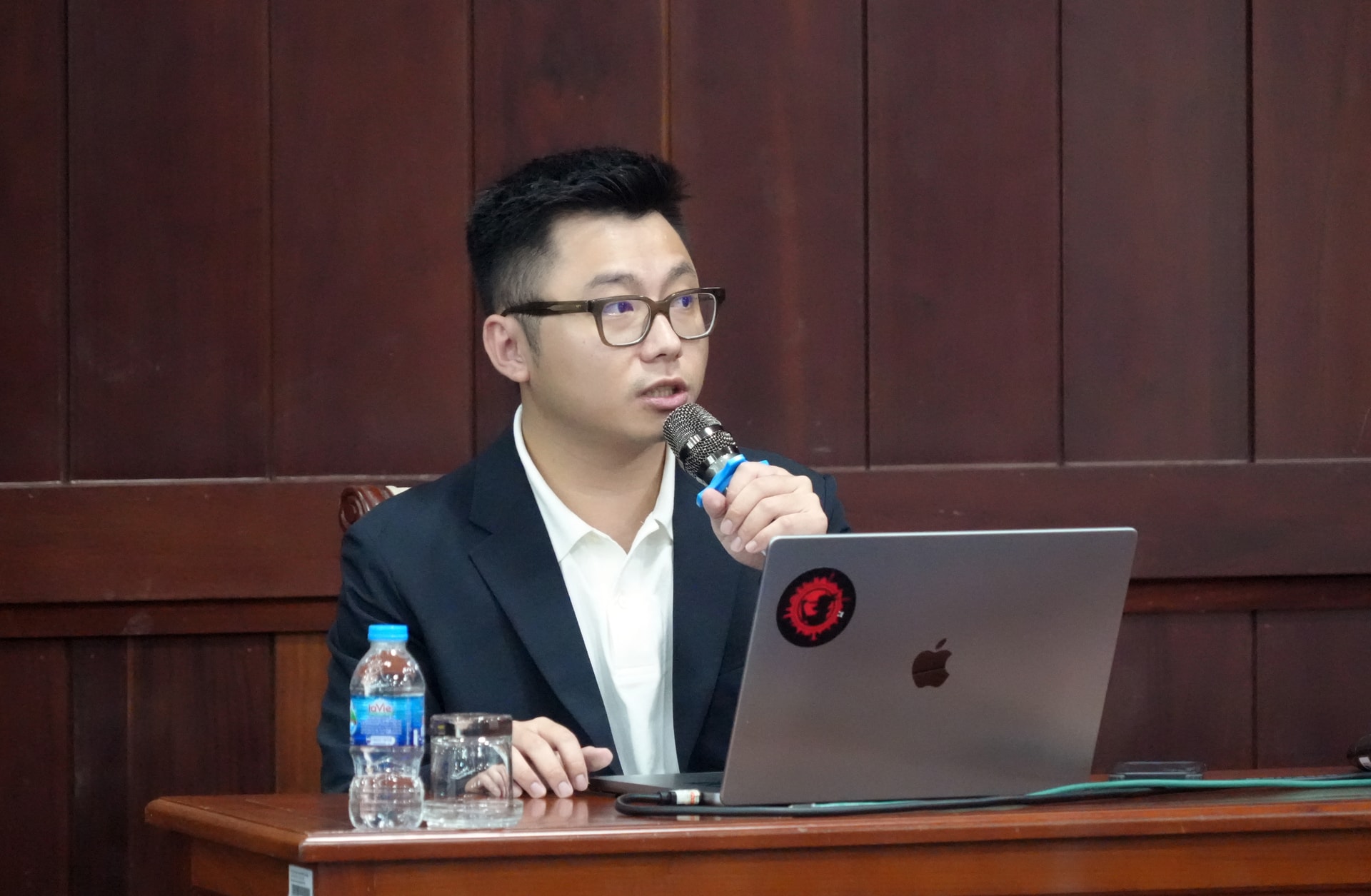
Mr. Nguyễn Mạnh Luật, Cybersecurity Expert, CEO of Cyberjutsu, and member of Chongluadao, sharing insights at the seminar
At the seminar, Mr. Nguyễn Mạnh Luật, Cybersecurity Expert, CEO of Cyberjutsu, and member of Chongluadao, discussed emerging fraud schemes. The most common method involves using benign tools to conceal malware for scams, such as: QR Code Fraud, where fake QR codes impersonate legitimate organizations or are placed in public areas. Scanning these redirects victims to phishing sites to steal login and OTP details; Deepfake Technology, where criminals impersonate senior executives for fraud. This technique is increasingly sophisticated, making detection challenging; and Impersonation of Trusted Entities, where fraudsters pose as reputable organizations to manipulate users.
After obtaining authentication details (Username, Password, OTP, CVV) via fake websites and apps, criminals use Real-Time Phishing (Man-in-the-Middle attacks) to replicate login processes and complete transactions instantly. They also seize device control to steal assets. Mr. Nguyễn Mạnh Luật emphasized that attack techniques are becoming more advanced, targeting banking infrastructure and contactless payments.
“We anticipate that criminals will increasingly exploit AI (Deepfake) and credit card cloning techniques, including NFC card replication, to execute transactions without user verification. They will also continue to misuse legitimate remote access software to bypass traditional defenses,” Mr. Nguyễn Mạnh Luật warned.
Raid on Da Nang Tech Firm: Police Uncover Dozens of Vietnamese Engineers Coding for Online Gambling Sites, Funneling Funds to Cambodian Partners

Uncover the truth behind the deceptive online betting websites designed to scam unsuspecting users: [https://vt88.com](https://vt88.com), [https://soi.bet](https://soi.bet), [https://tic88.com](https://tic88.com), [https://mi88.com](https://mi88.com), and [https://zo88.com](https://zo88.com). Stay informed and protect yourself from these fraudulent platforms.
“Cybersecurity Agency Representative: Scams Target Humanity’s Primal Instincts of Fear and Greed, Making It Impossible to Track Every Scheme”

According to Colonel Dr. Nguyễn Hồng Quân, Director of the Training Center under the Department of Cybersecurity and High-Tech Crime Prevention (A05), comprehensively identifying all fraud schemes is “impossible.” These schemes are orchestrated by organized “criminal syndicates” that constantly evolve their tactics. The majority of current online scams originate from transnational criminal networks operating in countries such as Cambodia, Myanmar, the Philippines, and the Middle East.
Police Presence Reported at Building Housing Shark Binh’s Company Headquarters

Late in the evening on October 6th, numerous Hanoi police officers arrived at a building on Tam Trinh Street, home to a company owned by Mr. Nguyen Hoa Binh (Shark Binh). The task force remained on site until 3 a.m. the following morning.
“TPBank: Elevate Your Digital Life with Intelligent Banking”

TPBank is at the forefront of a transformative journey, evolving from a digital bank to a bank of intelligence. We are harnessing the power of cutting-edge technology and combining it with a heart-felt approach to serve our customers in the most unique and personalized ways.
The Capital’s Woes: Half a Billion Lost from Bank Accounts after a Phone App Installation

After installing the software, as instructed by the scammer, Ms. L was shocked to discover that her bank account had been depleted of 500 million VND.