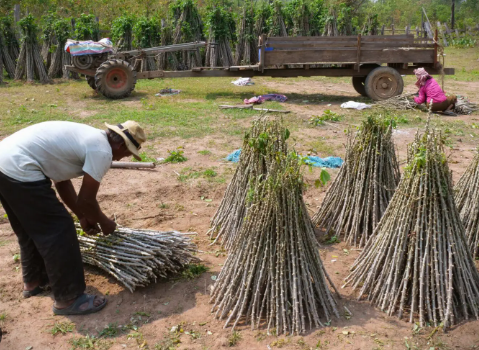
Illustrative image
Cassava and its derivatives are not only among Vietnam’s 13 key agricultural products but have also propelled the country to the second position globally in exports. According to preliminary data from the General Department of Customs, exports of this commodity group in the first 10 months of 2025 reached nearly 3.35 million tons, equivalent to approximately $1.04 billion, marking a 60% increase in volume and an 85% rise in value compared to the same period last year.
The average price stood at $310 per ton, a 32% decrease compared to the same period in 2024.
In October alone, cassava exports reached over 260,000 tons, valued at more than $88.5 million, reflecting a 3.6% decline in volume and a 1% drop in value compared to the previous month.
In terms of market distribution, 95% of cassava and its products are exported to China. Specifically, in the first 10 months of the year, Vietnam exported over 3.1 million tons of cassava to China, worth more than $962 million, representing a significant 64% increase in volume and a 10% rise in value compared to the same period last year. Prices decreased by 33%, to $304 per ton.
Exporting companies report that Vietnamese cassava starch is highly favored in China, especially during the Mid-Autumn Festival and year-end celebrations for confectionery production. However, competition remains fierce with cheaper alternatives, and corn starch is increasingly substituting cassava starch. Besides Vietnam and Thailand, China has also increased purchases from Laos, Cambodia, and Brazil, while reducing imports from Indonesia.

Taiwan (China) ranks second, importing over 46,000 tons of cassava and its products, earning $17.36 million, a 14% increase in volume but a 21.7% decrease in value compared to the same period. Malaysia is the third largest market, with 23,024 tons valued at $8.82 million, reflecting a 71.2% increase in volume and a 25.5% rise in value.
Despite generating significant export value, approximately $1–1.2 billion annually, Vietnam’s cassava industry faces considerable environmental challenges. Unsustainable and extensive cassava cultivation has led to severe soil depletion, as cassava is a nutrient-intensive crop with low ground cover, making it prone to erosion.
According to the Import-Export Department (Ministry of Industry and Trade), the decline in cassava export prices is attributed to increased starch inventory in Chinese factories due to earlier orders from Thailand and Vietnam. Additionally, the Vietnam Cassava Association notes that price reductions result from surplus starch inventory in domestic factories, reducing raw material absorption capacity. Increased cassava supply, as farmers expand cultivation areas, further exacerbates price declines.
Currently, Vietnam has over 140 cassava starch processing plants with a total capacity of 9.3 million tons per year. The Ministry of Agriculture and Rural Development aims to achieve cassava and derivative exports worth $1.8–2 billion by 2030.
To meet this goal, Vietnam must focus on enhancing product quality, diversifying export markets, and strengthening collaboration between processing companies and cassava farmers. Advancing the application of science and technology in production and processing is also crucial for improving productivity and product quality.
“Underground Goldmine” in Northern Vietnam Empowers Farmers with Hundreds of Millions per Harvest
“Discover the revolutionary crop transforming livelihoods and replacing traditional cornfields. This innovative plant is empowering communities, driving daily prosperity, and redefining agricultural success.”
Exposing the Counterfeit Durian Ring: The Industry’s Plea to Untangle Quality Testing Bottlenecks
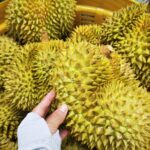
To ensure sustainable durian exports, it is crucial to enhance testing capabilities, prioritize transparency, and reduce costs.
Vietnam’s Durian Industry Faces a Major Lesson
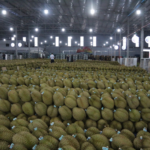
Rigorous control over regional plantation codes and packaging facility codes is a prerequisite for the sustainable development of the durian industry.
China Spends Nearly $1 Billion on Vietnamese Specialty in Just One Month
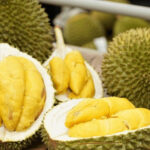
This exceptional Vietnamese product is now exported to over 20 countries and territories worldwide.
Cassava Starch Industry Rebounds: Apfco and Yfatuf Report Extraordinary Profit Surges
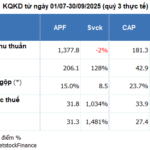
Two of the rare listed companies in the cassava starch industry, Quang Ngai Agricultural and Food Joint Stock Company (Apfco, UPCoM: APF) and Yen Bai Forest Agricultural Products and Food Joint Stock Company (Yfatuf, HNX: CAP), have both reported exceptional profit growth in Q3, despite revenues not yet showing a strong recovery.