




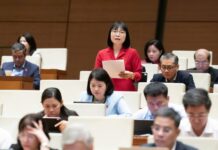







On the afternoon of December 3rd, the National Assembly held group discussions on draft resolutions to amend and supplement certain provisions of Resolution No. 98/2023/QH15 on piloting special mechanisms and policies for the development of Ho Chi Minh City (HCMC), and Resolution No. 136/2024/QH15 on urban administration organization and piloting special mechanisms and policies for the development of Da Nang City.
HCMC: A Growth Pole Losing Momentum
During the group discussion, Delegate Hoang Van Cuong (Hanoi) emphasized that while both Hanoi and HCMC are special urban areas, HCMC’s uniqueness is most evident in its location, scale, and role as an economic leader.
HCMC is not only the largest commercial and service hub in the country but also a convergence of regional strengths, having merged with Binh Duong, Ba Ria-Vung Tau to form a comprehensive growth pole encompassing industry, seaports, and international logistics.
“However, it’s concerning that for the past decade, HCMC’s growth rate has been lower than the national average. A growth pole moving slower than the average clearly indicates a problem,” he noted. He observed that previously, many new mechanisms originated from HCMC and spread nationwide, but its leadership role is no longer as prominent.
Therefore, he believes new mechanisms must help HCMC regain its position as a leader in institutional reform, becoming a testing ground for policies before wider implementation.
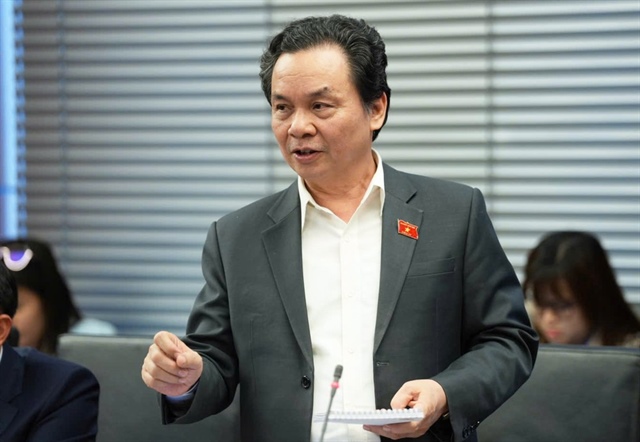
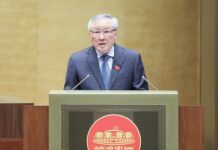
Delegate Hoang Van Cuong (Hanoi). Photo: Trong Phu |
Delegate Hoang Van Cuong pointed out that the current Resolution 98 has many limitations due to its enumerative approach, requiring approval for each small detail, lacking openness. He cited the example of the list of strategic investors, which includes dozens of types, but if a new investment model emerges tomorrow and is not on the list, HCMC has no mechanism to attract it.
The most unreasonable point, he noted, is at the beginning of the resolution: The HCMC People’s Council is granted authority over many areas but with the clause “in accordance with the law.”
“If it’s meant to be special but every action must follow existing laws, what autonomy does HCMC have? That ‘tail’ is why Resolution 54 had to be repeatedly requested, ultimately losing its special meaning,” he analyzed.
He proposed that the amended resolution should remove all constraints that negate openness. The National Assembly should only stipulate responsibilities, scope, and oversight mechanisms, leaving full decision-making authority to the city.
Proposing to Grant HCMC Authority to Immediately Address Legal Obstacles
Delegate Hoang Van Cuong suggested a new approach where laws and resolutions provide only frameworks, principles, and incentive ceilings, rather than specific lists. For example, instead of listing strategic investors, the resolution could define them as new investors capable of leading or solving problems the city faces. Alternatively, it could set incentive ceilings, with specific levels determined by HCMC.
This way, the HCMC People’s Council could flexibly set criteria for different stages and sectors, such as housing, tourism, or high technology. When new models emerge, the city could adjust without needing resolution amendments.
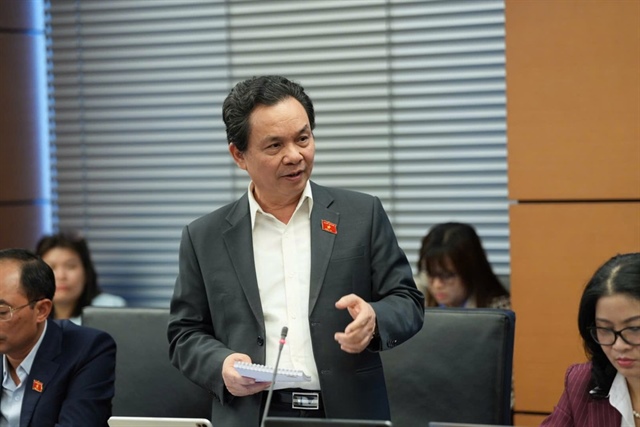
Delegate Hoang Van Cuong (Hanoi). Photo: Trong Phu |
“We cannot list every future possibility. The key is to create a broad framework for HCMC to innovate in practice,” he stressed.
Currently, for conflicting or unamended regulations, the country applies Resolution 2006, allowing the Government to pilot mechanisms and report afterward.
Mr. Cuong proposed extending this mechanism to the city level, allowing HCMC to independently issue policies to resolve special legal obstacles, reporting to the Government for submission to the National Assembly Standing Committee.
“If implemented, HCMC would have nearly its own sky to fly within oversight limits. Whether the city succeeds or not would be its responsibility, not the mechanism’s fault,” he emphasized.
Granting Authority Also Measures Capability
Discussing the draft on special mechanisms for Da Nang, Delegate Hoang Van Cuong found the city’s proposals too detailed, with some unreasonable content, such as approving planning tasks simultaneously with detailed planning, which is unnecessary as planning tasks are the investor’s responsibility under the law. He suggested Da Nang adopt an approach similar to HCMC: “Remove details, retain principles, increase autonomy.”
He also highlighted that high-tech zones and industrial parks in HCMC and Da Nang should have mechanisms akin to free trade zones. Management agencies must have full decision-making authority, not just act as “one-stop shops” forwarding files to departments.
|
Delegate Hoang Van Cuong (Hanoi). Photo: Trong Phu |
“International experience shows that special zones only succeed when managers have full approval, attraction, and licensing authority. Acting as intermediaries cannot lead to breakthroughs,” he said.
According to Delegate Hoang Van Cuong, the National Assembly should view special mechanisms not as favors but as a way to test local leadership capabilities in a highly autonomous environment. If HCMC and Da Nang fail to develop despite granted authority, the responsibility cannot be blamed on policies.
“Only when granted authority and held accountable can HCMC truly become an institutional testing ground, finding solutions to legal obstacles. Then, special mechanisms will have true meaning,” he emphasized.
REPORTING TEAM
– 16:58 03/12/2025
Why Is the Disbursement of Social Housing Credit and Worker Housing Funds Delayed?
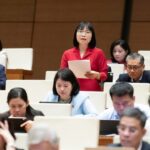
The issue was raised by National Assembly delegate Nguyễn Thị Việt Nga (Hải Phòng) during her feedback on the government’s report regarding the implementation results of resolutions on questioning and supervision in the banking sector.
Billion-Dollar Intersection: The Most Complex Junction on Hanoi’s Ring Road 3 Nears Technical Completion
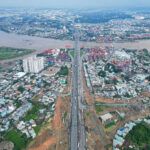
The Tan Van Interchange stands as the most intricate project along Ho Chi Minh City’s Ring Road 3, currently under accelerated construction with multiple work fronts operating in parallel.
Proposed One-Year Health Insurance Exemption for Disaster-Affected Citizens

Members of the National Assembly have proposed a one-year waiver of health insurance premiums, funded by the state budget, for citizens voluntarily enrolling in health insurance in provinces severely affected by natural disasters.
Lawmaker Proposes Citizens Receive Compensation Difference When Land Acquisition Prices Fall Below Agreed Rates
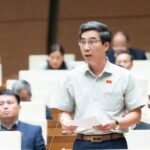
Every member of the National Assembly unanimously supported the proposal that citizens should receive the difference if the land compensation price is lower than the agreed-upon value.
Unblocking Land-Related Bottlenecks: A Comprehensive Solution
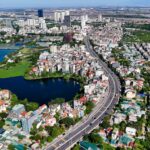
The National Assembly is considering the adoption of a resolution introducing new mechanisms and policies regarding land reclamation and land valuation. These measures aim to address existing challenges and meet the practical demands of the current situation.