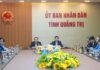






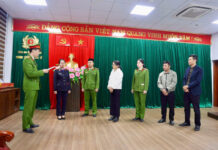






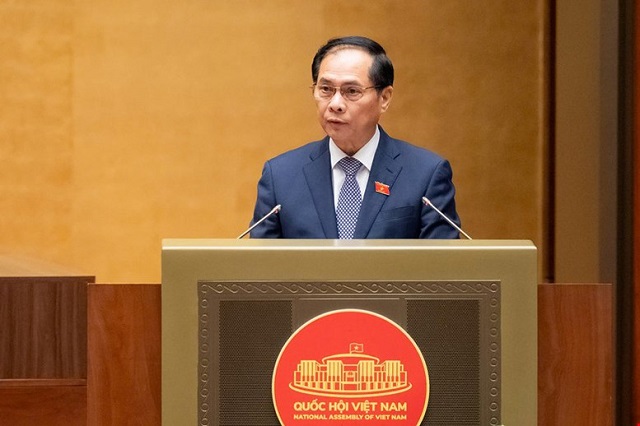
Deputy Prime Minister Bui Thanh Son presents the proposal to the National Assembly.
|
On behalf of the Prime Minister, Deputy Prime Minister Bui Thanh Son presented the government’s proposal to the National Assembly.
The proposal highlights that following the consolidation, Ho Chi Minh City (HCMC) has expanded its development potential with an area of 6,772.6 km² and a population of 13.6 million. Its labor force stands at approximately 7.281 million, accounting for 14% of the national total. The city’s GRDP is estimated at 3.03 million billion VND (equivalent to 123 billion USD), contributing 23.5% to the country’s GDP.
This expansion opens opportunities for spatial restructuring and integrated urban planning under the vision of “1 center, 3 regions, 1 special zone,” optimizing the comparative advantages of each area. The goal is to create a multi-centered megacity developing along three corridors, supported by five pillars: industrial hubs, logistics centers, international financial centers, tourism and cultural industries, and education, healthcare, and technology hubs. Specific targets include an average GRDP growth rate of 10-11% annually, a per capita GRDP of 14,000-15,000 USD by 2030, and total social investment averaging 35-40% of GRDP over five years. The digital economy is expected to contribute 30-40% to the GRDP.
To achieve these goals over the next five years, the city needs to mobilize an additional 8-12 billion USD annually. However, the budget can only cover about 30% of this requirement (1.2 million billion VND out of 3.5 million billion VND), insufficient to drive socio-economic development.
To ensure HCMC’s role as a leading economic hub and achieve double-digit growth by 2026, the city requires additional breakthrough solutions beyond Resolution 98/2023/QH15. These measures aim to attract investment, address bottlenecks, and unlock resources. Focus areas include strategic projects in transportation, urban infrastructure, tourism, environmental management, climate change mitigation, high technology, healthcare, and education, as well as the establishment of a free trade zone.
Developing HCMC into Southeast Asia’s largest megacity
The government emphasizes that amending Resolution 98 will strengthen the legal framework, ensuring special mechanisms and policies to attract strategic investors and mobilize domestic and foreign resources. This aligns with the city’s post-consolidation development goals.
Additionally, these amendments aim to resolve challenges in implementing Resolution 98, positioning HCMC as Southeast Asia’s largest megacity and a key growth driver for the Southeast and Southwest regions, as well as the entire nation.
The draft resolution proposes policies for transit-oriented development (TOD) and investment procedures. It allows land funds from TOD projects to be used for payment in Build-Transfer (BT) railway projects, enhancing feasibility and encouraging private investment in public transportation, in line with national policies.
Amendments also permit mixed-use development at railway stations, depots, and surrounding areas along the Ring Road 3, optimizing land use and promoting modern public transportation systems, similar to global urban models.
A key addition is the establishment of the HCMC Free Trade Zone (FTZ), with a comprehensive legal framework covering location, functional zones, management mechanisms, land policies, investment incentives, administrative simplification, and special customs procedures.
This initiative aims to create a superior institutional environment, similar to those in Hai Phong and Da Nang, to attract high-quality investment, foster modern services, and drive innovation. The HCMC FTZ is expected to become a regional economic, financial, and trade hub, piloting new models for potential nationwide replication.
Specific policies for the FTZ include granting HCMC People’s Committee authority to establish, expand, and adjust the FTZ’s boundaries, with the People’s Council regulating procedures. The Export Processing and Industrial Zones Management Board will oversee the FTZ’s state management.
The FTZ will offer non-auction land allocation for non-residential projects, streamlined administrative procedures, and relaxed investment conditions for foreign entities. It will also provide exemptions from specialized inspections, intra-bloc trade measures, and priority customs treatment for eligible businesses.
Tax incentives include a 10% corporate income tax rate for 20 years (4-year exemption and 50% reduction for 9 years), and a 50% personal income tax reduction for high-skilled experts over 10 years. Businesses in the FTZ can also list, price, and transact in foreign currencies.
– 20:40 03/12/2025
MCH to Officially Announce HOSE Listing Plan on December 4th
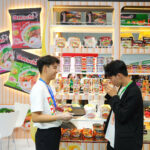
As a leading player in the fast-moving consumer goods (FMCG) industry, Masan Consumer’s (UpCom: MCH) announcement of its listing roadmap on HOSE has captured market attention. The anticipation stems from the expectation that HOSE will welcome a robust enterprise with strong brands and a substantial scale, poised to become a long-term anchor for both domestic and foreign capital.
2025 Milestones: Phạm Nhật Vượng Invests $1.2B in VinFast’s ‘No Plan B’ Strategy, Trần Đình Long Unveils New ‘Steel Fist’, Nguyễn Đức Tài Completes Mission

Vietnam’s business landscape is dominated by visionary leaders. Billionaires Phạm Nhật Vượng, Nguyễn Thị Phương Thảo, and Trương Gia Bình are global players, shaping industries on an international scale. Meanwhile, Bùi Thành Nhơn and Đoàn Nguyên Đức are masterminds of corporate revival, breathing new life into their enterprises.
Ho Chi Minh City to Pilot Flying Cars and Delivery Drones: Businesses Concerned Over Legal Hurdles and No-Fly Zones

Unmanned Aerial Vehicles (UAVs) are currently predominantly utilized in agriculture, but their application in delivery services necessitates a significantly more sophisticated management system.
Fortune Unveils Southeast Asia’s Top 100: Vietnam Stands Alone with Two Companies in the Top 10
Who are the two representatives?
Exciting News for Novaland and Homebuyers: 10,500 Land Titles in Ho Chi Minh City Soon to Be Delivered, Multiple Projects Break Free from Stagnation

With decisive government leadership and proactive legal unblocking measures from the Ho Chi Minh City People’s Committee, Novaland is poised to resolve property ownership rights for over 10,500 households and reignite key projects during the 2025-2026 period.