Residents Await Support
With just over six months remaining, Hanoi will ban gasoline motorbikes during specific hours within the Ring Road 1 area (covering 9 wards), gradually expanding the restricted zones in subsequent years. Residents living and working within Ring Road 1 are grappling with the transition to alternative vehicles.
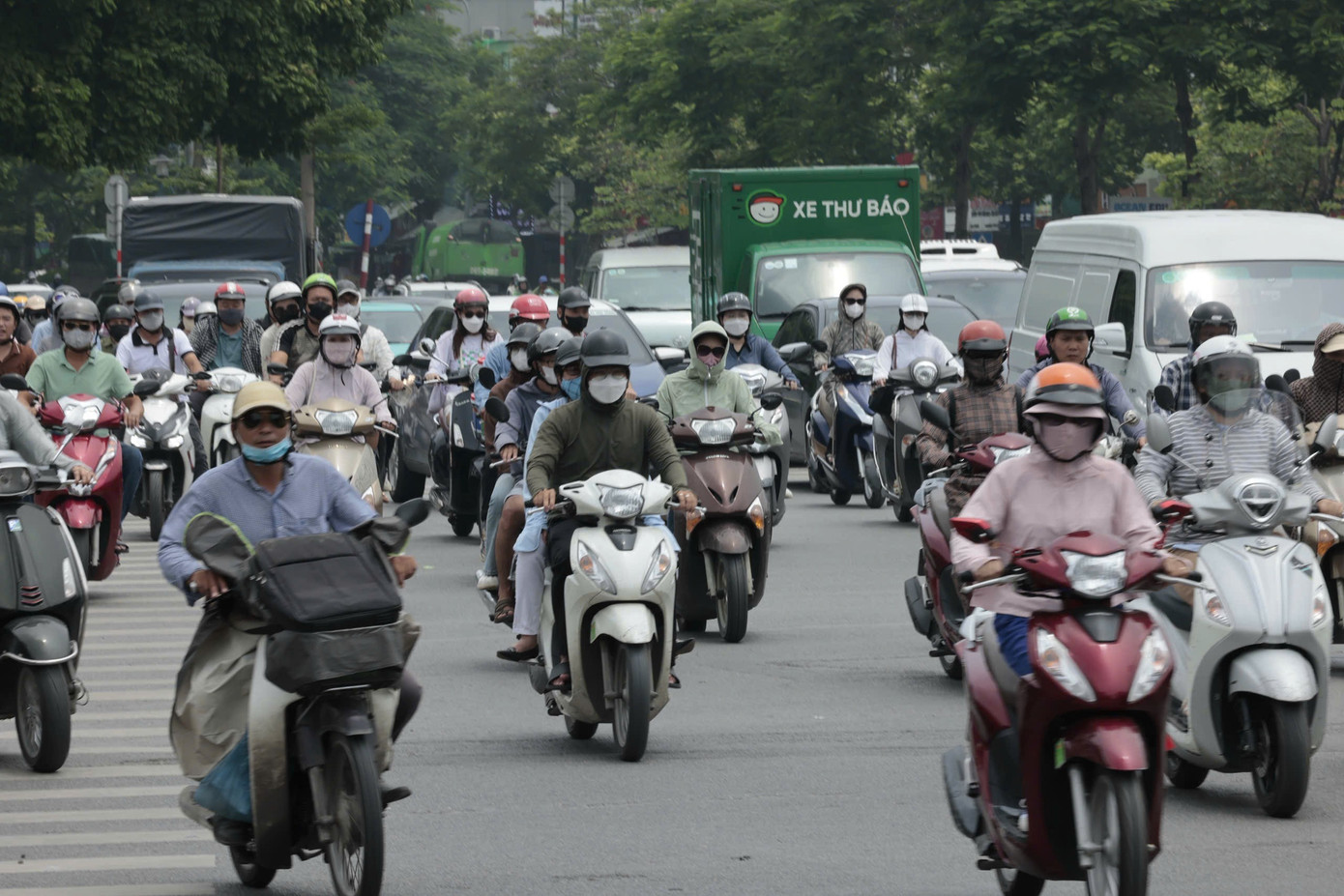
Hanoi will ban gasoline motorbikes in Ring Road 1 from July 1, 2026. Photo: Nhu Y
Mr. Pham Hai, residing in Quan Thanh Street, Ba Dinh Ward, shared that his three-generation family owns three gasoline motorbikes. He expressed concern about financing new electric vehicles, as the resale value offered for their current bikes is too low.
“Since hearing about the ban, my family has been anxious. Given our frequent travel needs and the inconvenience of bus stops, we’ll likely switch to electric motorbikes. Purchasing three electric bikes, each costing at least VND 20 million, is a significant expense. Our biggest worry is the fire risk from charging three bikes in our cramped, poorly wired home,” Mr. Hai said.
Mr. Hai’s concerns reflect those of many Ring Road 1 residents. Most families own at least two motorbikes, with some households having up to four. Ms. Le Thu Lan from Long Bien, Hanoi, and her husband work within Ring Road 1. Considering the ban, they initially thought of using buses but found it impractical, requiring three transfers to reach their office.
Regarding electric motorbikes, Ms. Lan noted that their apartment’s parking area has only 100 charging ports for over 1,500 households.
“Many in our building work in Ring Road 1. Switching to electric bikes poses charging challenges. I’ve heard of a VND 5 million subsidy per person for electric bikes, but it’s insufficient. Low-income families like ours hope for more support,” Ms. Lan urged.
According to Tien Phong reporters, Hanoi has approximately 6.9 million motorbikes, with about 450,000 in Ring Road 1. At a July 2025 environmental seminar, Hanoi authorities stated that gasoline motorbikes contribute 60% of the city’s air pollution, with 70% being old vehicles with uncontrolled emissions.
Under the Low Emission Zone Resolution, Hanoi will ban app-based commercial motorbikes and restrict other motorbikes by time or area. Gasoline vehicles not meeting Euro 4 emission standards will also face restrictions. From July 1, 2026, the pilot low emission zone will cover 9 wards: Hai Ba Trung, Cua Nam, Hoan Kiem, O Cho Dua, Van Mieu, Ba Dinh, Giang Vo, Ngoc Ha, and Tay Ho.
Infrastructure and Traffic Management
Speaking with Tien Phong, Ms. Bui Thi An, Director of the Institute of Natural Resources, Environment, and Community Development, emphasized replacing old motorbikes and supporting residents. Hanoi should expand green infrastructure, such as charging stations, increase public transport, and adopt cleaner fuels. These measures will aid residents in transitioning to low emission zones. For commuters, designated parking areas and shuttle services will be provided.
“Establishing low emission zones and banning old motorbikes is essential. The key challenge is planning the transition and support to minimize disruption. Hanoi must review green infrastructure, like charging stations, to ensure readiness by the policy’s effective date,” Ms. An stated.
Ms. An also stressed the need for financial support and guidance to help residents choose durable electric bikes. Motorcycles are vital for livelihoods, commuting, and school runs. Support measures should be tailored to different groups, with higher subsidies for low-income families.
VinFast offers a trade-in program for gasoline bikes, allowing owners to exchange their old bikes for new electric models with a discount. Free public charging is available until May 2026.
In preparation, companies like Selex are expanding charging and battery swap services. Dr. Nguyen Huu Phuoc Nguyen, CEO of Selex, noted growing interest in electric bikes. Selex plans to launch personal electric bikes in early 2026, alongside cargo models for delivery services.
In December, Tri Nam Group (TNG) piloted a public electric bike-sharing program in Ring Road 1, deploying 500 bikes across 130 stations. These bikes feature removable batteries, eliminating home charging needs. Each charge allows 90 km of travel at up to 25 km/h, with a 130 kg capacity and front storage. When out of power, users can pedal like a regular bicycle.
Smart Mobility Lessons from Europe
European technology partners propose piloting smart mobility zones in Vietnam, integrating public transport, electric vehicles, and data-driven traffic management for cleaner, safer, and more livable cities.
EuroCham highlights the complexity of transitioning to clean transport, suggesting plug-in hybrids as a bridge to full electrification. This approach builds market confidence and facilitates charging infrastructure development.
Vietnam’s EV transition faces challenges, including limited charging infrastructure and financial burdens, especially for low-income groups. EuroCham recommends a dual transition path: electric bikes or cleaner gasoline bikes (Euro 4, E10 biofuel), with stricter controls on old vehicles.
“Authorities should prioritize charging infrastructure, grid expansion, battery standardization, and recycling systems. This balanced approach reduces emissions while ensuring social stability and sustainable growth,” EuroCham advised.
Quỳnh Nga
Hanoi Shatters Records, Enters Golden Growth Season

With an estimated GRDP growth of 8.5% for the year, the economy is projected to reach a scale of approximately $63.5 billion, contributing a significant 12.5% to the nation’s GDP.
Revitalizing Ring Road 2.5: Addressing Repeated Encroachments to Prevent Project Delays

The Ring Road 2.5 project, connecting Dam Hong to National Highway 1, has been under construction and facing delays for nearly a decade. Currently, the project has reached the Dinh Cong Urban Area – National Highway 1 section, but continues to encounter land clearance issues. In some areas, previously cleared land has been reoccupied, further complicating construction efforts.
Hot: VinFast Considers Adding Gasoline Engines to Extend Range for Electric Vehicles
VinFast is reportedly considering equipping some of its electric vehicle models with small gasoline engines, primarily to charge batteries and extend driving range, according to Reuters. This strategy mirrors approaches taken by international automakers, addressing infrastructure challenges and boosting sales in global markets.
VinFast’s Three New Registered Models Go Viral: Are Lux SA and Lux A Making a Comeback?

VinFast has recently filed for design patent protection for a brand-new sedan model and two innovative SUV designs.
Ten Wards and Communes in Hanoi Still Lagging Behind in Land Clearance for Ring Road 4 Project
The completion of the parallel road section of Ring Road 4 passing through Hanoi is expected by the end of 2025. However, with 10 out of 17 communes and wards still pending, the project timeline has been extended to 2026.