Accelerating the $5.3 Billion Ring Road 4 Project in Ho Chi Minh City

AI-generated illustration of the future Ring Road 4 project in Ho Chi Minh City
The Ring Road 4 project in Ho Chi Minh City is recognized as the largest road infrastructure project in the Southeast region, spanning nearly 160 km across multiple provinces. Acknowledging its strategic importance and in response to government directives, the Ho Chi Minh City People’s Committee has established a Steering Committee to oversee the project’s investment and construction.
The committee comprises 15 members, led by Chairman Nguyen Van Duoc of the Ho Chi Minh City People’s Committee. Vice Chairman Bui Xuan Cuong serves as the Standing Deputy Chairman, responsible for overall coordination.
Vice Chairman Hoang Nguyen Dinh oversees compensation, resettlement, and land acquisition—a critical and complex phase requiring extensive inter-agency collaboration. The project’s regional connectivity is further emphasized by the participation of Vice Chairmen Ho Van Ha (Dong Nai Province) and Nguyen Minh Lam (Tay Ninh Province) as Deputy Chairmen, ensuring alignment among all involved localities.
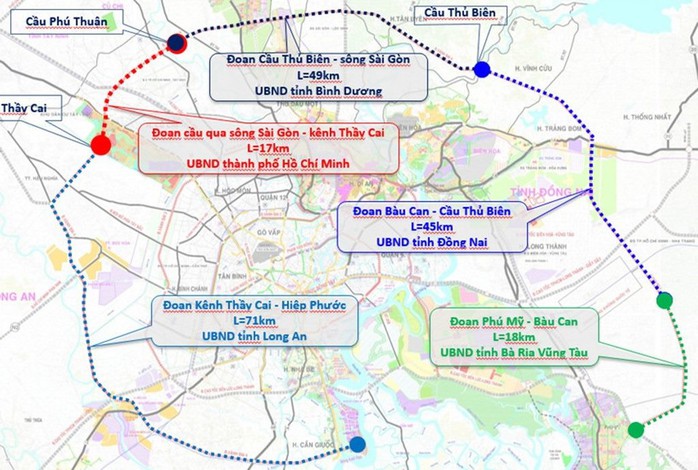
Route of Ring Road 4 – Ho Chi Minh City. Source: Bao NLĐ
Additional members include leaders from specialized departments such as Construction, Natural Resources and Environment, Planning and Architecture, and Finance from Ho Chi Minh City, Dong Nai, and Tay Ninh. These departments will manage technical procedures, planning, investment, and financial aspects throughout the project’s implementation.
The government has delegated significant authority to local leaders, empowering the Chairmen of Ho Chi Minh City, Dong Nai, and Tay Ninh to make investment decisions, conduct feasibility studies, and approve component projects.
Progress updates indicate that Ho Chi Minh City and other provinces along the route have accelerated preparatory work. Approximately 89% of land measurement, inventory, and compensation—essential for site handover—has been completed.
What Are the Key Features of the Ring Road 4 Project?
Approved by the National Assembly in June 2025, the Ring Road 4 project has a total investment of over $5.3 billion. The initial design includes a 4-lane road with a maximum speed of 62 mph and a width of 84 feet. Future expansions will increase the lanes to 8 and widen the road to 244 feet. Completion is targeted for 2028, with operations commencing in 2029.
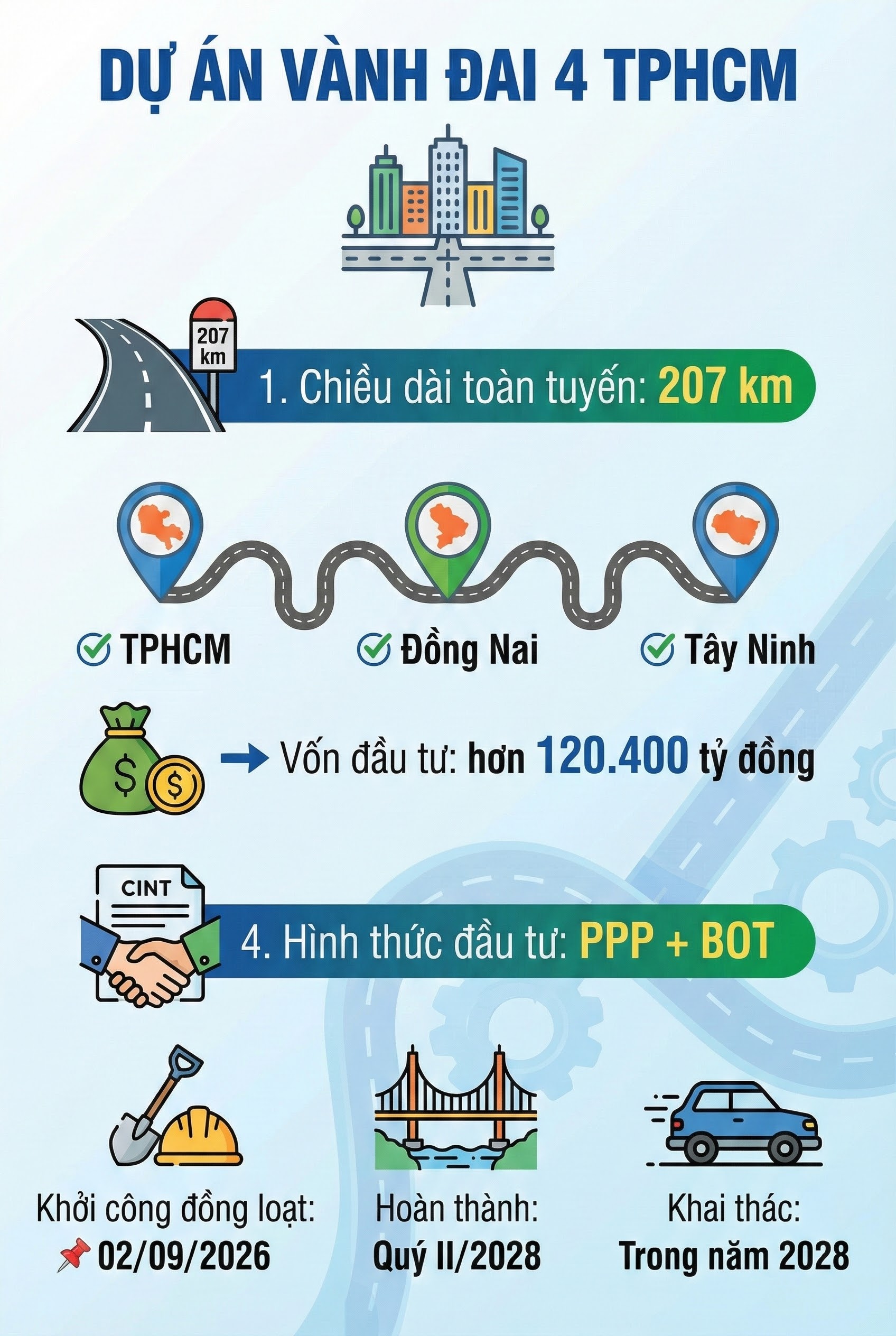
Spanning 129 miles across Ho Chi Minh City, Dong Nai, and Tay Ninh (post-merger), the project includes a 29-mile segment in Binh Duong (pre-merger) that began construction in June 2025. This marks the start of a major urban-industrial infrastructure initiative in the Southern Key Economic Region.
The remaining 100-mile segments, with an investment of over $5.3 billion, were approved by the National Assembly in June 2025. Notably, the Ho Chi Minh City segment expanded from 11 miles to 52 miles post-merger, becoming the longest section of the project.
For public-private partnership (PPP) components, feasibility studies are expected to be finalized by January 2026, with investor selection and BOT (Build-Operate-Transfer) contracts signed by June 2026. This timeline enables eligible packages to commence construction by late 2026.
The entire Ring Road 4 project is scheduled to break ground simultaneously on September 2, 2026, Vietnam’s National Day, demonstrating a strong commitment to its timeline. Completion is set for Q2 2028, with operations beginning the same year, facilitating trade and logistics across the Southeast, Southwest, and Central Highlands regions.
Once operational, the road will serve as a strategic link between key economic zones, streamlining cargo movement between industrial parks, urban areas, and seaports. It will also optimize connectivity with Long Thanh International Airport and major ports, fostering new development opportunities, increasing land value, and boosting urban growth, industrial production, and logistics services along the corridor.
Additionally, Ring Road 4 will ease traffic congestion in urban areas and gateway routes by facilitating access from National Highway 13 and National Highway 22 to ports in Tay Ninh and Hiep Phuoc (Ho Chi Minh City).
The Southeast region, home to major cities like Ho Chi Minh City and Dong Nai, is Vietnam’s largest investment hub, attracting over $189 billion across 21,000 projects as of October 31, 2024.
It is also Vietnam’s wealthiest region, contributing approximately $33.5 billion to the 2024 national budget, accounting for 42.2% of the total revenue (a 3.6% increase from the Prime Minister’s target).
Billionaire Pham Nhat Vuong’s Vingroup to Launch Mega Projects in Less Than 20 Days: From Largest-Ever Urban Development to Metro and Steel Plant

On December 19, 2025, Vingroup will simultaneously break ground on four major projects spanning real estate, transportation infrastructure, and steel manufacturing.
Da Nang Addresses Concerns Over Rapid Rise of Coastal High-Rises

Da Nang is actively exploring comprehensive solutions to alleviate infrastructure strain and ensure balanced development as numerous high-rise buildings emerge in the central riverfront and coastal areas.
Ten Wards and Communes in Hanoi Still Lagging Behind in Land Clearance for Ring Road 4 Project
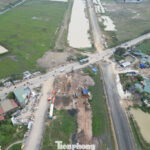
The completion of the parallel road section of Ring Road 4 passing through Hanoi is expected by the end of 2025. However, with 10 out of 17 communes and wards still pending, the project timeline has been extended to 2026.
Groundbreaking Date Set for Unprecedented Two-Tier Bridge-Road Project, Connecting to World-Class Airport

Vietnam’s wealthiest city has set a groundbreaking date for this one-of-a-kind project.
Crowdsourcing Logistics: Empowering Everyone to Build Infrastructure and Grow Businesses with Viettel Post

Viettel Post’s CEO, Phung Van Cuong, unveiled a groundbreaking strategy: “Socializing Logistics Infrastructure.” This innovative approach aims to engage the community in building a robust logistics network, empowering every individual to become an integral part of the operational chain. By fostering this collaborative model, the goal is to significantly reduce delivery wait times and progressively enhance the efficiency of Vietnam’s logistics sector.