

















The Vietnam Gold Traders Association (VGTA) has submitted a proposal to the National Assembly Chairman, advocating for the removal of conditional business restrictions on the gold industry in the revised Investment Law draft.
Specifically, VGTA requests the exclusion of gold jewelry and art production, trading, and the import/export of raw gold for such purposes from the list of conditional business sectors.
Article 7, Clause 1 of the Investment Law draft stipulates that conditional investment and business sectors are those requiring specific conditions due to national defense, security, social order, public health, and moral considerations. However, Appendix 4 of the Investment Law states: “Gold trading is a conditional investment and business sector.”
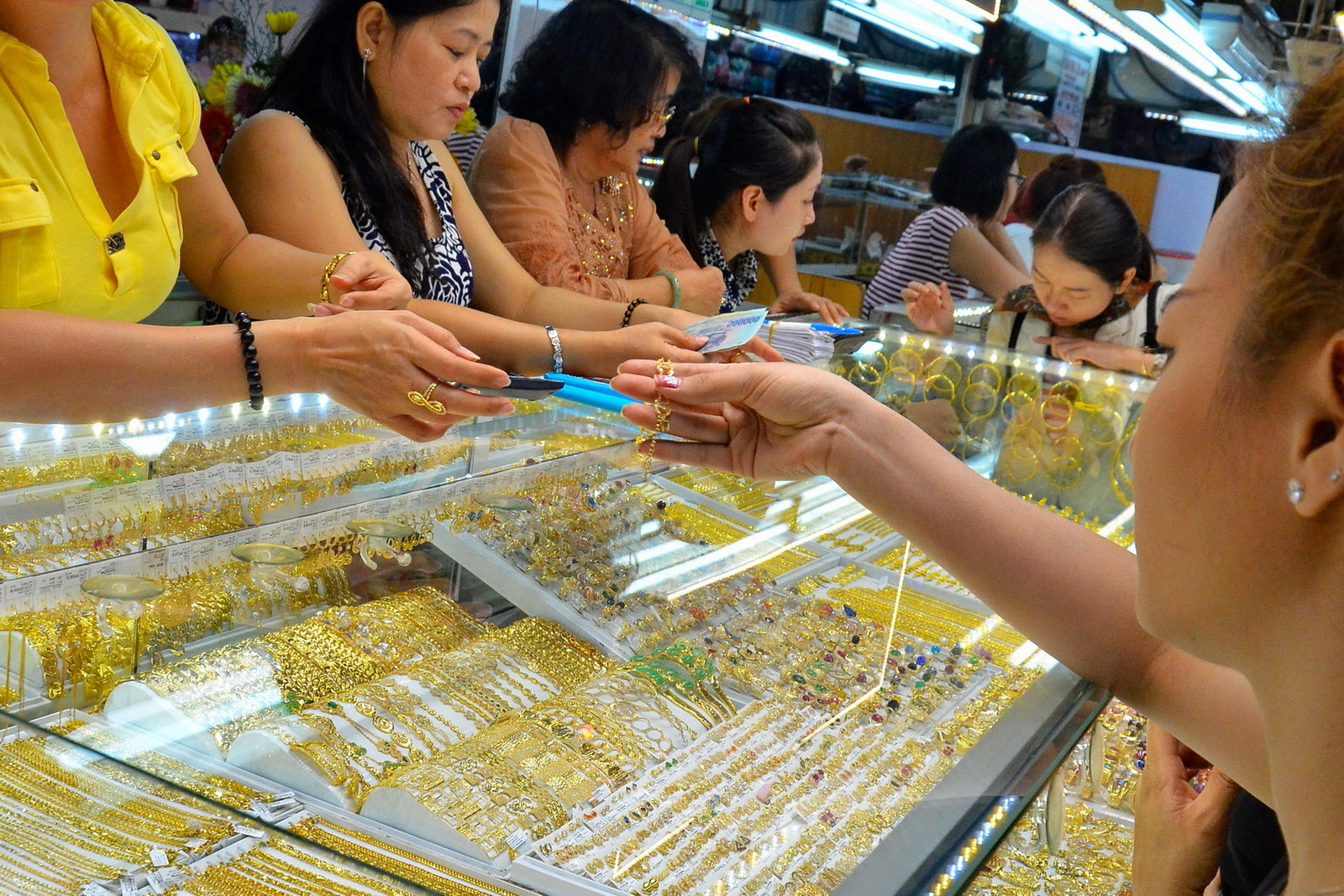
According to VGTA estimates, the annual demand for raw gold in jewelry and bar production averages 50 tons, valued at approximately $5 billion. Photo: Tấn Thạnh
VGTA argues that this regulation misaligns with Article 7, Clause 1 of the Investment Law and fails to reflect the realities of the gold trading sector. Despite ongoing National Assembly discussions on the revised Investment Law, “gold trading” remains unaddressed for conditional business restriction reductions.
Current regulations define gold trading as encompassing gold bar production and trading, gold jewelry and art production and trading, gold import/export, and other gold-related activities.
“Among these, only gold bar production, derivative gold products, and gold trading platforms should be subject to conditional business restrictions.
Other activities such as gold jewelry and art production, trading, and raw gold import/export for jewelry do not impact national defense, security, social order, public health, or morality,” VGTA representatives argue.
VGTA estimates the annual raw gold demand for jewelry and bar production at 50 tons, valued at $5 billion ($420 million monthly).
For over 13 years, gold jewelry producers have been unable to obtain raw gold import licenses, hindering production and market supply. VGTA highlights the challenges and risks businesses face in sourcing gold from the public.
Post-production, half of the output meets domestic demand, while the other half is exported, generating $3.5–5 billion. Labor value constitutes over 30% of export revenue.
Globally, gold jewelry and art production and trading are treated as standard commercial activities, with no countries imposing conditional business restrictions.
Countries like Thailand, Singapore, and Indonesia actively support and promote this sector, achieving $5–7 billion in annual jewelry exports.
“Allowing raw gold imports for jewelry production would not only meet domestic demand but also generate significant foreign currency through exports,” VGTA representatives conclude.
Hanoi Terminates Posco E&C’s Urban Development Project

Investors failed to comply with the mandated investment procedures, prompting the Hanoi People’s Committee to issue a decision terminating the validity of all documents and directives related to the Ngoc Liep – Dong Truc Urban Area (Zone 9) project by Posco E&C.
Unleashing Business Potential: The Urgent Need to Further Streamline Business Conditions
Numerous opinions suggest that there are currently too many conditional business sectors and professions that are not truly necessary. Therefore, it is essential to continue reviewing and reducing these to create greater ease and convenience for businesses.
Maximizing Incentives Without Technology Transfer: The Risk of Remaining a Manufacturing Hub

Delegate Hà Sỹ Đồng proposed that if the commitment to transfer is not fulfilled, incentives should be revoked, and a double penalty on the amount of incentives received could be imposed.
Streamlining Business: Eliminating 50 Conditional Industries and Professions
There’s no need to maintain conditional industries or professions at the legislative level. Instead, such specifics should be delegated to specialized laws or detailed decrees.
Finance Minister Proposes Cutting 50 Conditional Business Sectors
The Minister of Finance has announced that the ministry is conducting a comprehensive review to streamline and reduce the number of conditional business sectors and occupations.