













Air pollution is a pressing issue. According to a June 2023 World Bank estimate, Vietnam’s economic losses due to air pollution exceed $13 billion annually, equivalent to 4% of its GDP, including healthcare costs and reduced labor productivity.
Air pollution was also a key topic at the “Science and Innovation for a Sustainable Future” symposium, held during the VinFuture Science and Technology Week 2025 (December 2–6).
On the sidelines, we spoke with Dr. Filippo Giorgi, a researcher at Italy’s Abdus Salam International Centre for Theoretical Physics and a VinFuture Awards Preliminary Judge. Dr. Giorgi contributed to the first five IPCC reports and served as Vice Chair of IPCC Working Group I (2002–2008), which won the 2007 Nobel Peace Prize.

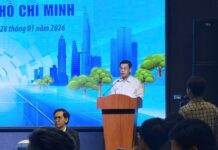
Dr. Filippo Giorgi discusses “Climate Action for a Sustainable Future” at the symposium.
Hanoi’s Air Pollution is Severe
Dr. Giorgi, you’ve been in Hanoi for a few days. How would you describe the air quality here? Do you have any solutions or research to address this issue?
Hanoi’s air pollution is severely noticeable—you can feel it just by breathing. Compared to European cities, the pollution here is much worse. It should be a top priority. The haze isn’t natural; it’s mostly fine dust and pollutants, which obscure the sun and indicate high pollution levels. This is critical, as pollution is the “third leading cause of death” after cancer and cardiovascular diseases. WHO reports 6–8 million annual deaths from pollution-related illnesses like respiratory and heart conditions.
High temperatures and humidity are also concerning. When temperatures exceed 35°C with high humidity, the body struggles to cool down, straining the cardiovascular system. In my country, lower humidity makes hot weather more bearable. Here, the combination of heat and humidity makes it harder to adapt, adding health risks. Addressing air pollution and extreme heat is crucial.
Hanoi plans to ban gasoline motorbikes and replace them with electric ones. Is this an effective solution for mitigating climate change impacts?
Electric vehicles, including motorbikes and cars, significantly save energy. Electric motors are far more efficient than internal combustion engines, so electric motorbikes use much less energy, regardless of the electricity source. This greatly improves energy efficiency.
Replacing old motorbikes is essential, but it requires funding and incentives. This would substantially improve air quality, as motorbikes are a major pollution source, even more than cars.
Switching from gasoline to electric motorbikes is vital, primarily to improve air quality.

Dr. Filippo Giorgi advises major cities like Hanoi on reducing air pollution.
What advice do you have for Vietnamese scientists researching solutions to air pollution in cities like Hanoi and Ho Chi Minh City? What recommendations do you have for Vietnam based on your research?
European pollution control measures consider climate change impacts, as it exacerbates pollution. Vietnam can adopt a similar approach. Solutions like stricter regulations on internal combustion vehicles can address both pollution and climate change.
To tackle Hanoi’s environmental issues, researchers should focus on two areas. First, reduce motorbike emissions by modeling emissions, identifying pollutants, and studying their environmental impact. This will inform effective pollution control measures.
Second, lower urban temperatures through urban planning. Hanoi can learn from cities like Singapore, which uses green buildings, rooftop gardens, and water features to cool down. Shopping centers and large buildings can incorporate greenery, rooftop gardens, and water bodies to reduce heat. Temporary solutions like shaded walkways, as seen in Spain and Portugal, also help.
The goal is to make the city cooler and more livable with more green spaces, shade, and water features. This is vital in Hanoi’s hot, humid climate, where healthy living thresholds are 35°C during the day and 25°C at night. Exceeding these limits causes health issues, especially cardiovascular problems. Combining air pollution control and urban cooling is essential for improving residents’ quality of life.
Central Vietnam’s Flooding Causes
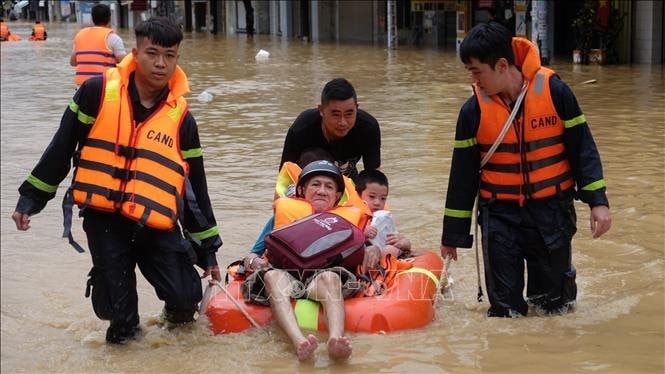
Residents in Nha Trang’s flooded areas (Khanh Hoa) are evacuated to safety on November 17, 2025. Photo: TTXVN
How is climate change affecting the stability and intensity of monsoons in Southeast Asia? Are extreme weather events like Central Vietnam’s floods a sign of changing monsoon patterns?
Climate change may alter some monsoon characteristics, such as the start and length of the rainy season. Generally, it slightly weakens monsoons but increases rainfall. While monsoons may become less intense due to certain dynamics, higher humidity means more rain.
Whether this has occurred in Southeast Asia is uncertain. Some monsoon trends may have shifted, but Southeast Asian monsoons remain hard to predict accurately.
For issues like pollution or flooding, technology and policies can help. Coastal flooding can be addressed with seawalls, and river flooding with improved flow management. These are adaptive measures tailored to specific problems.
Another concern in Southeast Asia is prolonged extreme heat. In Singapore, extreme heat forces people indoors and halts outdoor work. Similarly, in Europe, last summer’s heat in Italy made outdoor work impossible during peak hours.
For extreme heat, urban cooling technologies like green buildings and shaded streets can help. While technology can’t change the weather, it can mitigate impacts. Green buildings are particularly useful in cities with urban heat islands.
“We Can’t Predict When the Next Flood Will Occur”
Can floods like those in Central Vietnam two weeks ago be predicted?
Weather forecasts are reliable for only 7–10 days, useful for predicting storms but not long-term climate. We can’t know exactly when or where extreme events will occur.
After 10 days, don’t trust forecasts. For example, we can’t predict the next Central Vietnam flood, but we know such events will likely increase. This distinction between weather and climate is key.
Models show these events will become more frequent and severe due to higher atmospheric moisture and energy. Thus, we expect heavier rainfall and more intense events.
Vietnam can use international climate models like Europe’s, but these need adjustments for local conditions. AI can refine data to improve accuracy for Vietnam’s specific climate.
Thank you for your insights!
Dr. Filippo Giorgi is a Distinguished Scientist at Italy’s Abdus Salam International Centre for Theoretical Physics (ICTP) and a global leader in climate modeling. He pioneered regional climate modeling, advancing understanding of climate impacts and extreme events. Ranked by VIA-Academy as Italy’s top scientist in Natural and Environmental Sciences, he’s also among Stanford’s 2025 global top 10 in Meteorology and Atmospheric Physics.
Dr. Giorgi contributed to the first five IPCC reports and served as Vice Chair of IPCC Working Group I (2002–2008), which won the 2007 Nobel Peace Prize. He played key roles in WCRP and CORDEX, receiving the 2018 Alexander von Humboldt Medal from the European Geosciences Union.
Da Nang Addresses Concerns Over Rapid Rise of Coastal High-Rises

Da Nang is actively exploring comprehensive solutions to alleviate infrastructure strain and ensure balanced development as numerous high-rise buildings emerge in the central riverfront and coastal areas.
Hanoi Terminates Posco E&C’s Urban Development Project

Investors failed to comply with the mandated investment procedures, prompting the Hanoi People’s Committee to issue a decision terminating the validity of all documents and directives related to the Ngoc Liep – Dong Truc Urban Area (Zone 9) project by Posco E&C.
UOB Vietnam Launches 10,000-Tree Planting Initiative at Western Sea Protective Forest to Combat Climate Change

UOB Bank Vietnam has officially launched an ambitious project to plant 10,000 trees in the protective forest area of Đê Biển Tây, Cà Mau province, from 2025 to 2027. This initiative aims to restore the mangrove ecosystem, safeguard coastal areas, and promote sustainable livelihoods for local communities, underscoring the bank’s commitment to combating climate change in Vietnam.
Up-Close Look at the Series of Headquarters Set to Relocate from Hanoi’s Inner City
Hanoi has proposed relocating 51 industrial facilities and 15 government agency headquarters from the inner city, including several major enterprises currently occupying prime real estate locations.
“Golden Brown” Boom in Key BRICS Nation: 81% Surge Threatens Vietnam’s Top Global Dominance

Brazil’s robusta coffee production has surged by over 81% in the past decade, posing a significant challenge to Vietnam’s position as the world’s leading exporter.