

















Illustrative image
According to preliminary statistics from the General Department of Customs, in October 2025, Vietnam exported over 191,000 tons of fertilizers, valued at more than $44 million, marking a 37.2% decrease in volume and a 44.1% drop in value compared to the previous month.
In the first ten months of the year, the country exported over 1.7 million tons of fertilizers, worth more than $747 million, reflecting a 22.6% increase in volume and a 26.6% rise in value compared to the same period last year. The average export price was $423 per ton, a 3% increase from the first ten months of 2024.
In terms of market distribution, Cambodia was the largest importer of Vietnamese fertilizers, receiving over 610,000 tons valued at more than $249 million, representing a 28% increase in volume and a 26% rise in value compared to the same period last year. The average price decreased by 1%, to $409 per ton.
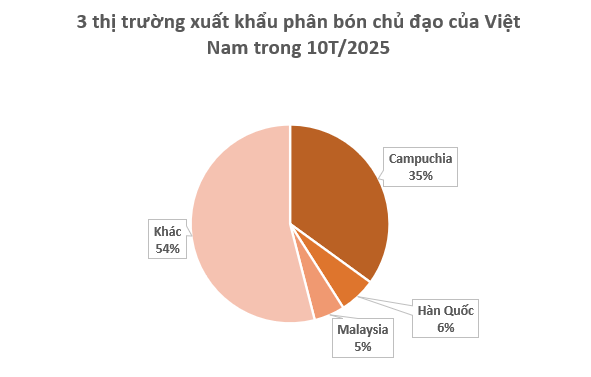
South Korea ranked second, importing over 111,000 tons valued at more than $45 million, though this represented a 33% decrease in volume and a 2% increase in price compared to the same period. The average price was $413 per ton, a 2% increase.
Malaysia was the third-largest market, importing over 98,000 tons valued at nearly $42 million, reflecting a 3% increase in volume and a 14% rise in value compared to the first ten months of 2024. The price also increased by 11%, to $423 per ton. Beyond these top three markets, other countries and territories significantly increasing their fertilizer imports from Vietnam include Laos, Taiwan (China), Myanmar, and more.
In Vietnam, the total fertilizer demand is approximately 11 million tons per year, while domestic industrial fertilizer production reaches about 8 million tons annually, meeting 73% of market demand. There is a surplus in urea (approximately 1.1 million tons per year) and phosphate (approximately 1 million tons per year), but a shortage in potash (100% imported), NPK (meeting 44% of demand), and other complex fertilizers (DAP, MAP, etc.).
Meanwhile, Cambodia’s fertilizer market is a key focus for Vietnamese enterprises, with significant demand, particularly for urea, DAP, and NPK. Annual demand is estimated at 380,000–410,000 tons for urea, 250,000–280,000 tons for DAP, and 260,000–300,000 tons for NPK. Cambodia is a major export market for Vietnamese fertilizers due to similar agricultural conditions and favorable geographic proximity.
According to the Trade Promotion Agency (Ministry of Industry and Trade), the trade structure between Vietnam and Cambodia has recently seen notable enhancements. Cambodia supplies raw materials such as rubber, cashews, timber, and textile-footwear accessories, while Vietnam exports essential goods to Cambodia, including gasoline, fertilizers, steel, textiles, machinery, confectionery, and processed foods. Cambodia is a neighboring market with substantial and stable demand for Vietnamese products.
As reported by the Vietnam Trade Office in Cambodia, goods exchanged between the two countries benefit from preferential tariffs under the ASEAN Trade in Goods Agreement (ATIGA) and the Bilateral Trade Promotion Agreement between Vietnam and Cambodia. Most import tariffs, especially on agricultural products, have been reduced to 0%, lowering costs and promoting trade. Infrastructure supporting border trade has been increasingly developed by both governments, with upgrades to border transportation routes, cargo handling facilities, and logistics services. Trade promotion activities with the Cambodian market are regularly conducted both domestically and in Cambodia.
Cambodia Purchases Over 500,000 Tons of Key Commodities from Vietnam: Hailed as a ‘Lifeline’ for Neighboring Agricultural Exports, Vietnam Secures Over $700 Million in Revenue
Every year, our country produces over 8 million tons of this commodity.
Cambodia’s Top Import from Vietnam: Surpassing Rice and Agricultural Products, This Commodity Leads Vietnam’s Global Export Rankings

In the first eight months of the year, Vietnam’s exports to Cambodia surged to over $3.7 billion, marking a 5.9% increase compared to the same period in 2024.
Milestone Achievement for Moc Bai Border Economic Zone

The Moc Bai Border Economic Zone has emerged as a dynamic powerhouse, poised to become a leading economic growth hub with competitive edge on both regional and international scales.
Vietnam’s Massive Export Surge: Hundreds of Thousands of Tons Flood Cambodia, Earning ‘Lifeline’ Status for Neighboring Nation, as Annual Output Hits 8 Million Tons
Since the beginning of the year, Vietnam has exported 1.5 million tons of this commodity.