At the international seminar titled “Digital Transformation in Urban Railway Operation and Maintenance” held on the afternoon of December 5th, domestic and international experts shared key insights on the path to technological self-reliance in urban rail systems.
South Korea Achieves Full Metro Autonomy After 20 Years
Over two decades ago, South Korea was nearly entirely dependent on imported technology when launching the Gyeongbu high-speed rail line. According to Dr. Jitaek Oh, Senior Researcher at the Korea Railroad Research Institute (KRRI), the nation spent approximately 10 years absorbing transferred technology and another 20 years to achieve near-complete autonomy in railway system development.
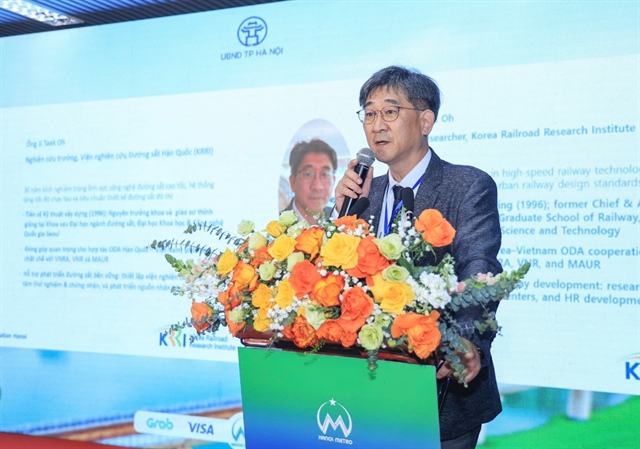
Dr. Jitaek Oh. Photo: V.Đ |
From 1995 to 2010, South Korea consistently absorbed, localized, and independently developed technology, gradually enhancing its R&D capabilities. High-speed trains like the KTX-Sancheon, KTX-Eum, and CheongRyong are the fruits of over two decades of knowledge accumulation, standard-setting, and operational experience.
“There is no one-size-fits-all model for technology transfer; each nation must choose a path aligned with its capabilities and goals,” stated Dr. Oh, emphasizing that the core value lies not in documentation but in practical operation and human trust.
China’s Self-Reliance from Operation to Maintenance
China adopted a different approach, achieving technological autonomy through large-scale practice. Shenzhen’s metro system now operates 595 km of urban rail with 417 stations across 18 lines, without state subsidies. It boasts China’s highest passenger density at 14,800 passengers/km.
Shenzhen’s success is rooted in its independent maintenance model. From a small workshop, the operator evolved into a professional overhaul center, proactively assessing components, issuing 21 technical standards, and gradually reducing reliance on foreign technology. Local component localization rates soared, cutting costs by 60–70% in many areas; domestic production of 9,000 bearings in 2024 alone saved approximately 35%.
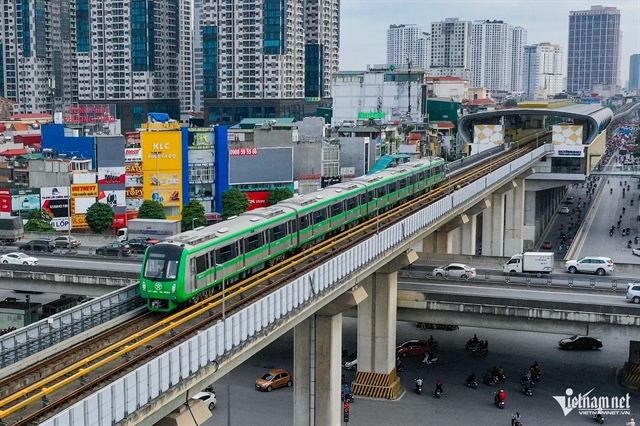 Vietnam stands at the threshold of shaping early-stage rail technology autonomy. Photo: Nam Khánh |
Condition-based maintenance (CBM) systems, smart workshops, and specialized repair lines boosted Shenzhen’s traction motor maintenance capacity by 150%. Large-scale technology and data application have made Shenzhen a global model for autonomous metro operation and maintenance.
Opportunities for Vietnam’s Urban Railways
Drawing from international lessons, Mr. Khuất Việt Hùng, Chairman of Hanoi Metro’s Board of Directors, believes Vietnam has a unique opportunity to establish rail technology autonomy from the outset. The focus should extend beyond new lines to mastering technology across the entire lifecycle of operation and maintenance.
Hanoi Metro is advocating for three breakthrough pillars: technology, data, and human resources, viewing them as essential for aligning the capital’s metro operations with international standards.
To achieve this, Vietnam must swiftly develop a technical autonomy roadmap, particularly for mid-life and overhaul train maintenance. Effective partnerships with international corporations and research institutes are crucial for sustainable technology testing, adoption, and development.
By Vũ Điệp
– 20:50 05/12/2025
Urgent Notice: Critical Red Book Issues Affecting All Residents

Residents should take note as the process of transferring land ownership certificates is now available online.
CIO Techcombank in the Hot Seat: Leveraging AI to Solve Real-World Challenges

“AI Battle” – the first-ever artificial intelligence competition on national television and the country’s flagship AI program, is nearing the end of its semi-final rounds. In the latest episode, teams tackle the theme “Building a Bank’s Financial Report,” with guest judge Mr. Nguyen Anh Tuan, Director of Technology Division at Techcombank, joining the panel.
SHB Named Bank of the Year 2025 by The Banker

On December 3rd, in London, UK, Saigon-Hanoi Commercial Joint Stock Bank (SHB) was honored by The Banker as the “Bank of the Year 2025,” one of the most prestigious and highly anticipated awards in the global financial and banking industry.
Voice-Activated Tax Filing Stuns Vietnamese Vendors
Revolutionize your business with our cutting-edge software. No tech expertise required—simply install, tap the microphone, and speak your product prices. In an instant, the software seamlessly calculates, declares, and submits taxes to the authorities, streamlining your operations effortlessly.
Dual Transformation in Industry and Trade: Digitizing Supply Chains – Greening Growth

On the morning of December 3rd, in Hanoi, the Department of E-commerce and Digital Economy (Ministry of Industry and Trade) hosted the 2025 Digital Transformation Forum for the Industry and Trade Sector. The event centered around the theme “Dual Transformation: Digitizing Supply Chains – Greening Growth.”