













Ho Chi Minh City Party Committee Approves High-Speed Metro Line from Ben Thanh to Can Gio
The Standing Committee of the Ho Chi Minh City Party Committee recently approved the investment plan for the Ben Thanh – Can Gio railway line, a project deemed crucial in the city’s strategy to expand development space and enhance urban connectivity.
This decision was made following a report from the City People’s Committee Party Committee and discussions held on December 5. According to the conclusion, the Ben Thanh – Can Gio line will serve as a new transportation axis, meeting passenger transport demands, driving socio-economic growth, and alleviating traffic congestion from the city center to the southern region.
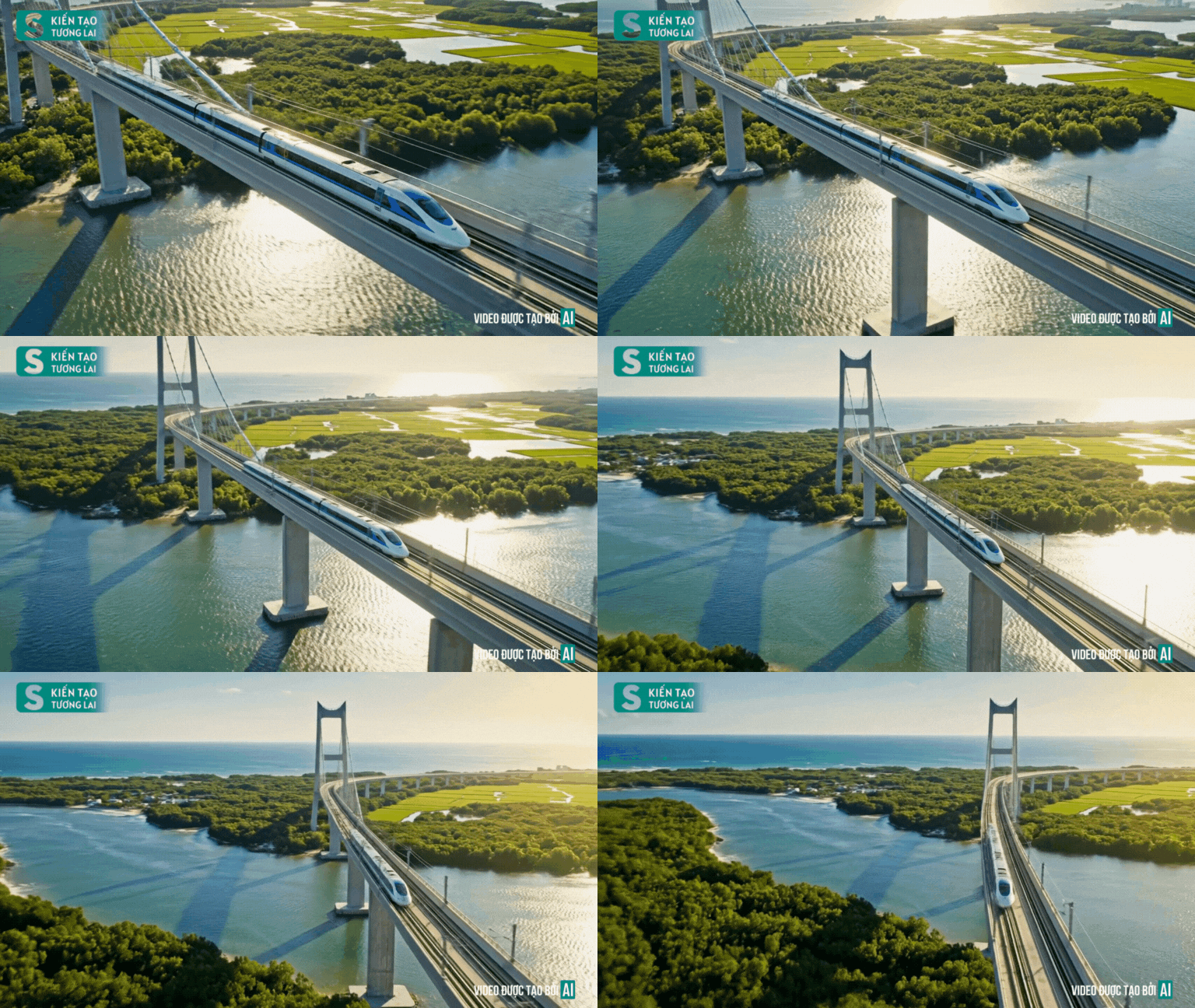
AI-generated illustration of the future Ben Thanh – Can Gio high-speed metro line
The Party Committee has mandated strict adherence to legal regulations during the project’s preparation and implementation, particularly emphasizing a thorough assessment of its impact on the Can Gio Mangrove Forest, ecosystem, landscape, and local historical sites.
Previously, in a proposal submitted to the Standing Committee of the City People’s Committee Party Committee regarding key projects to commemorate the 14th National Congress, the Ho Chi Minh City People’s Committee confirmed that the Ben Thanh – Can Gio metro project is fully prepared for a groundbreaking ceremony on December 19.
What’s the Design of the Ben Thanh – Can Gio Metro Line?
The high-speed metro line connecting downtown Ho Chi Minh City to Can Gio District has garnered significant attention, as Vingroup (via VinSpeed) has proposed an investment with impressive specifications. The route originates at September 23 Park, directly linking to Metro Line No. 1. From there, it runs along Le Lai Street, turns into Nguyen Thai Hoc Street, merges onto Ky Con Street, and crosses the Ben Nghe Canal.
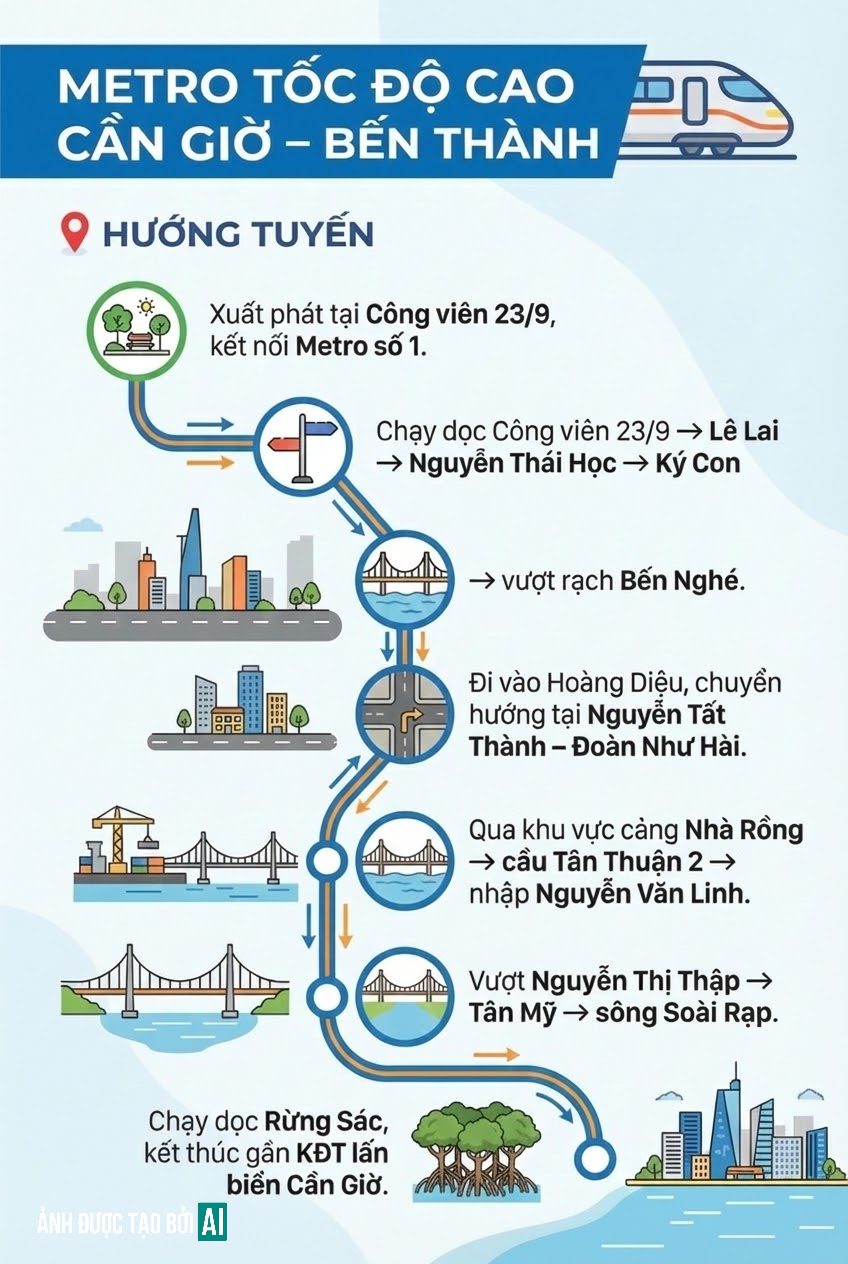
After crossing the canal, the line heads northeast onto Hoang Dieu Street, then shifts southeast near the Nguyen Tat Thanh – Doan Nhu Hai area. It continues past Nha Rong Port, approaches Tan Thuan 2 Bridge, merges onto Nguyen Van Linh Boulevard, and crosses the Nguyen Thi Thap intersection to reach Tan My. From there, it spans the Soai Rap River, runs along Rung Sac Road, and terminates near the Can Gio Coastal Tourism Urban Area.
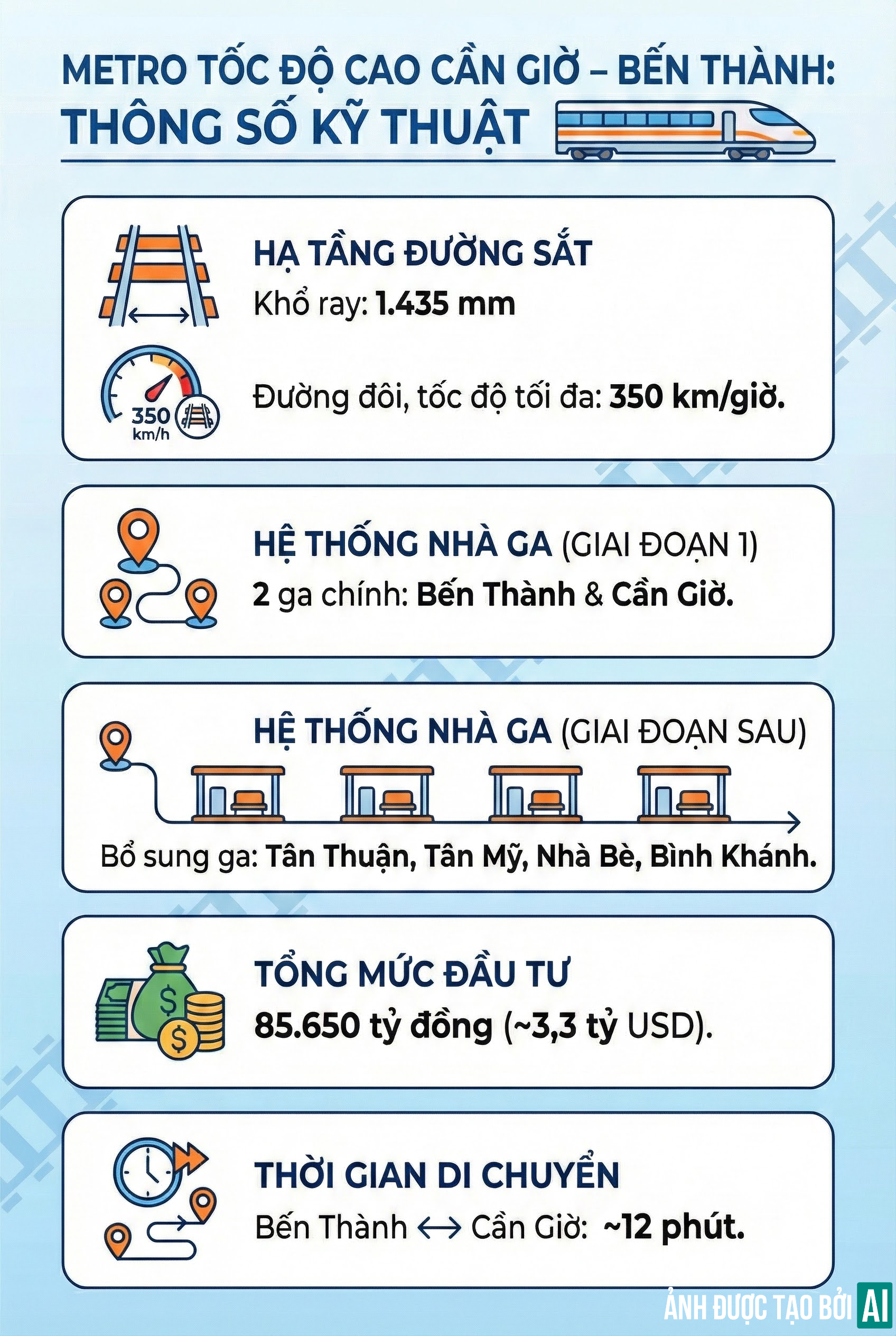
The metro system features a double-track design with a standard gauge of 1,435 mm and a maximum speed of 350 km/h. Initially, two main stations will be established at Ben Thanh and Can Gio, with additional stations at Tan Thuan, Tan My, Nha Be, and Binh Khanh added in later phases based on demand. The depot and control center will be located in Can Gio, facilitating efficient operation and management.
The total investment is estimated at 102.43 trillion VND (approximately 4 billion USD). Upon completion, travel time from downtown Ho Chi Minh City to Can Gio will be reduced to just 13 minutes, 7–8 times faster than current road or ferry options. This project promises to unlock urban development, tourism growth, and regional connectivity.
One standout aspect is VinSpeed’s proposal to complete construction within just 2 years, ensuring operational readiness by 2028. If achieved, this would mark a significant milestone, with implementation speed three times faster than domestic metro projects, a route twice as long as Metro Line No. 1, and a completion time six times shorter than existing projects.
As the first high-speed metro line funded by a Vietnamese enterprise, this project is a strategic leap for the city’s infrastructure. Beyond reducing urban distances, it serves as a pilot for large-scale public-private partnerships in transportation. If the “lightning-fast” timeline is realized, it will herald a new era for Vietnam’s urban rail system, positioning Can Gio as a modern satellite city of Ho Chi Minh City.
Ho Chi Minh City Offers Up to VND 20 Million in Support for Tourist Groups

For groups of 100 guests or more, staying a minimum of 3 days with a confirmed city tour itinerary, receive up to 20 million VND in support. This includes entrance tickets, meeting room rental fees, and more.
Ho Chi Minh City Approves High-Speed Rail Project Connecting Ben Thanh to Can Gio

Ho Chi Minh City has officially approved the investment plan for the Ben Thanh – Can Gio railway line, a project spearheaded by Vinspeed. This ambitious initiative aims to commence operations by 2028, marking a significant milestone in the city’s transportation infrastructure development.
Vingroup Invests $28 Million to Establish Subsidiary in Congo, Exploring Real Estate and Electric Vehicle Opportunities

On December 6th, the Board of Directors of Vingroup Corporation approved a resolution to establish a subsidiary company in the Democratic Republic of the Congo through capital contribution.
Accelerating the Metro Link Between Tan Son Nhat and Long Thanh
Metro Line 2 (Bến Thành – Tham Lương) is slated to break ground before January 19, 2026. Concurrently, the segments connecting Bến Thành – Thủ Thiêm and Thủ Thiêm – Long Thành are in the investment preparation phase. All three lines are projected to be operational before 2030, establishing a high-capacity, modern transit axis linking Tan Son Nhat and Long Thanh International Airports.
Why Ho Chi Minh City’s Land Database Remains Incomplete
As of now, Ho Chi Minh City has successfully established a comprehensive land database for 3.14 million land plots, ensuring accuracy, completeness, cleanliness, and real-time updates. Among these, 1.76 million plots have been verified with confirmed ownership. However, 689,629 plots remain incomplete due to unresolved discrepancies between land user information and the national population database.