












However, alongside localities that have disbursed over 100%, there are still ministries and agencies that have yet to disburse a single dong by now.
Record-High Public Investment Capital
The Ministry of Finance reports that the total public investment capital plan by the end of November 2025 stands at 1.08 trillion VND, comprising the capital plan allocated by the Prime Minister and the local budget balance. Of this, over 1.03 trillion VND has been allocated, while nearly 49 trillion VND remains unallocated due to being recently supplemented from budget surpluses and adjustments between ministries, agencies, and localities.
As of November 27, the entire country has disbursed more than 528 trillion VND, reaching 57.9% of the plan. Among these, 26 ministries, agencies, and localities have achieved the national average disbursement rate, while 38 are below this average.

O Cho Dua Ward conducts site clearance for Hanoi’s Ring Road 1 project.
Notably, despite the year 2025 nearing its end, some units have yet to disburse any funds, such as the Vietnam Union of Literature and Arts Associations, which was allocated 13.6 billion VND but remained stagnant by the end of November. Some units have disbursed less than 10%, including the Committee for Ethnic Minority Affairs and the Vietnam Academy of Science and Technology. Several localities have disbursed significantly below the national average, with rates under 50%, including Tuyen Quang, Lam Dong, and Can Tho.
According to the Central Internal Affairs Commission, in 2025, authorities focused on addressing obstacles to expedite the completion and utilization of delayed public investment projects, which pose risks of loss and waste. These include the construction of the second facility for Viet Duc Friendship Hospital and Bach Mai Hospital in Ha Nam Province (now Ninh Binh Province), the construction of the Ministry of Foreign Affairs headquarters, the project to address tidal flooding in Ho Chi Minh City, the Hoi Xuan Hydropower Project in Thanh Hoa Province, the construction of Can Tho City Oncology Hospital, and the student housing project in the new urban area of Phap Van – Tu Hiep (Hanoi).
Although 2025 has not yet concluded, three localities have already surpassed 100% of their public investment capital plan: Ha Tinh, Ninh Binh, and Thanh Hoa. Thanh Hoa, one of the early achievers, implemented innovative measures such as a 90-day intensive campaign to complete 2025 public investment disbursement, with milestones at 60%, 70%, and 100%.
To achieve this goal, Thanh Hoa assigned clear responsibilities and timelines. Project management boards increased inspection frequencies, closely monitored construction progress, and required contractors to concentrate resources, enhance equipment and labor, and take advantage of favorable weather to organize “three shifts, four teams” operations, including weekends and holidays. Contractors failing to meet construction timelines or quality standards were strictly penalized or reported for penalties.
To accelerate public investment disbursement, the Ministry of Finance has been submitting weekly reports on the allocation and disbursement status of the 2025 public investment capital. The Ministry has urged ministries, central agencies, and localities to vigorously promote disbursement.
The 2025 public investment capital volume is at a record high over the past five years, accounting for about 7% of GDP. Dr. Nguyen Minh Thao from the Institute of Financial Strategy and Policy believes public investment plays a crucial role in achieving growth targets. According to Dr. Thao, over the past 11 months, many localities have achieved double-digit growth alongside high public investment disbursement rates. “Disbursing 100% ensures effective capital use, drives growth momentum for future years, and strengthens confidence among the public and businesses. With increased capital, localities and ministries must strive to meet targets,” Dr. Thao stated.
Need for Public Investment Restructuring
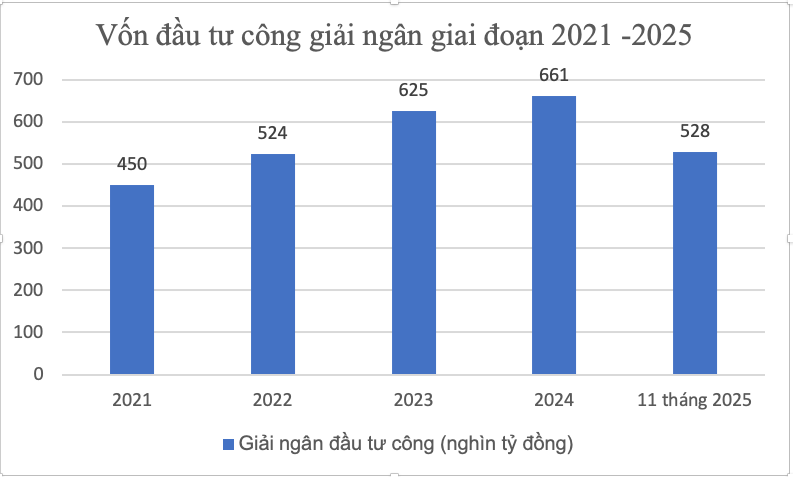
Chart of public investment capital scale over the past five years.
Dr. Can Van Luc, a member of the Prime Minister’s Policy Advisory Council, emphasizes the leading role of public investment. During 2021-2025, public investment accounted for 17.2% of total social investment capital. According to Dr. Luc, every additional VND in public investment attracts 1.61 VND in private investment. However, currently, 80% of public investment is concentrated in infrastructure, while funding for science and technology, healthcare, and education remains limited.
“Public investment is a vital driver for both immediate and long-term economic growth. Capital, including public investment, is one of three factors contributing to growth, helping the economy grow rapidly, overcome the middle-income trap, and become a high-income country (as seen in East Asia). It significantly enhances national competitiveness and sustainable development by improving transportation, energy, information and telecommunications infrastructure, digital infrastructure, healthcare and education facilities, and addressing climate change and natural disasters,” Dr. Luc analyzed.
Dr. Luc proposes restructuring and enhancing public investment efficiency. A comprehensive strategy for resource mobilization and allocation should be developed, linked to increasing labor productivity, investment efficiency—including public investment efficiency—and growth quality for 2026-2030.
“We should intensify public investment restructuring, reducing infrastructure investment to 50-55% of total capital, ensuring 20% for education and training, 10-12% for healthcare, and 3-5% for science and technology. The number of public investment projects should be controlled to no more than 3,000, with a reduction in small-scale projects. Nearly 3,000 stalled projects, including BT and BOT infrastructure projects, must be decisively addressed,” Dr. Luc recommended.
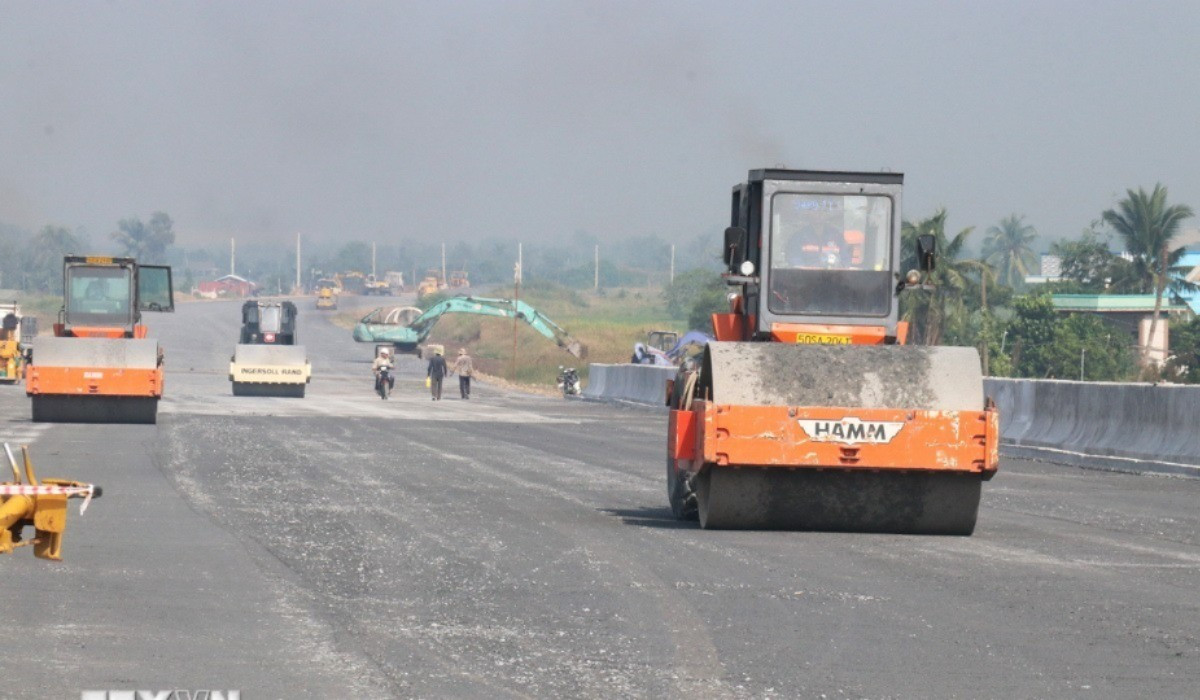
Construction units concentrate manpower and equipment to expedite the Ho Chi Minh City Ring Road 3 project, aiming for technical completion by December 19. (Photo: Bui Giang/TTXVN)
Mr. Le Xuan Ba, former Director of the Central Institute for Economic Management, notes that Vietnam’s economy currently has limited capacity to absorb public investment. To enhance investment efficiency, Mr. Ba suggests that authorities establish scientifically grounded investment policies, aligned with reality, and strengthen coordination, inspection, and supervision.
Strict Penalties for Negligent Officials
To boost disbursement rates, the People’s Committee of Lam Dong Province has reallocated approximately 1.469 trillion VND (8% of the total capital plan) to projects with faster implementation and better disbursement potential.
In an interview with Tien Phong, Mr. Le Trong Yen, Standing Vice Chairman of the Lam Dong People’s Committee, explained that the consolidation of project management boards after provincial mergers has been slow, necessitating adjustments to investment policies and seal changes. Establishing regional project management boards has also introduced additional procedures. “Projects previously under district management are now transferred to regional boards, making absolute disbursement rates extremely challenging. Given the current situation, the province aims for a disbursement rate above 75%,” Mr. Yen said.
At a recent meeting to address public investment disbursement challenges, Mr. Ho Van Muoi, Chairman of the Lam Dong People’s Committee, asserted that there is no room for delay in disbursing public investment capital. Project management boards must flexibly find solutions to overcome obstacles, as they currently manage substantial public investment funds.
The Chairman of the Lam Dong People’s Committee emphasized the heightened responsibility of leaders in agencies and units for public investment disbursement. Officials and civil servants failing to fulfill their duties or showing negligence will face strict penalties according to regulations.
Thai Lam
CT Group Unveils $200 Million Annual “Carbon Goldmine” Breakthrough

Unleashing the untapped potential of the green gold mine, this marks the beginning of an exciting journey in the province boasting the largest forest area in the Western Highlands region.
ADB Revises Vietnam’s Growth Forecast to 7.4%
The Asian Development Bank (ADB) has revised its growth forecast upward for Asian economies on December 10, with Vietnam among the countries receiving the most significant upgrades.
Da Nang Land Prices Skyrocket: Representative Calls for Temporary Halt on Increases
During the Da Nang City People’s Council session, numerous delegates urged against raising land prices, arguing that the current rates are already excessively high.
Unlocking Hanoi’s Potential: Resolving the Ring Road 1 Bottleneck
Hanoi City has announced the substantial completion of land clearance for the Hoang Cau – Voi Phuc section of Ring Road 1 within just over five months, decisively resolving a long-standing infrastructure bottleneck.
Gia Bình International Airport: A National Growth Catalyst and Breakthrough Hub
The years 2025-2026 herald a transformative era for Vietnam’s aviation industry, as pivotal national infrastructure projects enter a phase of aggressive implementation. Gia Binh International Airport (Bac Ninh), the largest private airport project in Vietnam’s history, has received unanimous investment approval from the National Assembly. This landmark development will solidify Vietnam’s position on the regional and global aviation map.