According to a decision by the Ho Chi Minh City People’s Committee, Sun Group’s subsidiary, Vung Tau Sun Company Limited, has been selected as the investor for this landmark project. It stands as the largest among four critical infrastructure and transportation projects breaking ground simultaneously, including the Rach Chiec National Sports Complex, Metro Line No. 2 (Ben Thanh – Tham Luong), Can Gio Bridge, and Phu My 2 Bridge. These initiatives are part of the city’s preparations to host the 14th National Party Congress.
Under Decision No. 269/QĐ-UBND dated January 13, 2026, the project is slated for completion within 8 years from the signing of the BT contract. However, as a key infrastructure catalyst, Ho Chi Minh City and the investor aim to expedite land clearance and synchronized construction, targeting a reduced timeline of approximately 5 years for full completion.
The centerpiece of the project is the 24-hectare central stadium, with an investment of approximately VND 35 trillion and a seating capacity of 70,000. The stadium features a retractable roof, advanced soundproofing, and a zoned climate control system. This design enables the venue to host not only elite sporting events but also large-scale concerts and international entertainment spectacles.
Globally, the Rach Chiec Stadium surpasses regional counterparts like Hong Kong’s Kai Tak and Singapore’s National Stadium in scale and technology, rivaling iconic venues such as London’s Wembley and Beijing’s “Bird’s Nest.”
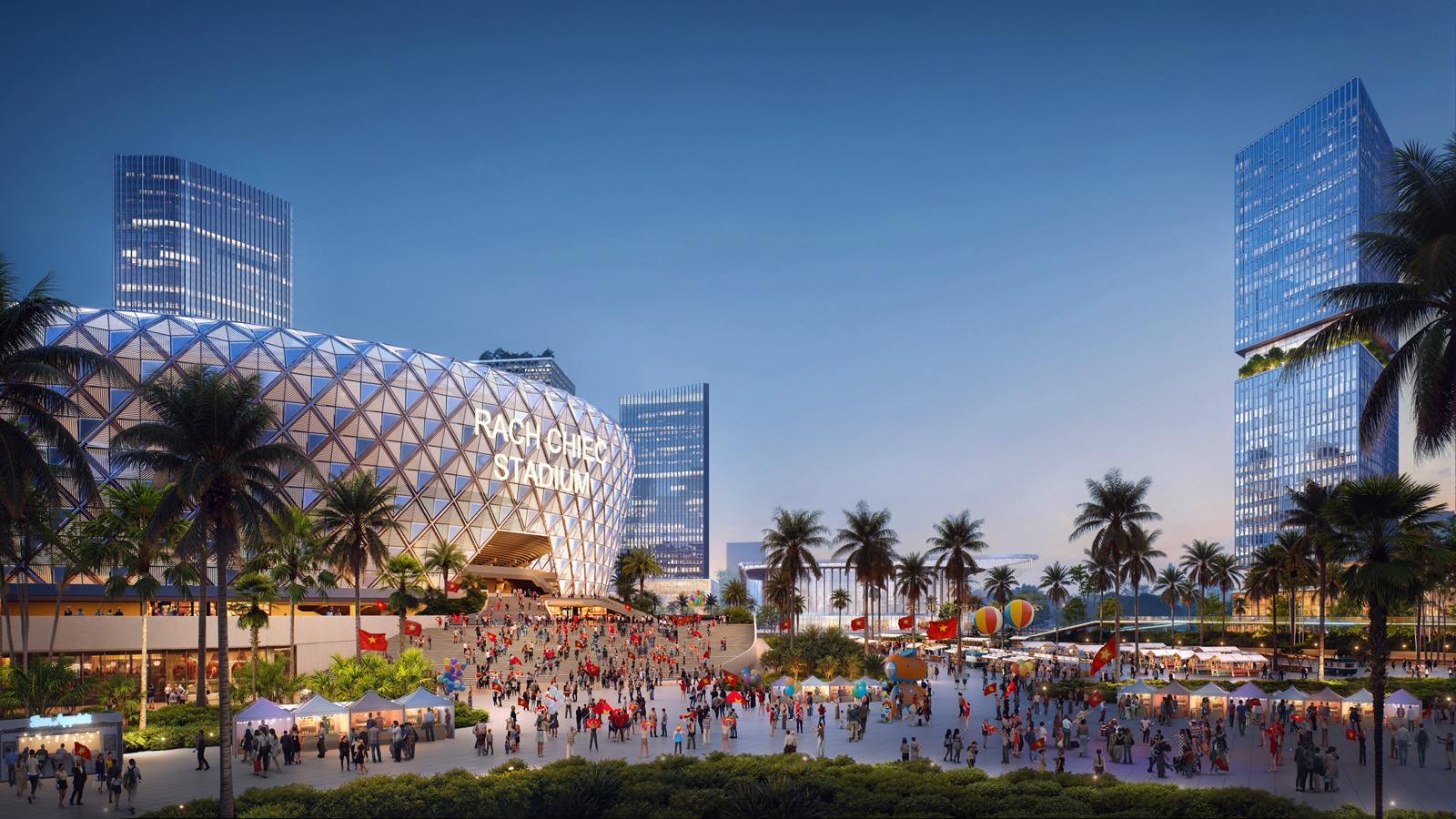
Spanning over 186.78 hectares, the Rach Chiec National Sports Complex is designed as a multi-functional sports hub, accommodating approximately 90% of Olympic disciplines. The project includes a 10-hectare multi-purpose arena with 18,000 seats, a 5,000–10,000-seat indoor sports center, an international aquatic center, a professional tennis complex, and integrated training facilities.
Beyond competition and training venues, the complex incorporates a community sports zone, athlete and coach accommodations, and sports medical services, fostering a closed-loop ecosystem for training, competition, and recovery, seamlessly integrated into urban life.
Complementing the sports infrastructure, the complex allocates extensive space for public areas and urban services. A central park and plaza interconnect functional zones, creating ecological buffers and community spaces. The commercial and conference district is poised to become a hub for event-driven and night-time economies, enhancing tourist spending and stay duration in Ho Chi Minh City.
The convention center features a 10,000-seat main hall and international-standard meeting rooms, suitable for major forums and conferences. Adjacent hotels ensure high-capacity, premium accommodations for delegates and guests, with seamless connectivity to the complex’s key areas.
Positioned as a “new growth pole” in eastern Ho Chi Minh City, the Rach Chiec National Sports Complex is set to host year-round elite sports events, international concerts, and cultural festivals. Long-term, it will strengthen Vietnam’s sports infrastructure, paving the way for hosting global events like the World Cup or Olympics.
Kỳ Thư
Bcons Newsky Project Launch: Official Clarification from the Department of Construction
At the regular press conference on Ho Chi Minh City’s socio-economic situation held on the afternoon of January 15th, a representative from the Department of Construction provided clarification regarding the Bcons Newsky project.
Latest Updates on the Prime Land Plot at 1 Ly Thai To, Ho Chi Minh City
Amidst the emerging issue of relocating VNPT’s headquarters in Ho Chi-Minh City, key advisory bodies convened to deliberate and propose strategic solutions.
Sidewalks Turned into ‘Outdoor Grills’: Urban Infrastructure Bottlenecks Exposed

From the smoky haze of street-side grills to the encroachment on public spaces, these issues are contributing to the overwhelming congestion and suffocation of major cities. This is not merely a tale of urban order management but a consequence of an imbalanced development model.
Ho Chi Minh City Unveils Northern Science and Technology Urban Hub
The former site of the new Binh Duong City will be transformed into the North Ho Chi Minh City Science and Technology Urban Area. This development includes the repurposing of the 1.4 trillion VND Administrative Center building.
Ho Chi Minh City Sets Ambitious Goal for Double-Digit Economic Growth

At the regular press conference on Ho Chi Minh City’s socio-economic situation held on the afternoon of January 15th, the Institute for Economic Development Research emphasized that the need for innovation in the growth model has never been more urgent, as traditional growth margins are gradually narrowing. This shift is also the foundation for Ho Chi Minh City to realize its ambition of achieving double-digit growth by 2030.