Mr. Tran Tuc Ma, with 33 years at Traphaco, has held nearly every key position and is considered the architect of many innovations within the company. His decision to step down as CEO at a time when Traphaco is thriving has surprised many. In a conversation with us, he shared his reasons for choosing to “step down at the right time,” his expectations for the new leadership team, and his confidence in Traphaco’s future.
What prompted your decision to leave the CEO position while your term is still active, your health is good, and the company is growing steadily?
When I announced my decision in the meeting, most people were taken aback: “Why now?” I’ve been with Traphaco for 33 years, holding various roles: from quality control, production, sales, Deputy CEO of Business, leading multiple subsidiaries, to 22 years on the Supervisory Board and Board of Directors, 15 years as CEO, and 10 years as SCIC’s capital representative. I’m so familiar with the company that every corner feels like home.
I’m not yet at retirement age, my term isn’t over, and my health is fine. Normally, when a company is doing well, people don’t want to leave. But I believe Traphaco’s next phase requires different preparation.
Next year marks the end of my term. The business environment will shift dramatically: streamlined administration, AI, R&D, digitalization… The company must prepare resources, strategies, and leadership now. Sometimes, the person who builds for the next phase isn’t the one to execute that strategy, and that might not be best for the company.
I chose this moment because I believe it’s best for the company and shareholders.
I remain a full-time member of the Board of Directors. Wherever I am, the most important thing is the company’s growth, employee well-being, and better service to society. I’ve held every role. More titles now mean less than Traphaco’s strong entry into its new phase.
For me, titles no longer matter much. What matters is Traphaco’s direction. I proposed this three months ago. After much thought, I’m confident this decision benefits the company.
Looking back at 15 years as CEO, what experiences or lessons stand out?
Each term faced different challenges, and Traphaco adapted strongly each time.
2011–2015: Overcoming Crisis, Restructuring for Survival and Growth
It was an extremely tough period: 20–25% interest rates, high inventory, and large debts. We proactively changed customer strategies, reduced inventory, and sold for immediate payment. Many in the industry thought Traphaco wouldn’t survive. But innovation paid off. We pioneered the DMS system for real-time sales data, which later helped us outpace the industry when inventory became a sector-wide issue.
During this time, Traphaco also led with a WHO-GMP certified factory, pursued GACP-WHO certified medicinal materials, and acquired Dak Lak Pharmaceutical to expand.
Term 2: Building a New Factory – Laying the Foundation for Technology and Culture
We invested in the Traphaco Hung Yen Factory, recouping costs in just five years. It’s a key facility for training and technology transfer. Simultaneously, we established a new corporate culture: standardized, humane, disciplined yet creative.
Term 3: The Covid Era, Ensuring Supply Chain Continuity
Covid was a major challenge. Hospitals closed, activities halted. We anticipated lockdowns and distancing, producing en masse and distributing to provinces without worrying about inventory. Thanks to this, Traphaco not only ensured supply but also supported pandemic efforts.
Alongside this, we pursued strong digital transformation, promoted high-quality pharmaceuticals, and established a logistics distribution company.
A consistent lesson I’ve learned: companies that dare to innovate, embrace new technologies and management thinking, will surely advance. But actions must be genuine, not just slogans.
The market seems ruthless. What opportunities and challenges do you see for Traphaco?
I often say, “It’s not the big fish that eats the small, but the fast fish that beats the slow.” Being large but sluggish is like a stalled truck at rush hour—not only stopping but blocking others.
In business, Traphaco has three main areas. Traditional medicine: our strength, needing maintenance and standardization. Pharmaceuticals: a market trend with rising quality standards—Traphaco must accelerate. Dietary supplements: high societal demand; with tighter state regulations, companies like Traphaco with R&D and technology will have an edge.
Currently, we have two research departments (traditional and pharmaceutical), with many successful new products. Commercialization will be challenging but also an opportunity for breakthroughs.
Recently, we streamlined distribution, professionalized systems, embraced digitalization for new work habits, used AI, and standardized personnel evaluations. These foundations are crucial for the new leadership.
Ms. Dao Thuy Ha
, with nearly 30 years at the company,
has been appointed CEO by the Board. What’s your view on succession?
The choice wasn’t mine alone but the shareholders’ and Board’s. Both internal and external candidates have strengths.
Internal candidates understand the company’s DNA, easily inherit values, but must be innovative enough for breakthroughs. Given our current shareholder structure and well-trained team, choosing internally is appropriate and wise.
Most important is determination and a spirit of collective good. If the new leader has ambition and unites the team, no challenge is insurmountable.
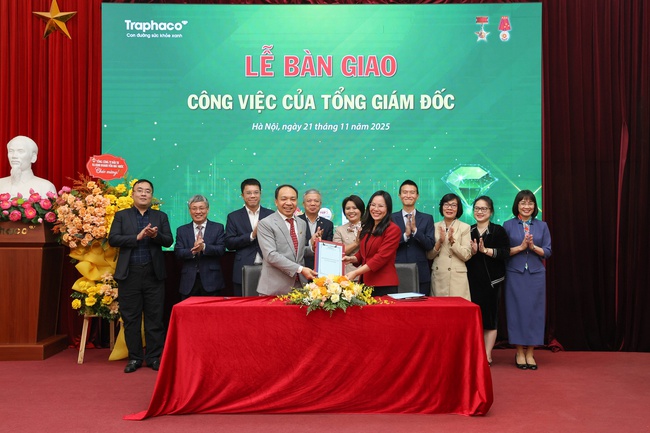
Handover ceremony for Ms. Dao Thuy Ha as CEO
After 33 years at Traphaco, how do you feel leaving the executive role?
Traphaco is part of my life. Every decision I make answers this: “Is it good for the company, shareholders, employees, and society?” I choose what’s best for Traphaco, shareholders, and dedicated employees.
We may not always agree, but if it’s good for the company, I support it. If not, I’ll speak frankly. Most important is Traphaco’s continued growth.
I’m stepping down while still energetic, giving the new leader time to prepare and the company a stronger start to its new phase. I’m confident this decision is right, and Traphaco will go far.
On November 21, 2025, Traphaco (TRA) held a CEO handover ceremony. According to Ms. Dao Thuy Ha, the new CEO, Traphaco will accelerate the EU-GMP certified factory project; maintain traditional medicine leadership while boosting pharmaceuticals; strongly apply digitalization and AI to management and supply chains; and aim for double-digit growth in 2026, leveraging existing production capacity, new distribution strategies, and shareholder support.
ABS Wins Most Innovative Investment Analysis Securities Company in Vietnam 2025 Award

An Binh Securities Corporation (ABS) has been honored with the prestigious “Most Innovative Securities Company in Vietnam for Investment Analysis” award by International Finance Magazine. ABS stands as the sole Vietnamese securities firm to receive this accolade in 2025.
Young Leadership Mindset: SHB’s Breakthrough Journey to Lead the New Era
At the Vietnam Future Economy Summit 2025, during the panel discussion titled “New Leadership Mindset: From Legacy to Breakthrough,” Mr. Do Quang Vinh – Vice Chairman of the Board of Directors and Deputy CEO of Saigon-Hanoi Commercial Joint Stock Bank (SHB) – shared profound insights into the role of young leaders in the digital age.
What Do Experts and Investors Say About the International Financial Center in Ho Chi Minh City?
The Ho Chi Minh City Financial Hub is poised to revolutionize Vietnam’s financial landscape. By fostering capital connections, nurturing startups, and attracting top talent, it aims to position Vietnam as a pivotal player in the global financial arena.
Vietnam’s Race to Join the Global Semiconductor Map: Can It Keep Pace as the World Shifts?
Global supply chain disruptions and robust policy commitments present a unique opportunity for Vietnam to emerge as a leader in the semiconductor industry, the backbone of the digital economy. However, this potential can only be realized if Vietnam successfully navigates challenges in workforce development, infrastructure enhancement, and regional FDI competition.
Accelerating BSR’s Research on Bio-Diesel Fuel Innovation

On November 7th in Hanoi, leaders of Binh Son Refining and Petrochemical Joint Stock Company (BSR) held a meeting to accelerate the progress of the Pilot BioDiesel Project. This initiative focuses on refining the technology and conducting semi-industrial scale trial production of biodiesel fuel derived from agricultural and food processing waste, as well as microalgae oil.