










Non-Performing Loans Gradually Decrease
According to the Q3 financial reports of banks, the total non-performing loans (NPLs) of listed banks rose to VND 274.05 trillion by the end of Q3, marking a 2% increase from the previous quarter and 8.1% year-on-year. The growth rate has significantly slowed compared to 2022-2024. NPL ratios surged during the transition period from late 2024 to Q1 after the debt restructuring circular expired but have since declined across subsequent quarters.
By Q3, the NPL ratio stood at 2.01%, still higher than the five-year average of around 1.84%, yet reflecting improvement following the 2023 debt and bond market stress.
State-owned banks continue to play a stabilizing role, maintaining low NPL ratios between 1-1.9%. BIDV faces notable NPL pressure, with its ratio nearing 2% in 2025. By Q3, this figure slightly eased from the previous quarter, returning to early-year levels (around 1.9%), though year-end NPL management remains critical to restore stability.
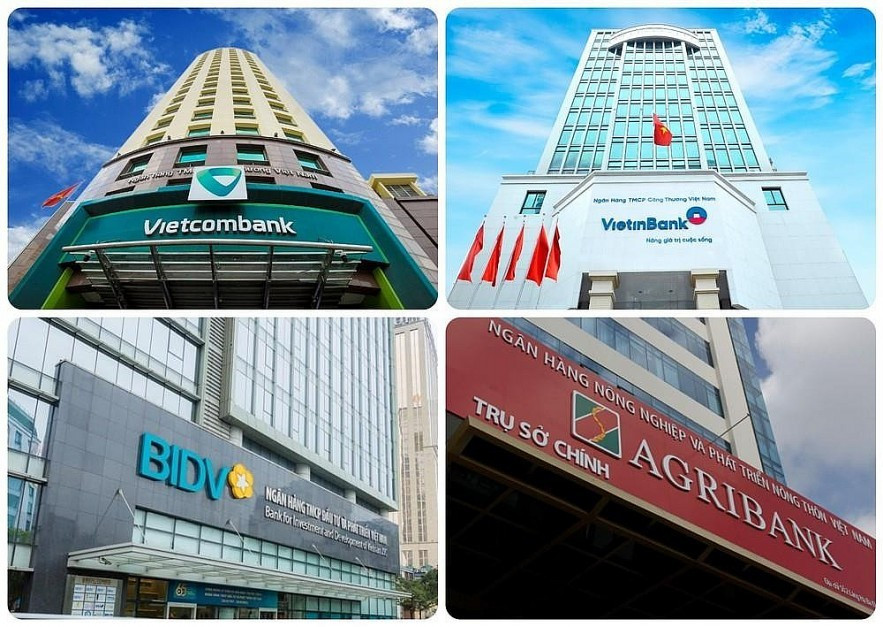
State-owned banks maintain low NPL ratios.
Conversely, VietinBank and Vietcombank sustained robust asset quality, with NPL ratios declining year-on-year to 1.1% and 1%, respectively.
Joint-stock banks also demonstrated effective credit quality control. Notably, NCB’s NPLs plummeted 37.7% from 2024-end, equivalent to VND 5.2 trillion; ABBank’s fell 23.3% (VND 860 billion); and ACB’s dropped VND 1.3 trillion (15.3%).
ACB representatives stated their NPL ratio fell to 1.09%, among the industry’s lowest, showcasing stable management and proactive risk governance. Their NPL coverage ratio rose 9.2 percentage points to 84%, a system high. Stage 2 loan ratios remained controlled at 0.48%, indicating contained credit risks.
NPL Reduction Driven by Credit Recovery
Aggregated data from Rồng Việt Securities (VDSC), FiinGroup, and Mirae Asset forecasts Q4 NPLs to stabilize or slightly decline, fueled by robust credit growth (15% as of October 30, projected 19-20% year-end) and sustained profit growth (up 24.9% in Q3). In 2026, bank performance will further diverge.
Banks with strong capital bases, high NPL coverage, and prudent lending will enhance asset quality. Conversely, those heavily exposed to real estate and bonds face heightened provisioning and NPL management pressures. Q3 asset quality recovery and Q4 stability signal a clearer “healing” phase for the banking sector.
However, risks from real estate, bonds, and watchlist loans persist. Maintaining adequate provisions, accelerating asset resolution, and concentrated risk control are vital for banks to ensure resilience and support sustainable 2026 growth.
The State Bank of Vietnam’s Monetary and Financial Stability Department survey reveals overall risk perceptions for borrower groups slightly rose in Q3-Q4. Yet, the share of institutions rating current risks as “high” or “quite high” sharply dropped from prior surveys.
By year-end, institutions predict risks will largely mirror 2024 levels but expect improvement in 2026. NPLs are projected to gradually decline in Q3/2025, as anticipated, and fall more sharply in Q4/2025, contrasting last year’s “increase” outlook.
Decree 304/2025/NĐ-CP: Regulations on Collateral Conditions for Non-Performing Loan Seizure

The government has recently issued Decree No. 304/2025/NĐ-CP, dated November 25, 2025, outlining the conditions for the seizure of collateral assets tied to non-performing loans.
Top Banks with the Highest Loan Interest Earnings: BIDV and VietinBank Lead, VPBank Outpaces Techcombank by 1.5 Times, SHB Trails Behind

Amidst the backdrop of the most significant surge in credit outstanding balances across the entire system in recent years, interest income from lending continues to serve as the cornerstone of profitability for banks.
Market Pulse 27/11: Efforts to Gain Momentum Face Ongoing Challenges
Despite early attempts to rally in the afternoon session, the VN-Index faced continued resistance around the 1,690-point mark, leading to a swift correction. By the close, Vietnam’s benchmark stock index managed a gain of just under 4 points, a far cry from the session’s peak of nearly 15 points.
Prime Minister Urges Banking Sector to Channel Capital into Priority Areas, Cut Costs, and Leverage Technology to Lower Interest Rates

On the afternoon of November 24th, in Hanoi, Prime Minister Pham Minh Chinh attended and delivered a speech at the 9th Patriotic Emulation Congress of the Banking Sector (2025-2030), organized by the State Bank of Vietnam.
Bank Net Profit Margins Face Continued Pressure as Year-End Approaches

Net interest margins (NIM) of banks remain under pressure as funding costs rise faster than asset yields in the final quarter.